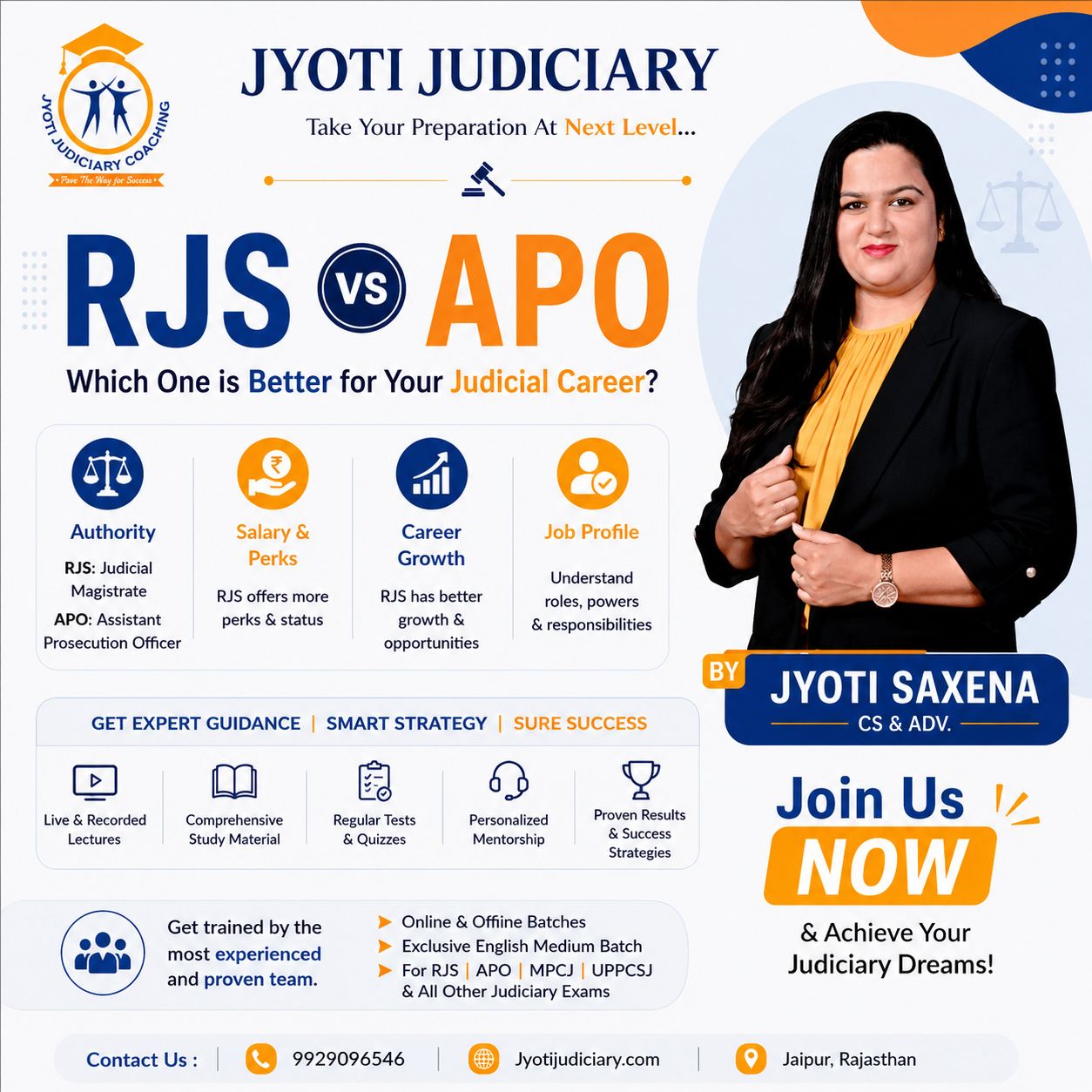
Every law graduate in Rajasthan faces the same question after completing their LLB: RJS vs APO? Both are government legal careers. Both use largely the same syllabus. Both are conducted by Rajasthan’s top recruitment authorities. And yet they are fundamentally different in what they ask you to do, where they take your career, how competitive they are, and what kind of preparation they demand.
This comparison is not written from a database. It is written by Advocate Jyoti Saxena — a practising advocate before the Rajasthan High Court who has spent twelve years at Jyoti Judiciary Coaching guiding law graduates through exactly this decision. Some candidates are clearly RJS material. Some are clearly APO material. Many can and should target both. The answer depends on what you understand about each exam, each role, and where you want to be ten years from now.
What Is RJS — Rajasthan Judicial Service?
The Rajasthan Judicial Service (RJS) examination is conducted by the Rajasthan High Court for recruitment to the post of Civil Judge (Junior Division). A Civil Judge is a judicial officer — a judge. They preside over civil and criminal trials in Rajasthan’s district courts. They write judgments, frame charges, evaluate evidence, and deliver orders that directly affect the lives of the parties before them.
The RJS exam has three stages: Prelims (qualifying only — marks not counted in merit), Mains (300 marks — the decisive stage), and Interview or Viva Voce (35 marks). Final selection is based entirely on Mains plus Interview marks out of 335. The Rajasthan High Court releases the RJS notification typically every year, with vacancies ranging from 44 to over 200 depending on the cycle. The 2024 RJS cycle had 222 vacancies — all of which were filled. The 2025 cycle had 44 vacancies. The 2026 notification is expected shortly.
What Is APO — Assistant Prosecution Officer, Rajasthan?
The Assistant Prosecution Officer (APO) post is a gazetted State government legal position in Rajasthan’s prosecution department, recruited by the Rajasthan Public Service Commission (RPSC). An APO represents the State in criminal trials — they present the prosecution’s case, examine witnesses, argue for conviction, and assist the government in criminal litigation.
The APO examination has three stages: Prelims (objective, conducted by RPSC), Mains (descriptive), and Document Verification(DV). There is no interview stage in the APO selection process — which is a significant structural difference from RJS. The RPSC APO 2026 notification announced 371 vacancies — a substantial number that makes this cycle one of the largest APO recruitment drives in recent years. The 2024 APO notification had 181 vacancies.
RJS vs APO — Complete Side-by-Side Comparison for Rajasthan Law Graduates
| Parameter | RJS — Civil Judge | APO — Asst. Prosecution Officer |
| Conducting Body | Rajasthan High Court (hcraj.nic.in) | Rajasthan Public Service Commission (rpsc.rajasthan.gov.in) |
| Post | Civil Judge (Junior Division) | Assistant Prosecution Officer |
| Role in Court | Neutral judge — decides cases | Prosecution side — represents State in criminal cases |
| Vacancies (2024) | 222 vacancies — all filled | 181 vacancies |
| Vacancies (2026) | Notification expected shortly (~60-100 approx.) | 371 vacancies announced |
| Exam Stages | Prelims → Mains → Interview | Prelims → Mains → Document Verification |
| Interview | Yes — 35 marks (Viva Voce by RHC judges) | No interview stage |
| Mains Marks | 300 marks (4 papers) | Descriptive papers (RPSC pattern) |
| Merit Basis | Mains (300) + Interview (35) = 335 total | Mains marks only |
| 3-Year Practice Rule | Yes — mandatory since May 2025 SC judgment | Not applicable — LLB degree sufficient |
| Minimum Qualifying | 40% aggregate + 35% per paper (Mains) | As per RPSC notification |
| Career Path | Civil Judge → District Judge → High Court | APO → Senior APO → Dy. AG → AG |
| Pay Scale | Pay Level 11 — approx. Rs. 90,000-1,10,000 gross | Pay Level 11 — approx. Rs. 60,000-80,000 gross |
| Syllabus Overlap | Constitution, BNS, BNSS, BSA, CPC, Evidence | Constitution, BNS, BNSS, BSA, CPC, Evidence |
| Hindi Required | Yes — Hindi Essay is a Mains paper | Yes — Hindi component in exam |
RJS vs APO Salary — What Does Each Pay?
Salary is the most searched aspect of the RJS vs APO comparison. Understanding the difference clearly — not just the basic pay but the complete package.
RJS Civil Judge Salary
A Civil Judge (Junior Division) in Rajasthan is placed at Pay Level 11 of the Rajasthan Judicial Service Pay Scale. The basic pay at entry level is Rs. 77,840 per month. With Dearness Allowance, House Rent Allowance, sumptuary allowance, and other service benefits, the gross monthly salary at the time of appointment ranges from approximately Rs. 90,000 to Rs. 1,10,000 depending on the posting location. Judicial officers additionally receive court accommodation facilities, judicial officer identity, and constitutionally protected security of tenure. The pension and retirement benefits are also structured differently from regular government service.
APO Salary
The Assistant Prosecution Officer in Rajasthan is placed in Pay Matrix Level L-11 under Rajasthan Government service rules. The basic pay ranges from Rs. 9,300 to Rs. 34,800 with a grade pay of approximately Rs. 4,200 per month at the entry level, with Dearness Allowance, HRA, and other government allowances. The gross monthly salary at the time of appointment is approximately Rs. 60,000 to Rs. 80,000 depending on the posting and applicable allowances.
| The Salary Comparison in Plain Terms: A Civil Judge (RJS) earns approximately 25-30% more than an APO at entry level. Both are Pay Level 11 posts but under different pay rules — the Rajasthan Judicial Service Pay Rules give Civil Judges additional allowances and facilities that are not available to regular State government officers. More importantly: the Civil Judge’s career ceiling — potential elevation to the Rajasthan High Court as a judge — is structurally higher than the APO’s ceiling of Additional Advocate General or Advocate General on the prosecution side. |
Which Is More Competitive — RJS or APO?
This is the practical question every law graduate in Rajasthan weighs. The honest comparison requires looking at both the number of vacancies and the number of candidates competing for them.
RJS Competition
The RJS Prelims cut off has risen consistently — from 60 in 2019 to 78 in 2025. The Mains has a 35% minimum qualifying mark per paper that eliminates a significant proportion of candidates who appear. The three-year mandatory practice rule (restored by the Supreme Court in May 2025) has changed the candidate pool — most serious RJS aspirants in 2026 are working advocates with at least three years of courtroom experience. Every RJS vacancy that is announced gets filled — the selection process is rigorous but the positions are not left vacant.
APO Competition
APO vs RJS on competition — the APO exam, conducted by RPSC, has a different profile entirely. With 371 vacancies in the 2026 notification — significantly more than the RJS cycle — the selection probability per candidate is higher. The APO exam does not have a personal interview, which removes one elimination stage. The Mains is descriptive but focused on criminal law and prosecution-related subjects. For a law graduate with strong criminal law preparation, the APO represents a more accessible entry point into a government legal career than the RJS.
| The Vacancy Reality — RJS vs APO 2026: RJS 2026: Notification expected shortly. The 2024 cycle had 222 vacancies, the 2025 cycle had 44. The 2026 cycle is expected to bring a fresh notification with approximately 60-100 vacancies — every single one of which will be filled. APO 2026: 371 vacancies already notified by RPSC. Raw numbers favour APO. But the RJS Civil Judge post offers a fundamentally different career trajectory — judicial independence, career elevation to the High Court, and a role that sits at the top of the legal career pyramid in Rajasthan. |
RJS vs APO Syllabus Overlap — How Much Is Common for Rajasthan Law Graduates?
This is where the strategic advantage for Rajasthan law graduates becomes clear. The core syllabus for both RJS and APO overlaps significantly — approximately 70% of the preparation is common to both exams.
| Subject | In RJS Syllabus | In APO Syllabus |
| Constitution of India | ✅ Core subject | – |
| BNS 2023 (Criminal Law) | ✅ Law Paper II | ✅ Primary focus |
| BNSS 2023 (Criminal Procedure) | ✅ Law Paper II | ✅ Primary focus |
| BSA 2023 (Evidence) | ✅ Law Paper II | ✅ Primary focus |
| Code of Civil Procedure | ✅ Law Paper I | Partial coverage |
| Hindu Law + Muslim Law | ✅ Law Paper I (new 2026) | – |
| Rajasthan-specific Acts | ✅ State legislation | Some coverage |
| Hindi Essay | ✅ 50-mark paper | ✅ Hindi component |
| English Essay | ✅ 50-mark paper | Limited |
| Interview / Viva Voce | ✅ 35 marks — RHC judges | ❌ No interview in APO |
The practical implication: a candidate preparing seriously for RJS — particularly for the BNS, BNSS, BSA, and CPC components — is simultaneously preparing for 70% of the APO syllabus. Appearing for both exams in the same cycle is not just feasible — it is a strategically sound approach for any Rajasthan law graduate.
Does APO Experience Count Toward the RJS 3-Year Practice Rule?
This is the question that no other RJS vs APO comparison article has addressed — and it is directly relevant to law graduates deciding their career strategy in 2026.
The Supreme Court’s judgment in All India Judges Association v. Union of India (May 20, 2025) restored the mandatory three-year practice requirement for eligibility to appear in the Civil Judge examination. Practice is counted from the date of provisional enrolment with the Bar Council of the relevant State. The key question is whether APO service counts as ‘practice’ for the purpose of this rule.
The short answer on whether APO counts toward the 3-year practice rule, based on the Supreme Court’s judgment and the Bar Council rules, is: APO service alone does not count as advocacy practice toward the three-year rule, because an APO is a government servant — not an enrolled advocate practising at the Bar. However, if a candidate was enrolled as an advocate before joining the APO service, their pre-APO advocacy period may count toward the three years — subject to the specific requirements of proof and certification laid down in the judgment.
At Jyoti Judiciary Coaching, Jyoti Saxena addresses this question frequently from candidates who are targeting both APO and RJS in sequence. The practical advice: enrol with the Bar Council as early as possible, even if you are primarily targeting APO first. The three-year clock starts at enrolment — and running it parallel to APO service means you reach RJS eligibility sooner.
RJS vs APO: Who Should Choose Which — Decision Guide for Rajasthan Law Graduates
Choose RJS If:
- Your long-term ambition is judicial — you want to be a judge, not a government lawyer. The Civil Judge role is the entry point to a career that can take you to the District Judge bench and potentially to the Rajasthan High Court.
- You are already enrolled as an advocate and are building or have completed your three years of practice. The three-year rule makes RJS the natural target for working advocates who have already invested in court experience.
- You have strong analytical writing skills and are willing to invest in building your judgment writing from Month 2 of preparation — because the RJS Mains rewards judicial reasoning in structured format, not just legal recall.
- You want a career with constitutionally protected independence — a Civil Judge cannot be transferred or dismissed by the executive in the way a government officer can be.
Choose APO If:
- Criminal law is your area of strength and interest. The APO role is entirely on the criminal prosecution side — every working day involves criminal trials, evidence examination, and courtroom advocacy for the State.
- You want to enter a government legal career while still building your three years of practice toward RJS eligibility. APO service is a stable, respected position that runs parallel to your longer-term RJS goal.
- You are a fresh law graduate without three years of practice yet — APO does not require advocacy experience and is accessible immediately after your LLB.
- The 371 vacancies in APO 2026 represent a significantly larger selection pool than the RJS cycle — for candidates who want to maximise their first government legal job success rate, APO is the more accessible entry point.
Prepare for Both — If:
- You have the preparation bandwidth — 70% syllabus overlap means the marginal preparation cost of appearing for both is low. If your RJS preparation is strong, your APO preparation for the overlapping subjects is complete.
- You want a backup in the same cycle — many RJS aspirants appear for APO in the same year as an insurance. Getting selected in APO while continuing RJS preparation is a well-established strategy among Rajasthan law graduates.
- You are from a criminal law practice background — APO preparation strengthens exactly the criminal law knowledge that RJS Law Paper II tests.
RJS and APO Preparation — Can You Do Both Together?
Since 70% of the syllabus is common, the question is not whether you can prepare for both — the question is how to structure the preparation so that the RJS-specific elements and the APO-specific elements are both covered without duplicating effort.
The common core — Constitution, BNS, BNSS, BSA, CPC, Evidence — should be prepared to RJS Mains depth. If you can write a complete civil judgment and a complete criminal judgment in the RJS format, you have already covered the analytical depth that the APO Mains descriptive papers require. The APO-specific additions are primarily focused on criminal law procedure and prosecution practice — which are covered within the BNSS and BNS preparation anyway.
At Jyoti Judiciary Coaching, candidates preparing for RJS alongside APO follow the standard RJS coaching preparation plan — with additional focused modules for APO’s specific exam format and RPSC pattern. Since the core is identical, the additional preparation required is marginal. The judgment writing, bare act reading, and case law preparation done for RJS directly translates into APO Mains performance.
Frequently Asked Questions — RJS vs APO: Which Is Better for Rajasthan Law Graduates?
Which Is Better — RJS or APO for a Law Graduate in Rajasthan?
Both are strong government legal careers — the choice depends on your long-term goal. If you want a judicial career with the possibility of elevation to the Rajasthan High Court, RJS is the right choice. If you want to enter a government legal position quickly, with more vacancies and without an interview requirement, APO is more immediately accessible. Many law graduates in Rajasthan target APO first — for the job security and the income — while continuing RJS preparation, using the 70% syllabus overlap to their advantage.
Is RJS more difficult than APO?
Yes — the RJS is structurally more difficult to clear than the APO. The RJS Mains has four papers with a 35% minimum qualifying mark in each, a 35-mark personal interview conducted by Rajasthan High Court judges, and a rising cut off trend (General category hit 78 in 2025). The APO has no interview, is conducted by RPSC rather than the High Court, and has significantly more vacancies in the 2026 cycle (371 APO vs RJS notification expected at 60-100). More vacancies and fewer elimination stages make APO more accessible for the average law graduate.
Can I prepare for RJS and APO simultaneously?
Yes — and it is a smart strategy. The core syllabus overlap between RJS and APO is approximately 70%: Constitution, BNS 2023, BNSS 2023, BSA 2023, and CPC are common to both. A candidate whose RJS preparation is strong will cover most of the APO syllabus without additional effort. The APO-specific adjustments are primarily around RPSC’s exam format and pattern — which require targeted practice but not separate subject preparation.
Does APO count as practice for RJS eligibility under the three-year rule?
APO service alone does not count as advocacy practice toward the three-year Bar practice rule restored by the Supreme Court in May 2025, because an APO is a government servant and not an enrolled practising advocate. However, if a candidate is enrolled with the Bar Council before joining the APO service, their pre-APO advocacy period may count toward the three years. The safest strategy is to enrol with the Bar Council as early as possible — even before joining APO — so the three-year clock runs from the earliest date possible.
Which has more vacancies — RJS or APO in 2026?
APO 2026 has significantly more vacancies — 371 notified by RPSC. The RJS 2026 notification is expected shortly. The 2024 RJS cycle had 222 vacancies (all filled) and the 2025 cycle had 44 vacancies. The 2026 RJS cycle is expected in the range of 60-100 vacancies. Raw numbers favour APO, but every RJS vacancy is filled and the Civil Judge post carries a career trajectory that no APO position can match in terms of judicial independence and elevation potential.
Should I Join RJS Coaching If I Am Also Targeting APO?
Yes. Since 70% of the RJS and APO syllabus is identical, joining structured RJS coaching covers the preparation foundation for both exams simultaneously. At Jyoti Judiciary Coaching, candidates preparing for RJS and APO together follow the RJS coaching programme — because the depth of preparation for BNS, BNSS, BSA, and CPC that RJS demands is the same depth APO Mains requires. The exam format and RPSC pattern are addressed through targeted APO modules within the programme.
All the best — from Jyoti Judiciary Coaching
Written by Advocate Jyoti Saxena — LLB, LLM, CS, enrolled with the Bar Council of Rajasthan, actively practising at Jaipur Family Court, Jaipur District Court, and the Rajasthan High Court. The career comparison and preparation strategy in this article reflect twelve years of guiding Rajasthan law graduates through the RJS and APO career decision at Jyoti Judiciary Coaching, Jaipur.
Jyoti Judiciary Coaching | Vaishali Nagar, Jaipur | +91 99290 96546 | jyotijudiciary.com