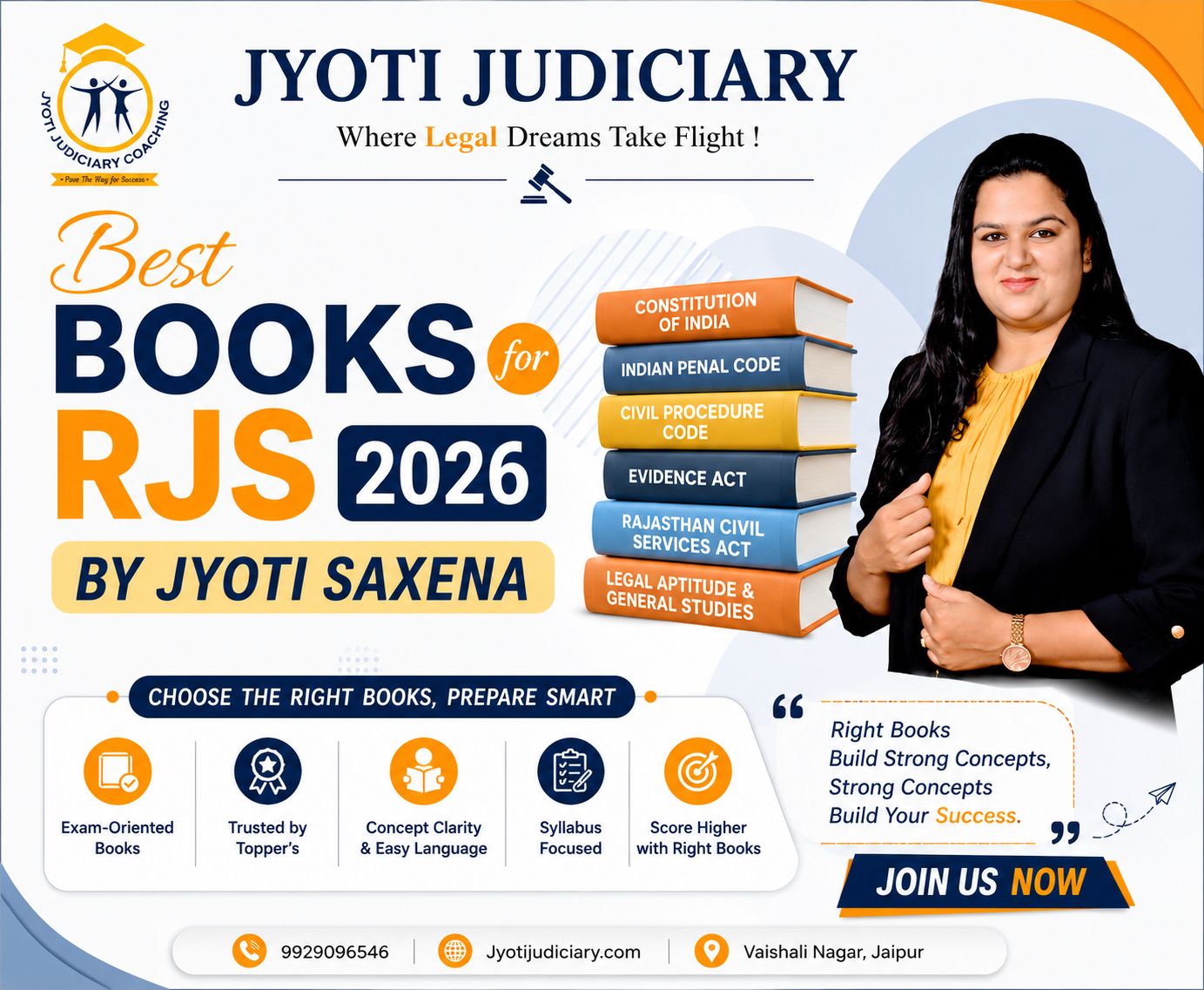
Best Books for RJS 2026: Subject-Wise Honest Review for Rajasthan Judiciary Exam
Every best books for RJS article published online does the same thing: lists fifteen book names per subject with no explanation of why, no warning about what is outdated, and no honest comparison of which books actually serve the RJS Mains versus which ones waste your time. The result is aspirants buying six books on CPC when they need one, reading IPC commentaries when BNS is the primary law since July 2024, and spending three months on books that were written for a different exam.
This is not that article. This is an honest subject-wise review of the best books for RJS 2026 — the most complete RJS books list that goes beyond listing names — what to use as your primary text, what serves as a secondary reference, what to avoid entirely, and — most importantly — why. The recommendations here come from twelve years of watching which study materials produce selections at Jyoti Judiciary Coaching and which ones produce well-read aspirants who cannot clear the Mains.
Before the Book List: The One Rule That Changes Everything
Every experienced RJS mentor says it. Very few aspirants follow it: one good book per subject, read deeply and revised three times, outperforms four books read once. The best books for Rajasthan judiciary preparation are not the longest or widest-covering books — they are the books that build your understanding to the level the RJS Mains tests and that you can actually complete and revise within your preparation timeline.
The RJS Mains Law Papers test application — not encyclopaedic recall. A 15-mark judgment writing question does not reward the candidate who read the most about CPC. It rewards the candidate who understood Order 14 (framing of issues) and Order 20 (judgment structure) deeply enough to apply them to fresh facts in 27 minutes. That depth comes from one book read multiple times — not from five books read superficially.
| The Book Rule Every RJS Aspirant Must Follow: For each subject: choose ONE primary text and complete it fully before touching anything else. Secondary references are for specific gaps — not for parallel reading. Bare Acts are mandatory for all subjects — no commentary replaces the statutory text. Do NOT buy a book because a coaching centre sells it or because a YouTube thumbnail recommends it. Buy a book because you understand what it covers, what its gaps are, and how it serves the specific stage of the RJS exam — Prelims, Mains Law Papers, or Interview. |
Best Books for RJS 2026 — Subject-Wise Honest Review
1. Constitution of India
| Constitution of India — RJS Law Paper I Primary: M.P. Jain — Indian Constitutional Law (latest edition) Also useful: D.D. Basu — Introduction to the Constitution of India (for case law depth); M. Laxmikanth (for Polity-based Prelims MCQs only) Avoid: Old editions of any constitutional law book — the 2024 amendments, recent landmark judgments (Navtej Singh Johar, EWS reservation challenge, electoral bonds) are not covered in pre-2023 editions Why: M.P. Jain is the standard judicial service text for Constitutional Law. It covers fundamental rights, directive principles, writ jurisdiction, and basic structure with the case law depth the RJS Mains requires. Basu adds case law breadth where Jain is thin. Laxmikanth is a Polity MCQ tool — useful for Prelims GK questions but not sufficient for Mains descriptive constitutional analysis. |
2. Code of Civil Procedure, 1908
| CPC — RJS Law Paper I (Core Subject) Primary: C.K. Takwani — Civil Procedure with Limitation Act (latest edition) Also useful: Mulla — Code of Civil Procedure (for deeper commentary on specific contested provisions); actual Jaipur district court civil orders from hcraj.nic.in (free) Avoid: Abbreviated CPC guides marketed as ‘quick revision’ — they omit the procedural nuance the Mains application questions require; any edition pre-dating the 2018 Commercial Courts amendment Why: Takwani is the best books for RJS CPC recommendation across all serious judiciary preparation circles because it explains procedure in the sequence courts actually apply it — FIR to decree — rather than section by section. Reading actual Rajasthan District Court civil orders alongside Takwani trains your judgment writing format in a way no textbook can. |
3. Bharatiya Nyaya Sanhita (BNS), Bharatiya Nagarik Suraksha Sanhita (BNSS), Bharatiya Sakshya Adhiniyam (BSA) — The New Criminal Codes
This is the most important update in the best books for RJS 2026 list — and the one most aspirants are still getting wrong. From 1 July 2024, BNS replaced IPC, BNSS replaced CrPC, and BSA replaced the Indian Evidence Act. These are not amendments — they are replacement legislations. The RJS 2026 syllabus tests BNS, BNSS, and BSA as the primary criminal law. Preparing from IPC, CrPC, and Evidence Act commentaries as your main texts is preparing for a syllabus that no longer exists.
| BNS 2023 / BNSS 2023 / BSA 2023 — RJS Law Paper II (Primary Criminal Law) Primary: Bare Acts — BNS 2023, BNSS 2023, BSA 2023 (Universal / Lexis Nexis / Eastern Book Company edition) Also useful: R.A. Nelson’s commentary on BNS (if available in updated edition); Ratanlal & Dhirajlal — Law of Crimes (updated to BNS); R.V. Kelkar — Criminal Procedure (updated to BNSS) Avoid: Any IPC/CrPC/Evidence Act commentary as your PRIMARY text for 2026 exam preparation — these are reference tools now, not primary texts; any BNS/BNSS/BSA guide that simply lists changes without explaining the new provisions in full Why: The bare acts of BNS, BNSS, and BSA are your non-negotiable primary texts for criminal law in RJS 2026. Build your IPC-to-BNS comparison chart yourself — this active process builds deeper retention than reading a summary. Kelkar remains useful for procedural understanding once you have read BNSS — his explanation of the logical sequence of criminal trial applies equally to BNSS. |
4. Evidence Law (BSA 2023 / Bharatiya Sakshya Adhiniyam)
| Evidence — RJS Law Paper II Primary: Batuk Lal — Law of Evidence (updated to BSA 2023, if available); bare act BSA 2023 as primary Also useful: Avtar Singh — Principles of Law of Evidence (for conceptual depth on admissibility and presumptions) Avoid: Any Evidence Act commentary that does not cover BSA 2023 provisions as its primary text; any book that treats electronic evidence as a supplementary topic — under BSA, electronic evidence is now mainstream, not an exception Why: Batuk Lal is the judiciary standard for evidence — clear on admissibility, burden of proof, and the logical structure of evidence appreciation, which is what the RJS Mains criminal judgment writing tests. Check that your edition covers Section 39 BSA (expert opinion) and the electronic records provisions of BSA — these are directly tested. |
5. Indian Contract Act + Specific Relief Act
| Contract Act + Specific Relief Act — RJS Law Paper I Primary: Avtar Singh — Law of Contract and Specific Relief (latest edition) Also useful: R.K. Bangia — Law of Contract (for simpler conceptual explanations; useful if Avtar Singh feels dense initially) Avoid: Any combined ‘Contract + Torts + Property’ shortcut guide — the Specific Relief Act is independently important for RJS mains and needs dedicated coverage Why: Avtar Singh covers Contract Act, Specific Relief Act, and Sale of Goods Act in one volume — practical for RJS where all three appear in the civil law paper. R.K. Bangia is friendlier for initial reading but lacks the case law depth needed for Mains answers. Read Bangia first if Contract Act basics are unclear, then shift to Avtar Singh for Mains preparation. |
6. Transfer of Property Act, 1882
| Transfer of Property Act — RJS Law Paper I Primary: Mulla — Transfer of Property Act (latest edition) Also useful: R.K. Sinha — Transfer of Property Act (shorter, easier starting point) Avoid: Any guide that covers TPA only through sections without case law — TPA mains questions often require application of doctrine of part performance, mortgage rights, and lease provisions through case analysis Why: TPA is a dense statute with significant case law overlay — particularly on mortgages, leases, and transfers to unborn persons. Mulla is the standard reference for these provisions. R.K. Sinha works for initial conceptual understanding. Neither replaces reading the bare TPA act itself — Section 54 (sale) and Section 58 (mortgage) definitions are directly tested in RJS Prelims MCQs. |
7. Hindu Law and Muslim Law
Hindu and Muslim Personal Laws were added to the RJS 2026 syllabus as new subjects in Law Paper I. Many competitors’ book lists still do not include these — which means aspirants using those lists will walk into the Mains underprepared on two subjects that now appear in the paper.
| Hindu Law + Muslim Law — NEW in RJS 2026 Syllabus (Law Paper I) Primary: Paras Diwan — Modern Hindu Law (for Hindu marriage, succession, adoption, maintenance); Aquil Ahmad — Mohammedan Law (for Muslim marriage, mehr, dissolution, succession) Also useful: Mulla — Principles of Mahomedan Law (for depth on specific Muslim Law provisions if Aquil Ahmad is insufficient for Mains depth) Avoid: Any civil law guide that treats personal laws as a two-page summary — these are full subjects in RJS 2026 Law Paper I and appear in both Mains and Interview Why: Personal laws are heavily tested in the Interview because the Rajasthan High Court panel knows that a Civil Judge will hear family matters daily. Paras Diwan covers Hindu personal law with the conceptual clarity needed for Mains answers. Aquil Ahmad is the standard Muslim Law text for judicial services — concise enough to complete fully while remaining substantive. |
8. Rajasthan-Specific Laws
| Rajasthan State Laws — RJS Paper I (State Legislation) Primary: Rajasthan Rent Control Act — bare act with any authoritative commentary (Rajasthan Law House publications are reliable); Rajasthan Land Revenue Act — bare act; Rajasthan Court Fees and Suits Valuation Act — bare act Also useful: Any Rajasthan-specific law guide from a local Jaipur law publisher (verify currency — must be post-2022 edition) Avoid: National-level law guides that claim to cover ‘all state laws’ — Rajasthan-specific provisions require Rajasthan-specific texts; any Rent Control commentary that does not cover the 2023 amendments Why: Rajasthan state laws are short acts that can be read from bare texts directly. The Rajasthan Rent Control Act and Court Fees Act appear in both RJS Prelims MCQs and as application-based Mains questions. Do not spend significant time on secondary commentaries for these — bare act reading with section-wise notes is sufficient. |
Bare Act vs Commentary — Which One to Read First for RJS?
This is the question behind the best books for Rajasthan judiciary debate that nobody addresses directly. The answer depends on the subject and the stage of your preparation.
For procedural law — CPC, BNSS — start with a commentary (Takwani for CPC, Kelkar for BNSS procedure) to understand the logic of how the procedure works, then read the bare act. Procedure makes no sense in isolation from its purpose. A commentary explains why Section 26 CPC requires the plaint to be in the form prescribed — which makes the bare act far more readable and retainable.
For substantive criminal law — BNS, BSA — start with the bare act directly. The new codes are clearly written and the bare text is the primary examination source. A commentary helps with contested provisions and case law application — but for initial preparation of BNS and BSA for RJS 2026, reading the bare act from start to finish, with a parallel IPC/Evidence Act comparison chart, is the most time-efficient approach.
For constitutional law — neither first. Start with the Preamble and Parts III and IV of the bare Constitution, then read M.P. Jain on those provisions, then return to the bare Constitution. Constitutional law gains meaning fastest when you move between the bare text and a commentary that explains the judicial interpretation of each provision.
How Many Books — The Complete RJS Books List You Actually Need for 2026
For a complete subject-wise RJS preparation covering all subjects in Law Paper I and Law Paper II — you need one primary text per major subject plus bare acts for all subjects. In practical terms, that is:
- Constitution — 1 commentary (M.P. Jain) + bare Constitution
- CPC — 1 commentary (Takwani) + bare CPC
- BNS / BNSS / BSA — 3 bare acts + 1 combined commentary if available
- Evidence (BSA) — 1 commentary (Batuk Lal) + bare BSA
- Contract + SRA — 1 combined text (Avtar Singh) + bare acts
- Transfer of Property — 1 commentary (Mulla or R.K. Sinha) + bare TPA
- Hindu Law — 1 text (Paras Diwan) + bare Hindu Marriage Act, Hindu Succession Act
- Muslim Law — 1 text (Aquil Ahmad) + bare Muslim Personal Law provisions
- Rajasthan State Laws — bare acts only (3-4 short acts)
- Minor Legislation (POCSO, JJ Act, DV Act, Probation, Arms, Rajasthan Excise, NI Act, Limitation) — bare acts only
That is ten to twelve texts and approximately eight to ten bare acts. Not fifty books. Not fifteen books on CPC. One per subject, read completely, revised three times, supported by the bare act. Every additional book beyond this list is a distraction from the revision cycle the RJS Mains requires.
What About Coaching Notes — Do They Replace Books for RJS?
Coaching notes are summaries. They are useful for revision — for checking whether you have covered the key provisions of a subject before a mock test. They are not a substitute for a primary text in the best books for RJS preparation strategy.
The reason is simple: the RJS Mains tests application, not recall. A coaching note that summarises Section 62 of the Contract Act as ‘novation means replacement of old contract with new one’ gives you the fact. Avtar Singh’s discussion of novation — with the cases that distinguish it from waiver, from alteration, and from rescission — gives you the understanding to apply it correctly to fresh facts in a Mains question. Summary knowledge fails at application. Substantive knowledge survives it.
Use coaching notes as revision tools from Month 7 onwards. Use primary texts as learning tools from Month 1. At Jyoti Judiciary Coaching this distinction is built into every RJS batch — primary texts in the teaching sessions, notes only for revision cycles.
Frequently Asked Questions — Best Books for RJS 2026
Which is the best book for RJS mains preparation?
There is no single best book for the RJS Mains as a whole — because the Mains has four papers covering civil law, criminal law, Hindi, and English. For the Law Papers: Takwani for CPC, Avtar Singh for Contract and SRA, M.P. Jain for Constitution, bare acts of BNS/BNSS/BSA for criminal law, and Batuk Lal for evidence. For the Language Papers: practice-based preparation — essay writing, precis, translation — matters more than any specific textbook.
Should I buy BNS and BNSS books or stick to IPC and CrPC?
Buy BNS, BNSS, and BSA bare acts and use them as your primary criminal law texts. IPC and CrPC are now reference tools — useful for understanding what changed and why, but not the primary examination texts for RJS 2026. Any RJS book list for 2026 that still recommends T. Bhattacharya’s IPC or R.P. Singhal’s CrPC as primary texts is outdated.
Are coaching notes enough for RJS or do I need to buy books?
Coaching notes are not enough for the RJS Mains. They are useful revision tools — not primary learning texts. The RJS Mains tests application of law to facts, which requires the depth of understanding that only a complete primary text provides. Use coaching notes for revision from Month 7 onwards. Use primary books for learning from Month 1.
Do I need to read full commentaries or just bare acts for RJS?
Both. Bare acts are mandatory — the exact statutory text is the primary source for both RJS Prelims MCQs and Mains application questions. Commentaries provide the case law context and interpretive depth that bare acts alone cannot give. The sequence matters: for procedural law, read commentary first then bare act; for substantive criminal law under BNS/BSA, read the bare act first then use commentary for contested provisions.
All the best — from Jyoti Judiciary Coaching
Written by Advocate Jyoti Saxena — LLB, LLM, CS, enrolled with the Bar Council of Rajasthan, actively practising at Jaipur Family Court, Jaipur District Court, and the Rajasthan High Court in Criminal Defence, Family Law, Cyber Crime, and Civil Litigation. The book recommendations in this article draw directly from twelve years of teaching these subjects at Jyoti Judiciary Coaching and from daily courtroom practice — not from reading about how courts work.
Founder and Chief Mentor, Jyoti Judiciary Coaching, Jaipur — results include 1st Rank GJS 2022, 2nd Rank UK PCSJ 2023, and 5th Rank RJS 2024. For subject-wise RJS preparation guidance: jyotijudiciary.com | +91 99290 96546