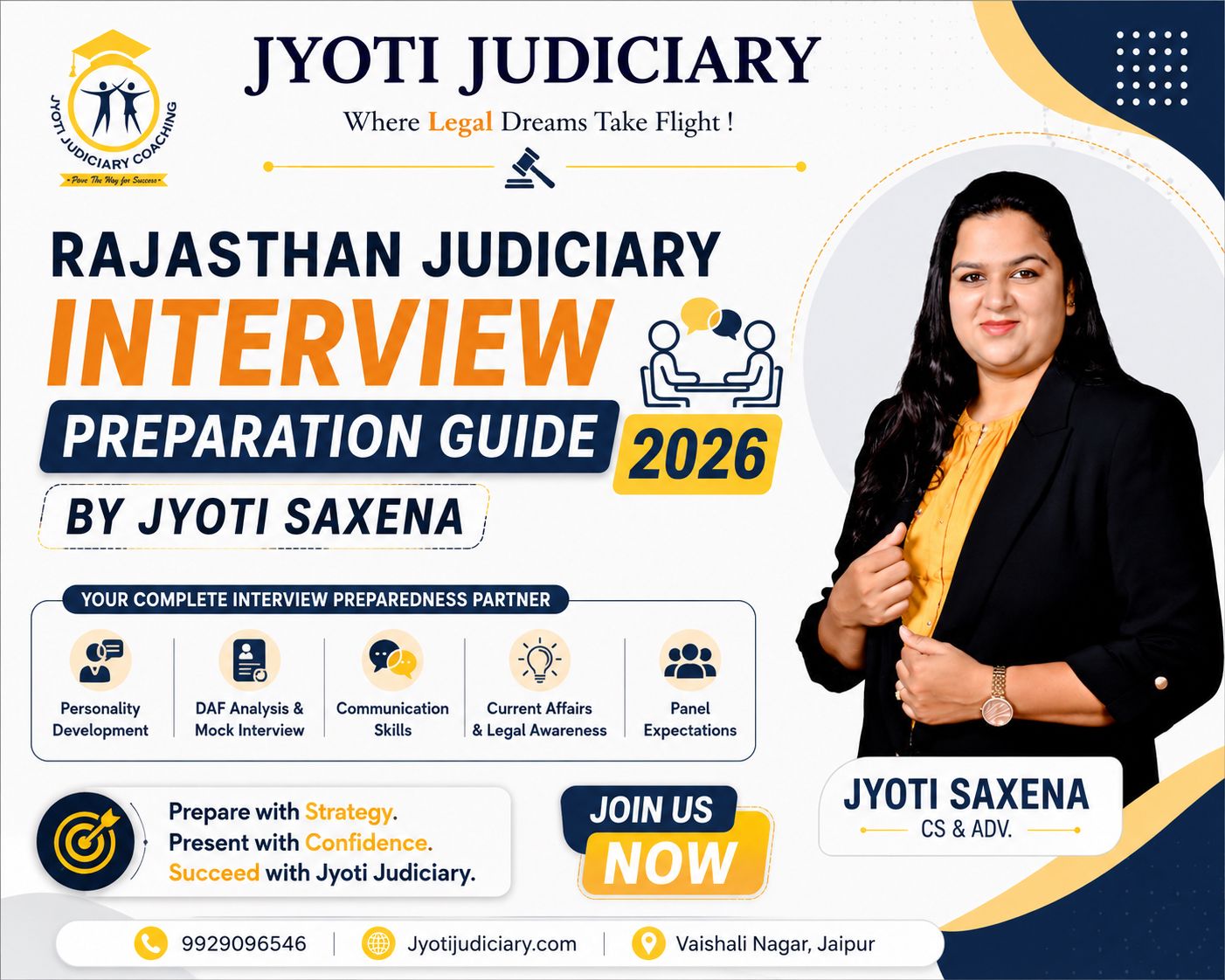
Rajasthan Judiciary Interview Preparation Guide 2026: What the RJS Viva Voce Actually Tests
Every article about RJS interview preparation tells you the same three things: focus on legal knowledge, brush up on current affairs, and be confident. None of them tell you what a Rajasthan High Court interview panel actually looks for when they sit across from a civil judge candidate. None of them explain what Rajasthani dialects means in the context of the viva voce — and why that specific requirement exists in the official notification. None of them give you an actual ethical dilemma question with a model answer structure. And none of them explain what a sitting judge finds unconvincing in a candidate’s answer — not because they have not researched it, but because they have never stood before those judges.
The RJS viva voce carries 35 marks. In competitive cycles, 35 marks can shift a candidate’s rank by dozens of positions. The Rajasthan judiciary interview preparation that most aspirants do — a few days of current affairs revision and a mock session at their coaching centre — is not built for those 35 marks. This guide is.
How Many Marks Is the RJS Interview and Why Does It Matter More Than You Think?
The RJS interview — formally called the Viva Voce — carries 35 marks. Final selection merit is based on Mains marks (300) + Interview marks (35). Prelims marks count for zero in the merit list. On a total of 335 marks, 35 marks is approximately 10.4% of the final score. That sounds modest until you see what it means in practice.
In any competitive RJS cycle where the top candidates are separated by narrow Mains margins, a strong viva voce performance of 25-28 out of 35 versus an average performance of 18-20 out of 35 creates a 7-10 mark differential. When the merit list is decided by fractions, that differential is rank-defining. Candidates who dismiss the interview as a formality because ‘mains decides everything’ are gambling with a tenth of their total score.
| What the Official RJS Notification Says About the Viva Voce: ‘The suitability for employment to the service shall be tested with reference to the candidate’s record at School, College and University, and character, personality, address and physique.’ ‘The questions may be of a general nature and will not necessarily be academic or legal.’ ‘Marks shall also be awarded for the candidate’s proficiency in the Rajasthani dialects and knowledge of social customs of Rajasthan.’ — Official Rajasthan High Court notification language on the RJS Viva Voce |
What Does the RJS Interview Panel Actually Evaluate?
The RJS interview panel consists of sitting judges of the Rajasthan High Court. They are not evaluating whether you know Section 103 BNS or the ratio in Kesavananda Bharati — they assume you do if you have cleared the Mains. What they are evaluating is whether you will be an effective, balanced, and trustworthy judge in a district court. That evaluation happens on five dimensions.
| 1. Judicial Temperament | Can you reason calmly under pressure? Do you form opinions prematurely or do you wait for both sides? Your response to a difficult or unexpected question reveals this — not your legal knowledge. |
| 2. Rajasthan-Specific Awareness | Knowledge of Rajasthani dialects, social customs, local land and family disputes that are common in Rajasthan courts. The interview panel knows the state — they test whether you do too. |
| 3. Legal Awareness (Current) | Recent Supreme Court and Rajasthan High Court judgments. The new criminal codes (BNS, BNSS, BSA) and their practical implications. Constitutional developments. Not textbook law — current law. |
| 4. Communication Quality | Not eloquence — clarity. A Civil Judge writes orders that must be understood by parties, advocates, and appellate courts. The interview assesses whether you communicate precisely and without ambiguity. |
| 5. Ethical Reasoning | Situational questions test your ethical compass — not whether you know the right answer but whether you reason through the problem correctly. Judicial integrity under pressure is what they observe. |
What Is Asked in the RJS Viva Voce — Category-Wise Questions
RJS interview questions fall into five broad categories. Understanding these categories changes your preparation from ‘revise everything’ to targeted, strategic coverage.
Category 1: Personal and Academic Background
The panel will ask about your academic record, your LLB institution, your areas of interest, why you want to be a judge, and what you have done since completing your law degree. If you are a practising advocate, they will ask about your practice — which courts, which areas of law, memorable cases. These questions are not formalities. They are the panel’s way of assessing character, motivation, and self-awareness.
- Why do you want to become a Civil Judge in Rajasthan?
- What was your LLB specialisation and which subjects did you find most challenging?
- Tell me about your advocacy practice — which courts and which areas of law?
- Have you dealt with any family court matters in your practice? What did you observe?
- What is one judgment — from any court — that influenced how you think about law?
The model approach for these questions: be specific, be honest, and connect your answer to what a judge does. ‘I want to serve justice’ is not an answer. ‘I practised family law for three years in Jaipur Family Court and I saw that the quality of the judge’s order in a maintenance case could change a child’s access to education for the next decade — that is why I want to be on the bench’ is an answer.
Category 2: Rajasthani Dialects and Social Customs of Rajasthan
This is the requirement that appears in the official RJS notification and that no preparation guide explains properly. ‘Marks shall be awarded for proficiency in Rajasthani dialects and knowledge of social customs of Rajasthan.’ What does this actually mean?
Rajasthani is not a single language — it is a group of related dialects spoken across Rajasthan’s regions. The major ones are Marwari (Jodhpur, Barmer, Jaisalmer), Mewari (Udaipur, Chittorgarh), Hadoti (Kota, Bundi, Baran, Jhalawar), Dhundhari (Jaipur, Tonk, Dausa), and Mewati (Alwar, Bharatpur). A civil judge in Rajasthan will hear witnesses, parties, and complainants who speak in these dialects. The panel tests whether you can understand and communicate in a dialect relevant to your home region — not fluency in all five dialects, but basic comprehension of at least one.
Social customs tested include: Rajasthani naming conventions and how they affect property documents, the Mukhiya / Sarpanch system in village disputes, joint family property customs that affect civil suits, local land measurement units (Bigha, Biswa) that appear in land revenue matters, and common dispute patterns in Rajasthan — particularly relating to agricultural land, water rights, and family property across generations.
| What to Prepare for the Rajasthani Dialects and Social Customs Section: • Know the major dialects of Rajasthan by region — not fluency, but awareness • Understand joint family property customs and how they appear in civil disputes • Know Rajasthan’s land measurement units — Bigha, Biswa, Biswa Ansi • Be aware of the Panchayati Raj system in Rajasthan and its role in village disputes • Read 5-6 recent Rajasthan High Court judgments on local land and family matters • Know the major festivals, social institutions, and community structures of Rajasthan • If you are from a specific district, know its dialect, major communities, and common disputes |
RJS Interview Questions on Current Legal Developments
The Rajasthan High Court panel expects candidates to know what is happening in Indian law right now — not what happened in law school. Recent developments that every RJS viva voce candidate must be prepared to discuss in 2026 include:
| New Criminal Codes | BNS, BNSS, BSA — effective from 1 July 2024. The panel may ask: ‘What is the most significant procedural change in BNSS compared to CrPC?’ or ‘What does Zero FIR mean and how does it affect a Magistrate’s jurisdiction?’ Know the practical implications, not just the section numbers. |
| Three-Year Practice Rule | All India Judges Association v. Union of India (May 2025) — the Supreme Court restored mandatory three-year practice for civil judge eligibility. The panel may ask your view on this and whether you think it improves judicial quality. |
| Recent RHC Judgments | Know at least 5 recent Rajasthan High Court judgments — available at hcraj.nic.in. The panel includes judges who may have authored them. Being aware of RHC jurisprudence on Rajasthan-specific issues signals that you have prepared for this specific court, not judiciary in general. |
| Constitutional Developments | Electoral bonds judgment (2024), EWS reservation validity, the basic structure doctrine in recent context. Expect questions on judicial independence and the relationship between the executive and judiciary. |
| Family Law Developments | If you have argued family cases or simply studied personal law — Hindu succession amendments, the Maintenance and Welfare of Parents Act, and POCSO interpretations in Rajasthan courts are all testable. |
RJS Interview Ethical Questions — What They Actually Ask and How to Answer
Ethical and situational questions are the most important and most underprepared category in Rajasthan judiciary interview preparation. The panel uses these questions to test judicial temperament — not what you know, but how you reason. There is rarely a single ‘correct’ answer. The evaluation is on your reasoning process.
Sample Ethical Questions and How to Structure Your Answer
Question 1: ‘You are a Civil Judge. The plaintiff before you is a widow claiming maintenance. During arguments, you notice that the defence lawyer is deliberately delaying proceedings to exhaust her financially. What would you do?’
Model Answer Structure: First, acknowledge the problem precisely — ‘This raises two issues: first, whether the conduct constitutes abuse of process; second, how to balance procedural fairness with the plaintiff’s substantive right to timely maintenance.’ Then apply the law — CPC Order XVII (adjournments), the family court’s specific powers, and the court’s inherent jurisdiction under Section 151 CPC. Then state a measured conclusion — impose strict timelines, warn against further delays, consider daily cost orders. Do not say ‘I would tell the defence lawyer off’ — that is not a judicial response.
Question 2: ‘A senior advocate appears before your court and tells you, outside the court, that the case before you involves a party who is distantly related to him and he is not appearing — he just wants you to know. What do you do?’
Model Answer Structure: Identify this as a recusal question and a judicial integrity question. The correct response is to disclose the communication in open court, record it, and if there is any reasonable apprehension of bias — however remote — recuse yourself. The principle is not whether you are actually biased but whether a reasonable observer would perceive bias. ‘Justice must not only be done but must be seen to be done’ — this principle from R v Sussex Justices (1924), applied in Indian courts consistently, is your anchor citation.
Question 3: ‘You are a Civil Judge. You know that a particular law leads to unjust outcomes in certain cases but you are bound to follow it. What is your approach?’
Model Answer Structure: This tests whether you understand the separation of judicial and legislative functions. A judge’s role is to interpret and apply the law — not to substitute their view of what the law should be. If the law leads to a harsh outcome, the remedy is legislative — the judge can note the hardship in the judgment and invite Parliament’s attention. The Constitutional courts can strike down law that violates fundamental rights — but a district court judge applies statute as written. Answer honestly and structurally: ‘My role is to apply the law as it stands, interpret it fairly, and if it conflicts with fundamental rights, refer the question to a constitutional court.’ Do not say ‘I would use my discretion to achieve a just result’ — that is a recipe for appeals.
What NOT to Say in the RJS Interview — Mistakes That Cost Marks
Twelve years of mentoring candidates through the Rajasthan judiciary interview at Jyoti Judiciary Coaching has produced a consistent list of what goes wrong. These mistakes are more common than weak legal knowledge — and they are more easily fixed.
- Do not say ‘I want to serve the nation’ or ‘I want to give justice to the poor’ as your primary reason for wanting to be a judge. These are motivations, not reasons. The panel wants to know what specifically draws you to the judicial role — based on what you have observed, practised, or studied. Be specific.
- Do not pretend to know something you do not. If the panel asks about a Rajasthan High Court judgment you have not read, say clearly: ‘I am not aware of that specific judgment, but if the issue concerns [relevant area], my understanding is…’ Honesty combined with a substantive attempt is far better than a fabricated answer that a High Court judge will immediately see through.
- Do not argue with the panel. If a panel member says your answer is wrong, the correct response is: ‘Thank you for the correction, Sir/Ma’am. I understand the position as…’ A candidate who argues with a sitting judge in an interview has already failed the judicial temperament test, regardless of whether they are right on the law.
- Do not speak faster when nervous. The interview panel evaluates communication clarity. Slow down. One precise sentence is worth three rushed ones. Practice speaking at 70% of your normal speed in mock vivas.
- Do not give memorised answers to ethical questions. The panel can tell. Ethical question answers must be reasoned through in the moment — that is the whole point. Prepare the framework, not the script.
- Do not ignore your LLB academic record. The notification specifically mentions ‘record at School, College and University.’ If your academic record has gaps — a failed attempt, a year’s break — have a clear, honest explanation prepared. Do not raise it, but do not be caught off-guard.
How to Prepare for the RJS Interview — A Month-by-Month Approach
Rajasthan judiciary interview preparation cannot be crammed in the two weeks between the Mains result and the interview date. The best RJS viva voce candidates begin their interview preparation from Month 6 of their overall preparation — while the Mains preparation is still ongoing.
| Month 6 onwards — Build your Interview File | Start a running document: (1) RHC recent judgments — one per week, summary and significance; (2) Rajasthan current affairs — political, social, and legal developments; (3) Rajasthani dialects and social customs notes — your district first, then neighbouring regions; (4) Ethical dilemma questions — write one per week and answer in structured format. |
| Month 9-10 — Legal Developments Update | Compile your five most important recent Supreme Court judgments and five recent Rajasthan High Court judgments. Know each one by: parties, issue, holding, and significance for a civil judge. |
| Month 11 — Mock Viva Sessions | At least three full mock viva sessions before the actual interview. The first two to identify weaknesses. The third to build confidence. In each session, cover all five evaluation dimensions — personal background, Rajasthan awareness, current law, communication, and ethical reasoning. |
| Final Week — Focus, Not Cramming | Read your interview file once. Read two or three recent RHC judgments. Do not attempt to learn new subjects. Sleep properly. The interview tests who you are as much as what you know — exhausted, over-prepared anxiety does not demonstrate judicial temperament. |
Frequently Asked Questions — RJS Interview Preparation
What is asked in the RJS viva voce?
The RJS viva voce tests five dimensions: personal and academic background, Rajasthan-specific awareness (dialects and social customs), current legal developments including recent Supreme Court and RHC judgments, communication clarity, and ethical reasoning through situational questions. The official notification states that questions ‘will not necessarily be academic or legal’ — which means general awareness, personality, and judicial temperament carry as much weight as legal knowledge.
How should I prepare for Rajasthani dialects in the RJS interview?
Know the five major Rajasthani dialects by region — Marwari, Mewari, Hadoti, Dhundhari, and Mewati. If you are from a specific district, know that dialect’s basic vocabulary and its geographic spread. The panel does not expect fluency — they expect awareness of the linguistic reality of Rajasthan’s courts and your preparedness to communicate with parties who speak in regional dialects. Know your own district’s dialect well. That is the minimum preparation.
Can the RJS interview change your rank significantly?
Yes. On a 335-mark total (Mains 300 + Interview 35), a 7-10 mark differential in the viva voce directly translates to rank movement in competitive cycles. Candidates who prepare seriously for the interview consistently outperform their Mains rank in the final merit list. Candidates who treat the interview as a formality consistently underperform their Mains score. Thirty-five marks is not a rounding error — it is a rank-deciding component.
How long before the interview should I start preparation?
Start from Month 6 of your overall preparation — not after the Mains result. The Rajasthan judiciary interview tests awareness that builds over months — current legal developments, Rajasthan-specific knowledge, ethical reasoning practice. None of these can be crammed in two weeks. Build your interview file from Month 6, do weekly entries, and use the final four weeks for consolidation and mock vivas.
Should I tell the interview panel if I do not know the answer to a question?
Yes — partially. If you do not know a specific case name or statute, say: ‘I am not aware of that specific case, but on the issue of [relevant legal question], my understanding is…’ and give a substantive analytical response. Complete admissions of ignorance score poorly. But fabricated answers score worse — High Court judges know the law better than any candidate in that room. Honesty combined with an attempt to reason through the question demonstrates exactly the judicial temperament the panel is looking for.
All the best — from Jyoti Judiciary Coaching
Written by Advocate Jyoti Saxena — LLB, LLM, CS, enrolled with the Bar Council of Rajasthan, actively practising at Jaipur Family Court, Jaipur District Court, and the Rajasthan High Court in Criminal Defence, Family Law, Cyber Crime, and Civil Litigation. The Rajasthan judiciary interview insights in this article draw directly from twelve years of preparing candidates for the RJS viva voce at Jyoti Judiciary Coaching and from daily practice before the Rajasthan High Court — including standing before the same judges who sit on the RJS interview panel.
Founder and Chief Mentor, Jyoti Judiciary Coaching, Jaipur — results include 1st Rank GJS 2022, 2nd Rank UK PCSJ 2023, and 5th Rank RJS 2024. For RJS interview preparation with mock viva sessions: jyotijudiciary.com | +91 99290 96546
Note: Interview question examples in this article are based on typical RJS viva voce patterns. Actual questions vary by panel and year. Always verify current RJS notification details at hcraj.nic.in.