Rajasthan Judiciary Preparation Strategy by Jyoti Saxena | Jyoti Judiciary Coaching, Jaipur
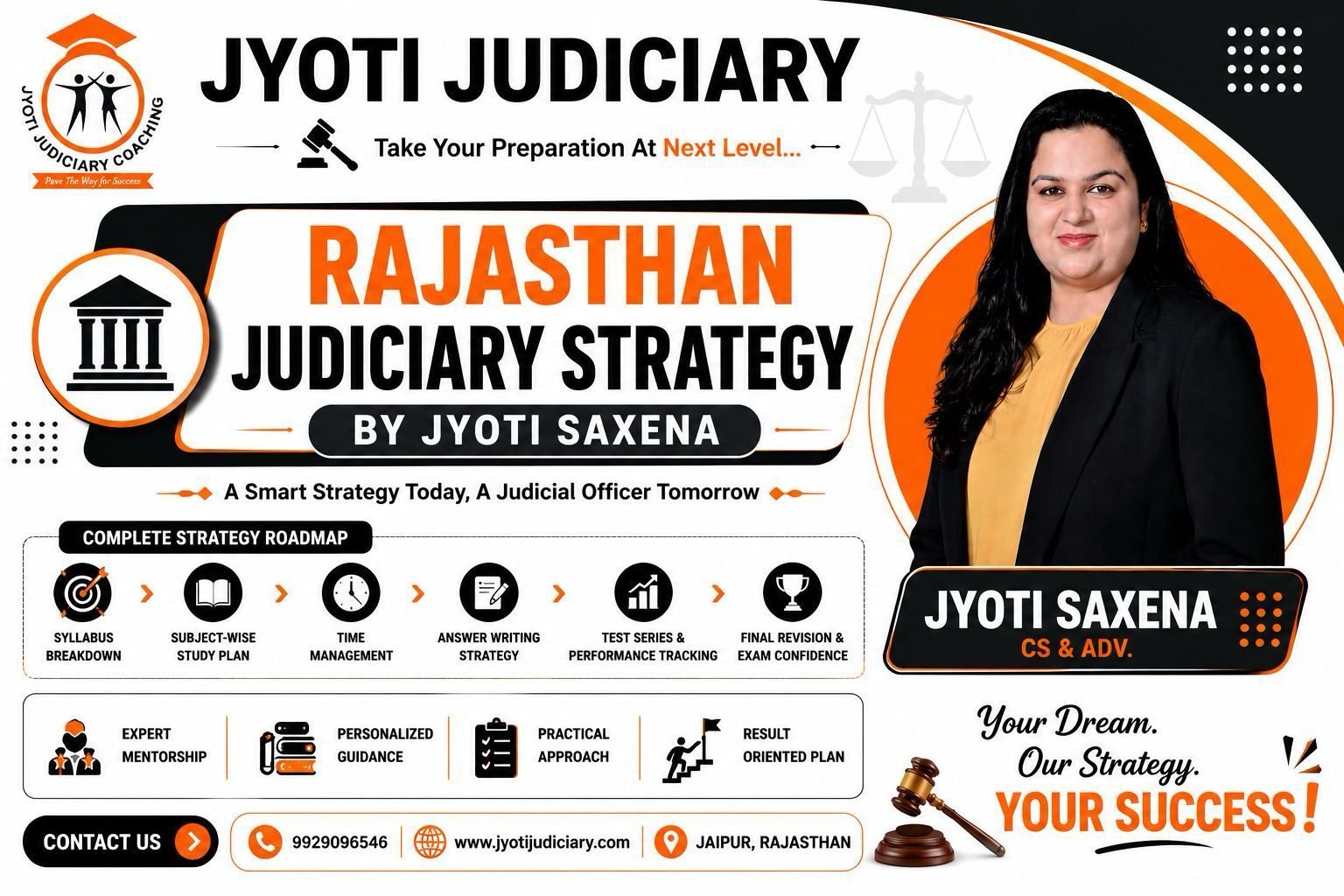
Who Is Jyoti Saxena — And Why Her Strategy Is Different
Before you read a preparation strategy, you deserve to know who wrote it and why they are qualified to. Advocate Jyoti Saxena is the Founder of Jyoti Judiciary Coaching, Jaipur. She holds an LLB, LLM, and is also a Company Secretary (CS) — a combination that is rare in the judiciary coaching space. She is enrolled with the Bar Council of Rajasthan and actively practises at Jaipur Family Court, Jaipur District Court, and the Rajasthan High Court in the areas of Family Law, Cyber Crime, Criminal Defence, and Civil Litigation.
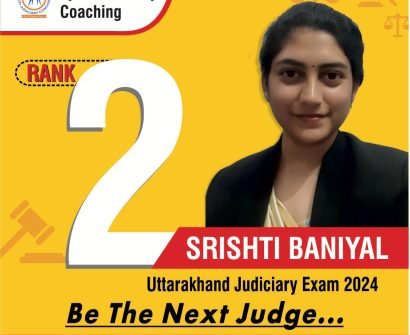
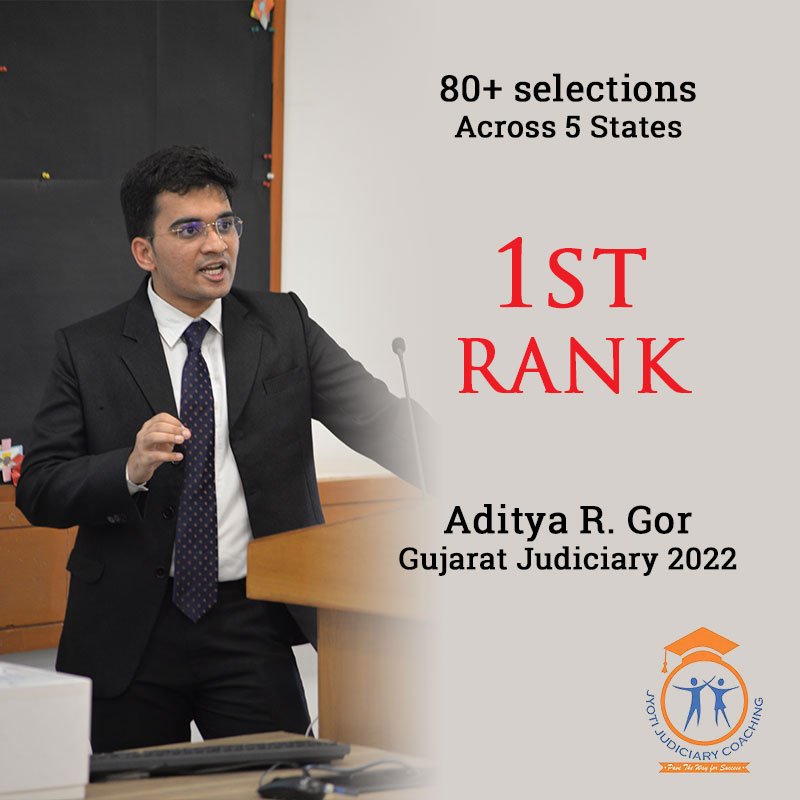
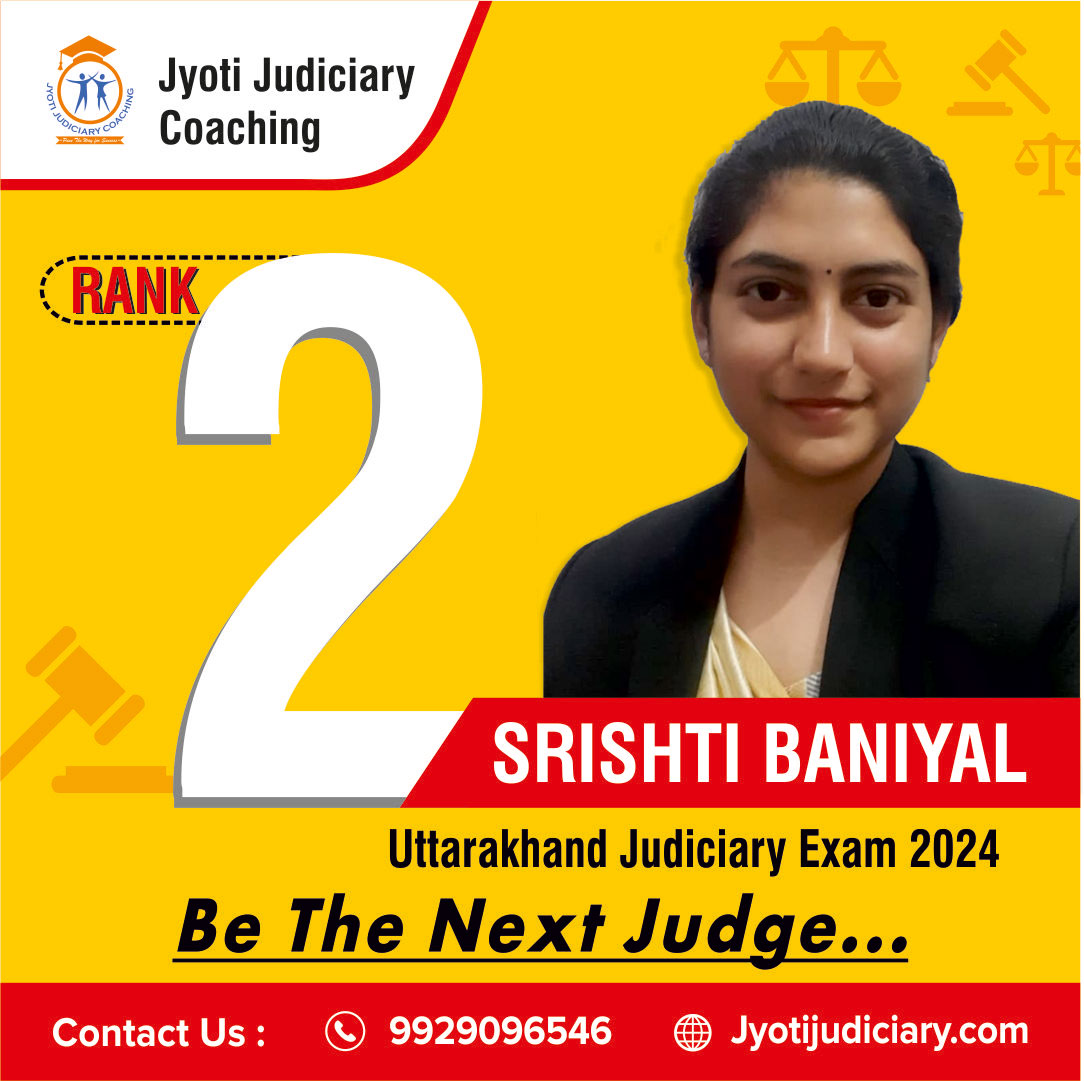
What makes her guidance different from most coaching institutes is this: she teaches what she practises. When she explains the Code of Civil Procedure, she is not reading from a textbook — she has filed plaints under it. When she discusses Family Law, she has stood in Jaipur Family Court arguing exactly those issues. Over 12 years of mentoring RJS aspirants, Jyoti Saxena Ma’am has produced selections across multiple state judicial services — including a 1st Rank in GJS 2022, a 2nd Rank in UK PCSJ 2023, and a 5th Rank in RJS 2024. These are not borrowed results — they came from a method built inside a real courtroom.
| Advocate Jyoti Saxena — At a Glance • LLB | LLM | Company Secretary (CS) • Enrolled — Bar Council of Rajasthan • Active Practice — Jaipur Family Court | Jaipur District Court | Rajasthan High Court • Practice Areas — Family Law, Cyber Crime, Criminal Defence, Civil Litigation • Chief Mentor — Jyoti Judiciary Coaching (Jaipur & Delhi offices) • 12+ Years mentoring Rajasthan Judiciary and multi-state judicial service aspirants • Notable Results — 1st Rank GJS 2022 | 2nd Rank UKPCSJ 2023 | 5th Rank RJS 2024 |
First, Understand Exactly What RJS Is — and Who Conducts It
This is the first correction most aspirants need. The Rajasthan Civil Judge examination — commonly called RJS — is conducted by the Rajasthan High Court, not RPSC. The Rajasthan High Court at Jodhpur releases the official notification on hcraj.nic.in for recruitment to the cadre of Civil Judge in the Rajasthan Judicial Services. Understanding this is not a technicality — it shapes everything from where you look for the notification to how you verify your syllabus.
The RJS exam has three stages. Prelims is objective and qualifying-only. Mains is descriptive and determines 80%+ of your actual score. The Viva-Voce (Personal Interview) carries 35 marks and tests judicial temperament, Rajasthan-specific legal awareness, ethical reasoning, and communication clarity. Final merit is based on Mains marks plus Interview marks — Prelims marks do not count. This hierarchy should determine how you allocate your time.
| Conducting Body | Rajasthan High Court (hcraj.nic.in) |
| Post | Civil Judge (Rajasthan Judicial Services — RJS) |
| Selection Stages | Prelims (Qualifying) → Mains (Descriptive) → Viva-Voce (Interview) |
| Prelims Pattern | 100 objective questions | 100 marks | Qualifying only | No negative marking |
| Prelims Weightage | 70% Law (from Mains syllabus) + 30% Language (Hindi & English) |
| Mains Papers | Law Paper I: Civil Law (100 marks, 3 hrs) | Law Paper II: Criminal Law (100 marks, 3 hrs) |
| Mains Language | Hindi Essay (50 marks, 2 hrs) | English Essay (50 marks, 2 hrs) |
| Viva-Voce | 35 marks — Personality, legal awareness, Rajasthan knowledge, ethics |
| Final Merit | Mains + Interview marks (Prelims marks NOT included) |
| Exam Website | hcraj.nic.in |
RJS 2026 Syllabus — What Changed and Why It Matters
The 2026 RJS syllabus marks the most significant structural update in years. The Rajasthan High Court has incorporated the three new criminal codes — Bharatiya Nyaya Sanhita 2023 (BNS), Bharatiya Nagarik Suraksha Sanhita 2023 (BNSS), and Bharatiya Sakshya Adhiniyam 2023 (BSA) — into Law Paper II. Hindu and Muslim personal laws have been added to Law Paper I. Rajasthan-specific local Acts have been expanded in both papers. If you are still using 2024 study material without updating it, you are preparing for a different exam.
Law Paper I — Civil Law (100 Marks)
| S.No. | Subject | Priority Level |
| 1 | Code of Civil Procedure, 1908 | High — Judgment writing core subject |
| 2 | Specific Relief Act, 1963 | High — Frequently tested in descriptive |
| 3 | Indian Contract Act, 1872 | High — Foundational civil law |
| 4 | Transfer of Property Act, 1882 | High — Important for civil proceedings |
| 5 | Constitution of India, 1950 | High — Constitutional questions in interview too |
| 6 | Limitation Act, 1963 | Medium — Section-specific recall required |
| 7 | Hindu Personal Laws (Marriage, Succession, Adoption, Maintenance) | High — NEW ADDITION 2026 |
| 8 | Muslim Law (Marriage, Succession, Maintenance, Wakf) | High — NEW ADDITION 2026 |
| 9 | Rajasthan Rent Control Act | Medium — State-specific, short Act |
| 10 | Rajasthan Court Fees & Suits Valuation Act | Medium — Procedural |
| 11 | Rajasthan Land Revenue Act | Medium — Rajasthan-specific |
| 12 | Partnership Act, 1932 | Low-Medium |
| 13 | Sale of Goods Act, 1930 | Low-Medium |
| 14 | Registration Act, 1908 | Low-Medium |
| 15 | Judgment Writing (Civil) | High — Directly assessed in descriptive |
Law Paper II — Criminal Law (100 Marks)
| S.No. | Subject | Priority Level |
| 1 | Bharatiya Nyaya Sanhita, 2023 (BNS) | Very High — Replaced IPC; new in 2026 |
| 2 | Bharatiya Nagarik Suraksha Sanhita, 2023 (BNSS) | Very High — Replaced CrPC; new in 2026 |
| 3 | Bharatiya Sakshya Adhiniyam, 2023 (BSA) | Very High — Replaced Evidence Act; new in 2026 |
| 4 | Juvenile Justice Act, 2015 | High |
| 5 | POCSO Act, 2012 | High |
| 6 | Protection of Women from Domestic Violence Act, 2005 | High |
| 7 | Sexual Harassment at Workplace Act, 2013 | Medium |
| 8 | Negotiable Instruments Act, 1881 | Medium |
| 9 | Probation of Offenders Act, 1958 | Medium |
| 10 | Rajasthan Excise Act, 1950 | Medium — State-specific |
| 11 | Information Technology Act, 2000 | Medium — New addition |
| 12 | Charge Framing & Criminal Judgment Writing | Very High — Core mains skill |
| Critical Note on New Criminal Laws: Many aspirants are preparing BNS, BNSS, and BSA in isolation — reading them without knowing how they differ from IPC, CrPC, and Evidence Act. That approach will hurt you in Mains. The descriptive answers will require you to apply the new provisions correctly, which means you must understand WHY the change was made, what is new, what was retained, and what was omitted. Jyoti Saxena Ma’am trains aspirants on comparative analysis — not parallel reading. |
Jyoti Saxena’s Phase-Wise Preparation Strategy for RJS 2026
Most coaching institutes give you a subject list and a timeline. What they rarely give you is the actual logic behind the order of preparation — why some subjects must come before others, how to calibrate Prelims versus Mains effort, and what kills good candidates in the Interview. Here is the complete strategy, developed from 12 years of watching what works and what does not inside the Jyoti Judiciary classroom.
Phase 1 — Legal Foundation (Months 1 & 2): Build Your Reasoning, Not Just Your Memory
The biggest mistake new RJS aspirants make is treating judiciary preparation like a law college examination — reading chapter by chapter and taking notes. That approach produces students who can recite sections but cannot apply them. Civil Judge examination at RJS level tests your ability to think like a judge — to spot the legal issue buried inside a factual problem, frame the relevant law, apply it, and reach a reasoned conclusion.
- Start with the Code of Civil Procedure and the Bharatiya Nagarik Suraksha Sanhita (BNSS) in the first month — one civil, one criminal. These two procedural codes are the skeleton of court practice and connect almost every other subject on the syllabus. Understanding CPC Order VII (plaint) and BNSS Chapter XIV (charge framing) early gives you a practical lens for everything you study after.
- Read Rajasthan High Court judgments alongside bare acts from the first week itself. Many aspirants defer this to ‘later stage’ — by which point they have months of theory with no practical grounding. Even two or three High Court judgments per week builds your ability to structure an answer like a judge thinks.
- For the new criminal codes (BNS, BNSS, BSA), do not just read them in sequence. Make a three-column comparative chart — old provision, new provision, what changed. This becomes your revision tool for Mains and a discussion tool for the Interview.
- Do NOT skip Hindu Personal Law and Muslim Law. These are new additions in 2026 and are tested in both Mains and Interview. The Family Court connection makes them real, practical subjects — Jyoti Saxena Ma’am practises in Jaipur Family Court, and she can tell you these questions appear in civil proceedings constantly.
Phase 2 — Mains Answer Writing (Months 3 & 4): This Is Where RJS Is Won or Lost
Every serious RJS aspirant knows the subjects. Very few know how to write a Mains answer that scores. The difference between a 60/100 and a 85/100 answer on the same topic is almost never knowledge — it is structure, legal reasoning, and presentation. Jyoti Judiciary Coaching under Jyoti Saxena Ma’am dedicates more structured classroom hours to answer writing than almost any other coaching in Jaipur, because that is where the marks actually live.
- Every descriptive Law answer has a four-part skeleton: Issue — Law — Application — Conclusion. Practise writing every answer in this structure from Month 3 onwards. Judges in Mains evaluation notice immediately when a candidate can frame the legal issue precisely versus when they just narrate facts.
- Judgment writing is tested separately and carries significant marks. Practice writing at least one civil judgment and one criminal judgment per week — not from templates, but from fresh problems. Look at actual Rajasthan District Court orders for structural reference, not just coaching-provided templates.
- For Law Paper I descriptive answers, landmark case law integration earns marks. Know these cases by ratio — not just name and year: Kesavananda Bharati (1973) on Basic Structure, Navtej Singh Johar (2018) on constitutional morality, B.R. Ambedkar’s vision in the Constituent Assembly debates for constitutional interpretation questions. These references separate a good answer from an exceptional one.
- Write 2 Law answers and 1 essay per day — set a 30-minute clock, write, then self-evaluate using the Issue-Law-Application-Conclusion framework. Show your written answers to a mentor or senior aspirant for feedback. Writing in isolation without feedback improves speed but not quality.
Phase 3 — Prelims Sprint (3–4 Weeks Before Exam)
Prelims has no negative marking in the RJS exam — which changes your test-taking strategy significantly compared to RPSC exams. Every question must be attempted. The 70% Law weightage means your Mains preparation is essentially your Prelims preparation for the Law section. The 30% Language portion (Hindi and English proficiency) is what many Law-heavy candidates underestimate.
- Attempt 3 full Prelims mock tests per week in timed conditions (100 questions, approximately 2 hours). Review every wrong answer — not just the correct option, but why the wrong options were wrong. RJS Prelims setters often craft distractors from real sections and adjacent provisions.
- For the Language section: practise grammar-based MCQs in Hindi and English. This requires active practice — reading comprehension passages and spotting errors daily. Language section cut-offs matter because aspirants who ignore this component often fail to clear the Prelims despite scoring well in Law.
- Revise your comparative new criminal laws charts intensively in this phase — the Prelims often tests transitional provisions and renumbered sections in BNS/BNSS/BSA directly.
Phase 4 — Interview (Viva-Voce) Preparation: The 35 Marks That Can Change Your Rank
The RJS Interview is not a formality. 35 marks out of the total can shift your rank by dozens of positions. The Rajasthan High Court interview panel evaluates judicial temperament — your ability to reason calmly, your ethical compass, your awareness of Rajasthan’s legal and social landscape, and your communication quality. This is not about performing confidence — it is about demonstrating that you think like a judge.
- Know Rajasthan’s social customs, dialects, and recent legal developments. Interview panels test Rajasthan-specific awareness deliberately — knowledge of the Rajasthan High Court’s recent significant judgments, local Acts, and state-specific legal issues directly affects your evaluation.
- Practise situational ethical questions: ‘What would you do as a Civil Judge if…?’ These questions have no single correct answer — they test your reasoning process. Practise articulating your thought process step by step, not just giving a conclusion.
- Your LLB academic record, publications, moot court experience, and any advocacy experience will be discussed. Prepare 2-minute crisp explanations of each relevant experience. For advocates appearing for RJS, actual court experience is a significant advantage that should be highlighted calmly, not pushed aggressively.
- Communication clarity matters more than verbosity. A precise, structured 90-second answer demonstrates judicial thinking better than a 4-minute rambling explanation. Jyoti Saxena Ma’am regularly conducts mock viva sessions — these are not optional if you reach the interview stage.
Recommended Books for RJS 2026 — What Actually Helps
The book list debate in the judiciary community never ends. Here is the practical answer: for most subjects, one authoritative text read deeply is worth more than three books read superficially. Jyoti Saxena Ma’am recommends these based on what has worked for selections — not affiliate relationships.
| Subject | Recommended Text |
| Code of Civil Procedure | C.K. Takwani — Civil Procedure; also read actual court orders |
| Specific Relief Act | Mulla’s commentary; short Act — read bare act thoroughly |
| Indian Contract Act | Avtar Singh — Law of Contract & Specific Relief |
| Transfer of Property Act | Mulla — Transfer of Property Act |
| Constitution of India | M.P. Jain — Indian Constitutional Law; D.D. Basu for case law depth |
| BNS / BNSS / BSA (New Criminal Codes) | Bare acts + Comparative analysis with IPC/CrPC/Evidence Act |
| Hindu Personal Law | Paras Diwan — Modern Hindu Law |
| Muslim Law | Aquil Ahmad — Mohammedan Law |
| POCSO / JJ Act / DV Act | Bare acts — short enough to read fully multiple times |
| Rajasthan State Acts | Rajasthan Law House publications for local acts |
| Judgment Writing | Practice from Rajasthan District Court and High Court orders online |
What Most RJS Aspirants Get Wrong — Insights from 12 Years of Mentoring
Jyoti Saxena Ma’am has observed the same patterns across hundreds of RJS aspirants over 12 years. Here are the real failure points — not the standard generic mistakes you will read on every coaching website:
- Reading new criminal codes (BNS, BNSS, BSA) in isolation without comparison to the old codes — then struggling in Mains when questions demand applied analysis of specific changes.
- Treating Prelims and Mains as two entirely separate preparation phases — then losing Prelims because Mains Law preparation was deferred too long.
- Neglecting judgment writing until one month before Mains — then submitting answers in essay format instead of judicial format, losing structured marks despite knowing the law.
- Ignoring the Interview because ’35 marks is small’ — then watching candidates with lower Mains scores outrank them on the final merit list.
- Using coaching notes as a substitute for bare acts — particularly dangerous in 2026 when the syllabus has new legislation that many printed coaching materials have not yet updated.
- Not reading Rajasthan High Court judgments — the Interview panel regularly asks about recent RHC decisions, and this knowledge is almost impossible to acquire in the last two weeks before the viva.
Frequently Asked Questions — Rajasthan Judiciary Preparation
Q1. Who conducts the RJS Civil Judge exam — RPSC or the Rajasthan High Court?
The Rajasthan High Court conducts the RJS exam. Notifications are released on hcraj.nic.in. RPSC conducts other Rajasthan government exams but not the Civil Judge recruitment.
Q2. Is there negative marking in RJS Prelims?
No. The RJS Preliminary Examination has no negative marking. Every question must be attempted since unattempted questions carry zero marks and there is no penalty for wrong answers.
Q3. Do Prelims marks count in the final merit list?
No. The Prelims is qualifying only. Final merit is based exclusively on Mains marks plus Interview marks. This is why disproportionate time on Prelims at the cost of Mains preparation is a strategic mistake.
Q4. What is the weightage of the Interview in RJS?
The Viva-Voce carries 35 marks. Combined with Mains marks, the aggregate determines your final rank. 35 marks can move your rank significantly in a competitive cycle — do not treat the Interview as a formality.
Q5. What are the new additions in RJS Syllabus 2026?
The 2026 syllabus has added Bharatiya Nyaya Sanhita (BNS), Bharatiya Nagarik Suraksha Sanhita (BNSS), and Bharatiya Sakshya Adhiniyam (BSA) replacing the old IPC, CrPC, and Evidence Act respectively. Hindu and Muslim Personal Laws have been added to Law Paper I. IT Act and additional Rajasthan-specific Acts have also been incorporated.
Q6. How important is judgment writing for RJS Mains?
Extremely important. Judgment writing is a distinct skill that is directly assessed in the Mains examination. Candidates who cannot structure a judgment — issue, relevant law, application, operative part — consistently score below their knowledge level. It must be practised from Month 3 of preparation, not left for the final weeks.
Q7. Can an advocate with court practice prepare for RJS alongside their practice?
Yes — and court experience is actually an advantage in RJS preparation if used correctly. Advocates already understand procedural law practically, which directly aids Mains application-based answers and the Interview. The challenge is structured study time. Jyoti Judiciary Coaching’s offline and online programmes are designed to accommodate working advocates with both live and recorded access.
Q8. How does Jyoti Judiciary Coaching help RJS aspirants specifically?
Jyoti Judiciary Coaching under Jyoti Saxena Ma’am provides structured preparation covering all three stages — Prelims, Mains answer writing, and Viva-Voce — with regular mock tests, judgment writing workshops, and concept-clarity sessions. Both offline batches in Jaipur (Vaishali Nagar) and live online programmes are available. Contact: +91 99290 96546 | info@jyotijudiciary.com | jyotijudiciary.com
Final Words — From Jyoti Saxena Ma’am to Every RJS Aspirant
Becoming a Civil Judge in Rajasthan is not just a career. It is the ability to give someone their right on the day they need it most. That responsibility deserves preparation that goes beyond memorising sections — it demands understanding why the law exists, how courts actually apply it, and what a judge must think through before writing a single line in an order.
At Jyoti Judiciary Coaching, every batch, every mock test, and every answer feedback session is built around one simple belief: clarity beats volume. You do not need 20 books. You need the right few, studied deeply, with consistent writing practice, under the guidance of someone who has lived the law in court — not just taught it in a classroom.
Start now. Start right. The Rajasthan High Court will announce the next RJS notification — and when it does, the aspirants who have spent this time building real legal reasoning will have an edge that no last-minute crash course can replicate.
All the best — from Jyoti Judiciary Coaching
Advocate Jyoti Saxena | Chief Mentor
Jyoti Judiciary Coaching | B/135 Chitrakoot, Vaishali Nagar, Jaipur | +91 99290 96546 | info@jyotijudiciary.com | jyotijudiciary.com