Maintenance Under Section 125 CrPC / Section 144 BNSS: Wife, Children, Parents and Supreme Court Cases 2026
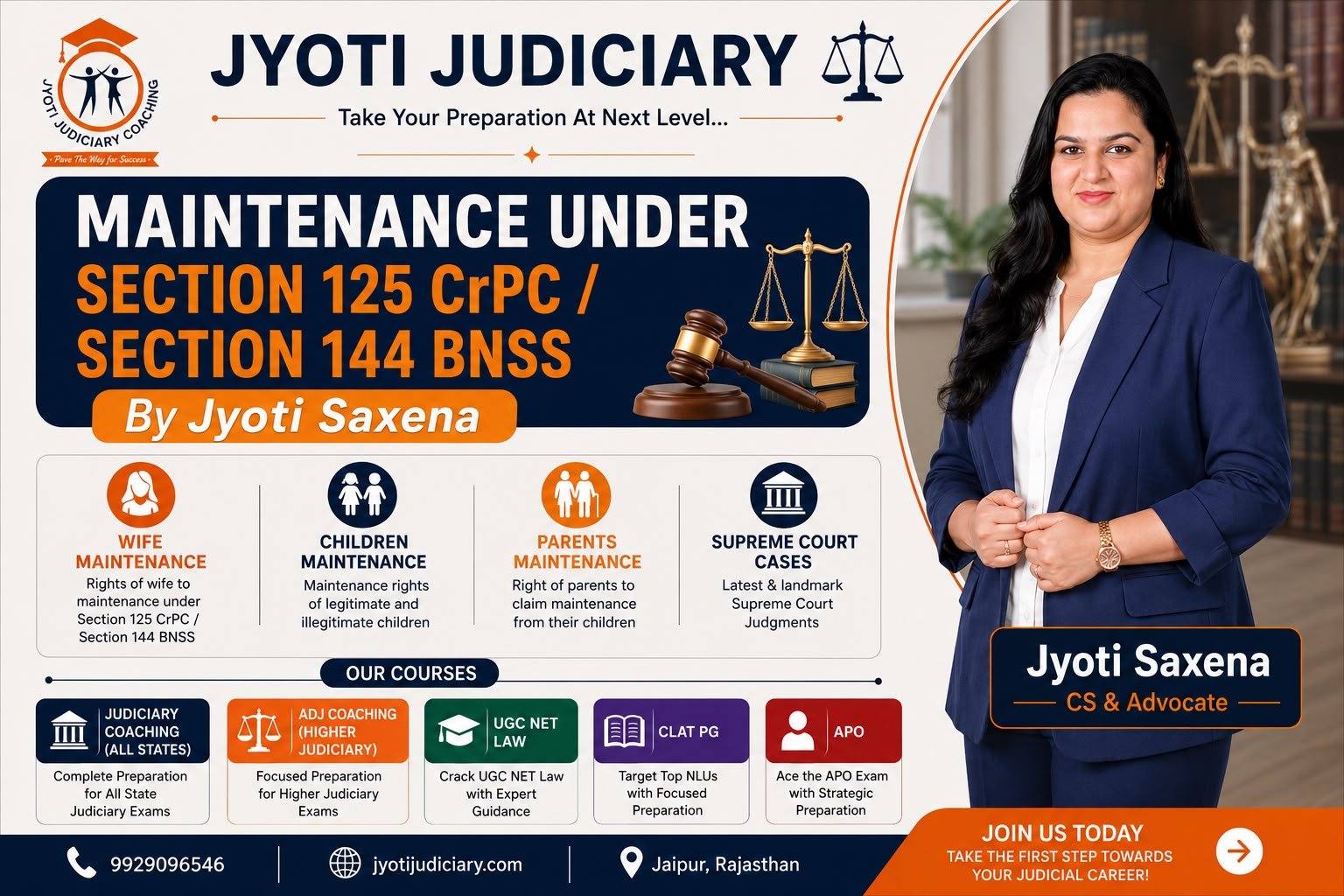
Section 125 CrPC | Section 144 BNSS | Wife Maintenance India | Children Parents Maintenance | Rajnesh v Neha 2021 | Mohd Abdul Samad 2024 | Interim Maintenance 60 Days | Who Can Claim | Disqualification | DV Act Comparison | Judiciary Exam Notes | July 2026
| Maintenance — Quick Reference: Old law: Section 125 CrPC 1973 New law: Section 144 BNSS 2023 — in force from 1 July 2024 Who can claim maintenance under Section 144 BNSS: → Wife unable to maintain herself → Legitimate or illegitimate minor children → Major children with physical or mental disability → Father or mother unable to maintain themselves Tried by: Judicial Magistrate First Class (summary proceedings) No ceiling on maintenance amount — depends on facts Interim maintenance: Must be disposed of within 60 days of notice Maintenance payable from: Date of application (not date of order) — Rajnesh v. Neha (2021) 2 SCC 324 |
Maintenance under Section 125 CrPC — now Section 144 BNSS from 1 July 2024 — is one of the most practically significant provisions in Indian family law. It gives wives, children, and parents the right to claim monthly maintenance from a person who has the means to pay but neglects or refuses to do so. The proceedings are summary in nature — designed to provide quick relief, not to wait years for a civil decree. Section 144 BNSS carried forward Section 125 CrPC with minimal changes. All five decades of Supreme Court case law built on Section 125 CrPC continues to apply to Section 144 BNSS. For judiciary exam candidates, this topic appears in Prelims MCQs on section numbers and disqualifications, and in Mains short notes on Rajnesh v. Neha guidelines, maintenance quantum, and the DV Act vs Section 144 BNSS comparison.
The Section 144 Renumbering Trap — Critical Exam Point
| Do Not Confuse These Two — Direct Prelims MCQ Trap: Under CrPC 1973: Section 125 CrPC = Maintenance of wife, children, parents Section 144 CrPC = Power to issue orders to prevent unlawful assembly Under BNSS 2023 (from 1 July 2024): Section 144 BNSS = Maintenance of wife, children, parents (was 125 CrPC) Section 163 BNSS = Power to issue orders to prevent unlawful assembly (was Section 144 CrPC) Exam question: “Which BNSS section deals with maintenance?” Answer: Section 144 BNSS — not Section 125 (which no longer exists). Exam question: “What is Section 144 BNSS?” Answer: Maintenance — not unlawful assembly (which is now Section 163 BNSS). |
Who Can Claim Maintenance — Section 144 BNSS
Section 144(1) BNSS provides that if a person having sufficient means neglects or refuses to maintain certain categories of dependants, a Judicial Magistrate of the First Class may order a monthly allowance to be paid. The four categories who can claim are:
| Who Can Claim | Condition | Key Point |
| Wife | Unable to maintain herself | Includes divorced wife who has not remarried. Does not include wife living in adultery. Secular provision — applies to all religions including Muslim women (Mohd. Abdul Samad, 2024). |
| Legitimate or illegitimate minor child | Unable to maintain themselves | Both legitimate and illegitimate children are covered. Applies equally whether born inside or outside marriage. |
| Major child with disability | Physical or mental abnormality or injury — unable to maintain themselves | Adult children who cannot work due to disability are covered. Married daughters are excluded under Section 144(1) BNSS. |
| Father or mother | Unable to maintain themselves | Both parents can claim against a child with sufficient means. Daughters are equally liable as sons — Supreme Court confirmed. Applies regardless of religion. |
Disqualification — When Maintenance Is Refused
Section 144(4) BNSS (was Section 125(4) CrPC) lists three situations where a wife loses her right to maintenance:
| Three Disqualifications for Wife — Section 144(4) BNSS: 1. Living in adultery — if the wife is living in adultery, she cannot claim maintenance from her husband. 2. Refusing to live with husband without sufficient reason — if the wife refuses to live with her husband without any sufficient cause, she loses the right to maintenance. 3. Living separately by mutual consent — if the husband and wife are living separately by mutual consent, maintenance is not payable. “Sufficient reason” for refusing to live together: If the husband has taken a second wife, keeps a mistress, is cruel, or has committed any serious matrimonial wrong — the wife has sufficient reason to refuse to live with him and retains her right to maintenance. Exam trap: The disqualifications apply ONLY to wives — not to children or parents claiming maintenance under Section 144 BNSS. |
Rajnesh v. Neha (2021) 2 SCC 324 — The Governing Authority on Maintenance
Before Rajnesh v. Neha, maintenance proceedings in India were deeply fragmented. The same parties were often in three different courts simultaneously — one under Section 125 CrPC, one under the Hindu Marriage Act, and one under the Domestic Violence Act. Husbands routinely concealed income. Interim maintenance took years to arrive. Courts had no standard framework. Justices Indu Malhotra and Subhash Reddy laid down binding guidelines that changed all of this.
| Rajnesh v. Neha (2021) — Binding Guidelines for All Courts: 1. DATE OF PAYMENT: Maintenance is payable from the date of application — not from the date the order is passed. Courts cannot deny arrears from the date of filing. 2. MANDATORY AFFIDAVITS: Both parties must file standardised affidavits disclosing assets, income, liabilities, and expenses before the court fixes quantum. Concealment of income is treated as contempt. 3. INTERIM MAINTENANCE: Applications for interim maintenance must be disposed of within 60 days of service of notice — mandatory timeline. 4. OVERLAPPING PROCEEDINGS: Where multiple maintenance proceedings are running (Section 144 BNSS + DV Act + HMA), courts must harmonise and set off amounts to prevent double recovery. 5. QUANTUM: Fixed based on respondent’s income, claimant’s needs, standard of living during the marriage, and reasonable expenditure. No ceiling — quantum depends entirely on the facts. 6. ENFORCEMENT: Section 147 BNSS — warrant, attachment of property, or imprisonment up to one month for each default. These guidelines are binding on all Magistrates and Family Courts. Exam angle: Any Mains question on maintenance quantum or procedure must cite Rajnesh v. Neha. It is the single most important case. |
Muslim Women and Section 144 BNSS — Mohd. Abdul Samad (2024)
Section 144 BNSS is a secular provision — it applies to all religions. The question of whether Muslim women can claim maintenance under Section 125 CrPC (now Section 144 BNSS) has been settled through a line of cases starting from Shah Bano (1985) through Danial Latifi (2001) and now definitively in Mohd. Abdul Samad v. State of Telangana (2024 INSC 506).
The Supreme Court in Mohd. Abdul Samad (July 2024) held that a divorced Muslim woman can claim maintenance under Section 144 BNSS (Section 125 CrPC) — this right exists independently of Muslim personal law and the Muslim Women (Protection of Rights on Divorce) Act 1986. The right under Section 144 BNSS is available until the divorced wife remarries. A Muslim wife does not lose this right simply because she has received mahr — the quantum and period of entitlement are separate questions.
Section 144 BNSS vs DV Act vs HMA Section 25 — Comparison
| Parameter | Section 144 BNSS | DV Act Section 20 | HMA Section 25 |
| Who can apply | Wife, children (minor/disabled), parents | Aggrieved woman in domestic relationship | Either spouse (husband or wife) |
| Nature of proceedings | Criminal — before Magistrate | Civil — before Magistrate | Civil — before Family Court / District Court |
| Condition for wife | Must be unable to maintain herself | NOT linked to inability to maintain herself — Delhi HC 2024 | Either spouse can apply regardless of means |
| Applies to which religions? | All religions — secular | All religions — secular | Only Hindus (HMA applies only to Hindus) |
| Quantum ceiling | No ceiling | No ceiling | No ceiling |
| Interim relief available? | Yes — within 60 days (Rajnesh v. Neha) | Yes — quickly on application | Yes — pendente lite maintenance |
| Can both be claimed simultaneously? | Yes — Rajnesh v. Neha: courts must set off to avoid double recovery | Yes — but amounts must be harmonised | Yes — same set-off principle applies |
Important Supreme Court Cases on Maintenance
1. Mohd. Ahmed Khan v. Shah Bano Begum (1985) 2 SCC 556 — Secular Character Established
The Supreme Court held that Section 125 CrPC applies to all citizens regardless of religion — including Muslim women. A Muslim husband is liable to pay maintenance to his divorced wife if she is unable to maintain herself. Muslim personal law provisions do not override the secular right under Section 125 CrPC / Section 144 BNSS. This judgment established the secular character of the maintenance provision that continues to govern all cases under Section 144 BNSS.
2. Rajnesh v. Neha (2021) 2 SCC 324 — Governing Authority on Quantum and Procedure
Justices Indu Malhotra and Subhash Reddy laid down binding guidelines for all maintenance cases. Maintenance is payable from the date of application — not the date of order. Both parties must file standardised affidavits disclosing assets and income. Interim maintenance must be disposed of within 60 days of service of notice. Courts must harmonise overlapping maintenance proceedings to prevent double recovery. These guidelines bind all Magistrates and Family Courts across India.
3. Mohd. Abdul Samad v. State of Telangana (2024 INSC 506) — Muslim Women and Section 144 BNSS
The Supreme Court definitively held that Section 144 BNSS (Section 125 CrPC) is religion-neutral and applies to Muslim women. A divorced Muslim woman can claim maintenance under this secular provision independently of Muslim personal law and the Muslim Women (Protection of Rights on Divorce) Act 1986. The right continues until she remarries. Mahr received does not automatically extinguish this right.
4. ABC v. XYZ (2025 INSC 129, February 2025) — Maintenance as Legal Duty, Not Charity
Justices B.V. Nagarathna and Satish Chandra Sharma held that the right to maintenance under Section 125 CrPC / Section 144 BNSS is not a benefit received by a wife but a legal and moral duty owed by the husband. This reframing removed any social stigma associated with claiming maintenance — the obligation is the husband — not a concession to the wife. Courts cannot use a wife non-compliance with a restitution decree as an automatic bar to maintenance unless unjustified refusal is proved.
5. Deepa Joshi v. Gaurav Joshi (16 April 2026) — Section 144 BNSS in Practice
One of the earliest Supreme Court cases directly decided under Section 144 BNSS (the wife had filed on 18 September 2024 — after BNSS came into force). The Court applied all pre-existing Section 125 CrPC jurisprudence to the Section 144 BNSS proceedings, confirming that the transition from CrPC to BNSS did not alter the substantive law — only the section number. This case confirmed the continuity of SC precedents under the new provision.
6. Nikhat Parveen v. Rafique (2026 LSI SC 100) — DNA Evidence and Maintenance
The Supreme Court held that where DNA evidence conclusively establishes that the respondent is not the biological father of a child, no maintenance obligation can be imposed upon him under Section 144 BNSS. The legal presumption under Section 112 IEA / BSA (child born during marriage presumed legitimate) cannot override conclusive DNA evidence in maintenance proceedings. Scientific truth must prevail when it provides certainty. The Court clarified this should not be read as endorsing routine DNA testing in every maintenance case.
FAQs — Maintenance Section 144 BNSS
Pati se maintenance kaisemilegi? (How to get maintenance from husband?)
Maintenance keliye Section 144 BNSS keantargat Judicial Magistrate First Class kepaas application daakhilkarnihotihai — us jagahjahanaaprehti hain, yajahanpatirehtahai, yajahandono ne saathmeinniwaskiyatha. Application mein yeh batanahoga ki patikepaas paisa hai aur usnepaalna-poshnakarne se mana kar diya yanazar-andazkiya. Rajnesh v. Neha (2021) keanusaar maintenance application daakhilkarne ki date se hi milnichahiye. Interim maintenance — jo case chaltewaqtmiltihai — 60 din mein decide honichahiye.
Section 125 CrPC aur Section 144 BNSS meinkya fark hai?
Koi substantive fark nahihai — Section 144 BNSS, Section 125 CrPC ka seedha replacement hai jo 1 July 2024 se laguhua. Offence definition, who can claim, disqualifications, quantum determination, and enforcement provisions — sab same hain. Jo zarooryaadrakhnahai: Section 144 CrPC (jo pehle unlawful assembly kebaaremeintha) ab Section 163 BNSS hogayihai. Section 144 BNSS ab maintenance hai — yeh ek important exam trap hai jo Prelims MCQs mein directly poochajatahai.
Kya working wife ko maintenance miltihai?
It depends. Under Section 144 BNSS, a wife must show she is “unable to maintain herself” for the maintenance claim to succeed. A wife who is earning but earning significantly less than the standard of living during the marriage may still be entitled to maintenance — the test is not whether she has any income but whether her income is sufficient for her to maintain herself at the accustomed standard. The Allahabad High Court in a December 2025 case denied maintenance to a wife earning Rs. 36,000 per month with no dependants while the husband had to maintain his aged parents. But a wife earning a nominal amount while the husband earns substantially more would ordinarily succeed. Under the DV Act (Section 20), there is no “unable to maintain herself” condition — the Delhi High Court confirmed this in 2024.
Kya Muslim aurat Section 144 BNSS ke under maintenance maangsaktihai?
Haan. Section 144 BNSS ek secular provision hai — yeh sab religions pe laguhotihai. Supreme Court ne Mohd. Abdul Samad v. State of Telangana (2024 INSC 506) mein confirm kiya ki divorced Muslim aurat Section 144 BNSS ke under maintenance maangsaktihai — yeh right Muslim personal law se alaghai. Jab takusnedoosrishaadinahi ki, yeh right rehtahai. Mahr lena is right ko automatically khatam nahikarta.
From what date is maintenance payable in India?
Per the Supreme Court guidelines in Rajnesh v. Neha (2021) 2 SCC 324, maintenance is payable from the date of filing the application — not from the date the Magistrate passes the order. This is a binding direction on all courts. If an application is filed in January 2025 and the order comes in December 2025, the maintenance is owed from January 2025. Arrears from the date of application are recoverable through the enforcement mechanism under Section 147 BNSS — warrant, attachment of property, or imprisonment up to one month for each month of default.
Related Articles
→ Domestic Violence Act 2005: Sections, Five Orders and SC Cases — DV Act Section 20 monetary relief vs Section 144 BNSS maintenance — key difference
→ Hindu Marriage Act Divorce: Section 13 Grounds and SC Cases — HMA Section 25 maintenance vs Section 144 BNSS — both can run simultaneously
→ BNSS vs CrPC: Complete Section-Wise Comparison for Judiciary Exam — Section 125 CrPC → Section 144 BNSS — complete BNSS transition mapping
→ Zero FIR Meaning: Section 173 BNSS, How to File and 2025 SC Cases — FIR procedure under BNSS — connects to maintenance enforcement
→ The Case of D. Velusamy v. D. Patchaiammal (2010) — Live-In Relationship — Live-in relationship and maintenance — Section 144 BNSS application
→ RJS Online Coaching — Live Classes and Verified Results — Section 144 BNSS maintenance is tested in RJS Mains criminal law paper
→ Best Haryana Judiciary Coaching — HJS Exam Pattern and Online Classes — Maintenance Section 144 BNSS is in HJS Mains Paper II under personal laws
All the best — from Jyoti Judiciary Coaching
Written by Advocate Jyoti Saxena — LLB, LLM, CS, Bar Council of Rajasthan, practising at Jaipur Family Court, Jaipur District Court, and the Rajasthan High Court. Maintenance applications under Section 144 BNSS are a regular part of family court practice in Rajasthan. All BNSS references verified from the Bharatiya Nagarik Suraksha Sanhita 2023. SC citations verified from SCC Online and main.sci.gov.in. Contact: +91 99290 96546 | jyotijudiciary.com