Gujarat Uniform Civil Code 2026: Key Provisions, Article 44, Comparison with Uttarakhand UCC and Exam Notes
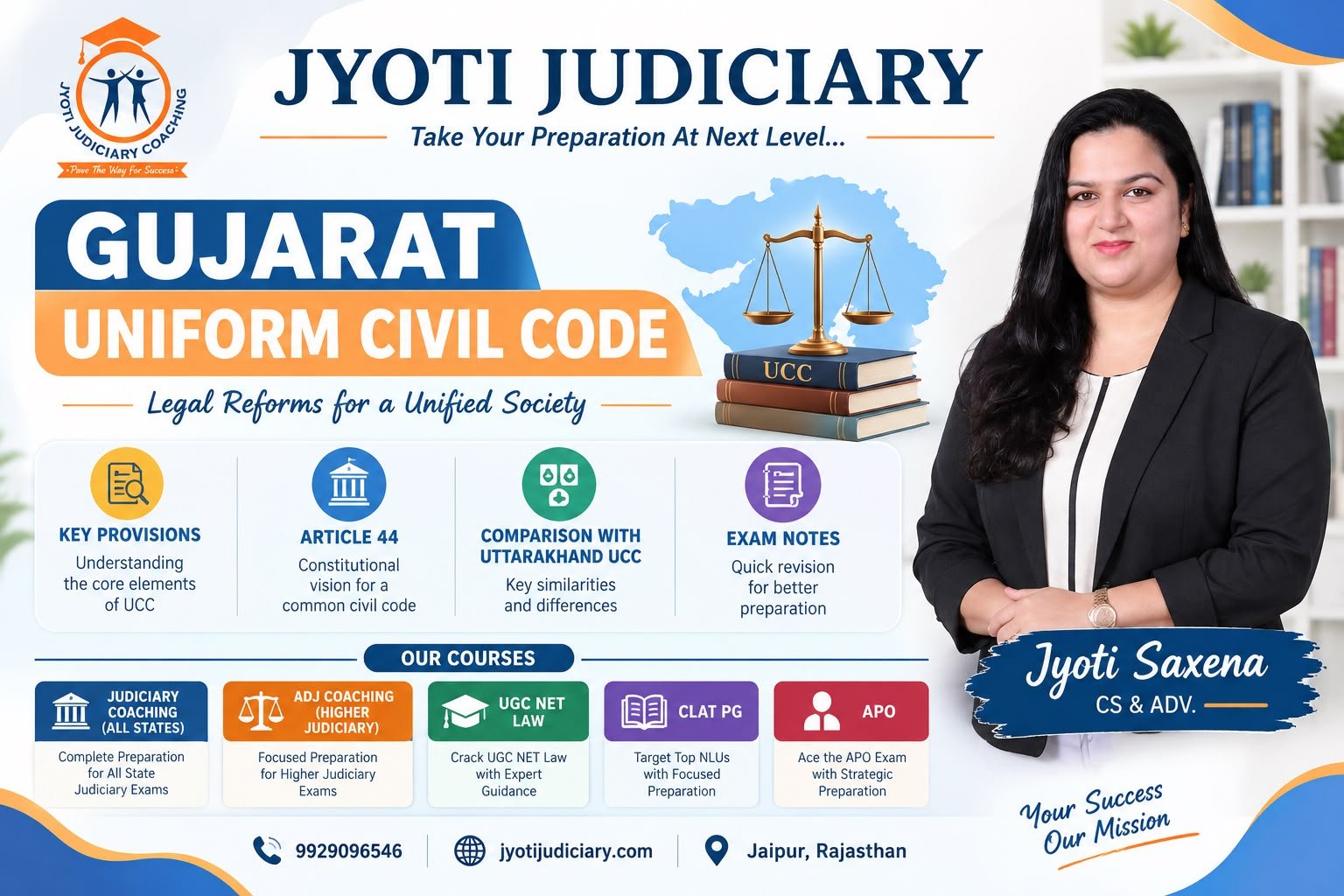
Gujarat UCC 2026 | Gujarat Uniform Civil Code | Second State After Uttarakhand | Article 44 DPSP | Marriage Registration 60 Days | Live-in 30 Days | Polygamy Banned | Justice Ranjana Desai Committee | GJS Exam Current Affairs | March 24 2026
| Gujarat UCC 2026 — Quick Reference: Full name: Gujarat Uniform Civil Code, 2026 Passed: March 24, 2026 — Gujarat Legislative Assembly Duration of debate: 7+ hours | Vote: Majority Gujarat is: Second state in India after Uttarakhand (2024) Four areas covered: 1. Marriage 2. Divorce 3. Succession/Inheritance 4. Live-in Relationships Key provisions at a glance: Marriage registration: Within 60 days — default fine Rs. 10,000 Live-in registration: Within 30 days Polygamy/Bigamy: Strictly banned for all religions Divorce: Only through civil court — no customary divorce Inheritance: Daughters and sons get equal share Triple talaq / Halala: Banned Forced marriage penalty: Up to 7 years imprisonment Exemption: Scheduled Tribes — not covered by Gujarat UCC Extra-territorial: Applies to Gujarat residents living outside Gujarat Committee: Justice (Retd.) Ranjana Prakash Desai — 5-member panel Constitutional basis: Article 44 — Directive Principle of State Policy |
The Gujarat Uniform Civil Code 2026 is the second state-level Uniform Civil Code in India — after Uttarakhand passed its version in February 2024. The Gujarat Legislative Assembly passed the Gujarat Uniform Civil Code Bill, 2026 on March 24, 2026 after a debate lasting over seven hours. The bill was introduced by Chief Minister Bhupendra Patel, based on the recommendations of a five-member committee headed by Justice (Retd.) Ranjana Prakash Desai — the same judge who had headed the Uttarakhand UCC drafting committee. The Gujarat UCC applies to all residents of Gujarat regardless of religion, caste, or creed — replacing religion-based personal laws for marriage, divorce, succession, and live-in relationships with a single uniform framework. Scheduled Tribes are exempted.
Constitutional Basis — Article 44
Article 44 of the Constitution of India is a Directive Principle of State Policy — Part IV — which reads: “The State shall endeavour to secure for the citizens a uniform civil code throughout the territory of India.” Directive Principles are not enforceable in court — unlike Fundamental Rights — but they guide state policy. Article 44 has been referred to in multiple Supreme Court judgments as an unfulfilled constitutional aspiration.
| Supreme Court Cases That Called for UCC — Directly Testable in Exam: Mohd. Ahmed Khan v. Shah Bano Begum (1985): Five-judge bench observed that a common civil code will help the cause of national integration by removing disparate loyalties to laws with conflicting ideologies. The Court noted Parliament must take steps to bring about a UCC. Sarla Mudgal v. Union of India (1995) AIR 1995 SC 1531: Addressed conversion to Islam to take a second wife. SC reiterated the need for a UCC, stating the lack of a uniform code was a major defect in the legal system. Jordan Diengdeh v. S.S. Chopra (1985): SC again expressed the urgent need for enacting a UCC. Article 44 is a DPSP — not a Fundamental Right. Violation of Article 44 cannot be challenged in court. But states can legislate UCC under Entry 5, List III (Concurrent List). |
Key Provisions of Gujarat UCC 2026
| Provision | What the Gujarat UCC Says | Impact on Existing Law |
| Marriage Registration | All marriages must be registered within 60 days of solemnisation. Failure attracts fine up to Rs. 10,000. | Muslim nikahs, Hindu marriages, and Christian marriages — all must now be registered within 60 days in Gujarat. |
| Polygamy / Bigamy Ban | Strictly prohibited for all religions — a person cannot marry while already legally married. | Muslim men who had the right to four wives under Muslim personal law — this right is abolished in Gujarat under the UCC. |
| Divorce — Court Only | No customary, religious, or out-of-court divorce is valid. All divorce must go through civil court. | Talaq-e-biddat (already nationally banned), community panchayat divorce, and other informal dissolution methods are invalid. |
| Equal Inheritance | Sons and daughters get equal shares in property succession — regardless of religion. | Under Muslim inheritance law, daughters get half the share of sons. Under Gujarat UCC, they get equal shares. |
| Live-in Relationships | Must be registered within 30 days of starting cohabitation. Certain protections (maintenance, inheritance) available. | Legalises and regulates live-in relationships — creates rights and responsibilities for partners. |
| Triple Talaq / Halala Ban | Both are banned under the Gujarat UCC civil framework — in addition to existing criminal law ban on triple talaq. | Already banned nationally by SC (Shayara Bano 2017) and by law (Muslim Women Protection Act 2019) — Gujarat UCC adds civil law prohibition. |
| Forced Marriage Penalty | Forced or fraudulent marriage can lead to up to 7 years imprisonment. | New criminal consequence under civil code — not previously available in this form. |
| Scheduled Tribes Exemption | STs and communities with constitutional customary protections are exempted from the Gujarat UCC. | Consistent with Article 342 — tribal communities retain their customary personal laws. |
| Extra-territorial Application | Applies to Gujarat residents living outside Gujarat territorial limits also. | A Gujarat domicile person living in Delhi is still bound by Gujarat UCC for personal matters. |
Gujarat UCC 2026 vs Uttarakhand UCC 2024 — Key Differences
| Parameter | Uttarakhand UCC 2024 | Gujarat UCC 2026 |
| When passed | February 2024 | March 24, 2026 |
| State | Uttarakhand — first state in India | Gujarat — second state in India |
| Committee | Justice Ranjana Prakash Desai | Same — Justice Ranjana Prakash Desai (same chair) |
| Live-in registration period | 30 days | 30 days — same |
| Marriage registration period | Not specified in same form | 60 days explicitly |
| Scope | Marriage, divorce, inheritance, live-in | Same four areas |
| Tribal exemption | Yes — STs exempted | Yes — STs exempted |
| Key difference | First state — model for others | Explicitly bans triple talaq and halala in civil code language — more specific on Muslim personal law displacement |
Impact on Personal Laws in Gujarat
The Gujarat UCC 2026 effectively displaces the following personal laws for Gujarat residents in the four covered areas — marriage, divorce, succession, and live-in relationships:
| Laws Displaced by Gujarat UCC 2026: Hindu Marriage Act 1955 — marriage/divorce provisions displaced for Gujarat Hindus Hindu Succession Act 1956 — succession provisions displaced (though equal inheritance already existed after 2005 amendment for daughters) Muslim Personal Law (Shariat) Application Act 1937 — displaced for Gujarat Muslims in marriage, divorce, inheritance — religion-based personal law no longer applies Indian Christian Marriage Act 1872 — marriage provisions displaced Parsi Marriage and Divorce Act 1936 — displaced Dissolution of Muslim Marriages Act 1939 — displaced IMPORTANT FOR GJS EXAM: The Gujarat UCC displaces personal laws ONLY in Gujarat. Hindu Succession Act, Muslim Personal Law, etc. still apply in states that have NOT enacted a UCC. A Muslim residing in Rajasthan — Muslim personal law applies. A Muslim residing in Gujarat — Gujarat UCC applies. |
Challenges and Criticism
The Gujarat UCC 2026 faced significant opposition in the Assembly and from religious communities. Critics raised three main concerns: first, the UCC threatens religious freedom guaranteed under Article 25 of the Constitution — a Hindu cannot be compelled to abandon religious customs, but UCC effectively does this for personal matters. Second, the lack of consensus among communities — particularly Muslim and tribal communities — raises questions about social legitimacy. Third, constitutional critics argue that while states can legislate personal laws under Entry 5 of the Concurrent List, imposing a uniform code that displaces existing central legislation like the Muslim Personal Law Shariat Application Act 1937 (a central legislation) raises federalism questions.
Exam Angle — What Will Be Asked in GJS and Other Judiciary Exams
| Directly Testable Points — GJS Prelims and Mains 2026: MCQ likely: “Gujarat is the ___ state to pass UCC after Uttarakhand” Answer: Second MCQ likely: “Which committee drafted the Gujarat UCC 2026?” Answer: Justice Ranjana Prakash Desai committee (5-member panel) MCQ likely: “Under Gujarat UCC, within how many days must a live-in relationship be registered?” Answer: 30 days MCQ likely: “Gujarat UCC does NOT apply to which group?” Answer: Scheduled Tribes Mains short note: “Constitutional validity of state-level UCC — Article 44 DPSP vs Article 25 religious freedom” Mains: “Compare Gujarat UCC 2026 with Uttarakhand UCC 2024” Current affairs in GJS interview: CM Bhupendra Patel — “equal laws are essential for national unity and development” |
FAQs — Gujarat UCC 2026
What is the Gujarat Uniform Civil Code 2026?
The Gujarat Uniform Civil Code, 2026 is a state legislation passed by the Gujarat Legislative Assembly on March 24, 2026. It replaces religion-based personal laws for all Gujarat residents with a single uniform legal framework for marriage, divorce, succession and inheritance, and live-in relationships. Gujarat is the second state in India to enact a UCC — after Uttarakhand which passed its version in February 2024. The code bans polygamy and bigamy, mandates marriage registration within 60 days, requires live-in relationship registration within 30 days, and ensures equal inheritance rights for sons and daughters. Scheduled Tribes are exempted from the Gujarat UCC.
Which article of the Constitution is linked to UCC?
Article 44 of the Constitution of India — which is a Directive Principle of State Policy under Part IV — states: “The State shall endeavour to secure for the citizens a uniform civil code throughout the territory of India.” Directive Principles are not enforceable in courts but direct state policy. The Supreme Court in Shah Bano (1985) and Sarla Mudgal (1995) specifically called on Parliament to enact a UCC. States can legislate on personal laws under Entry 5 of the Concurrent List (List III, Seventh Schedule).
Does the Gujarat UCC apply to Muslim personal law?
Yes. The Gujarat UCC applies to all residents of Gujarat regardless of religion — including Muslims. It displaces Muslim personal law in Gujarat for the four covered areas: marriage, divorce, succession, and live-in relationships. Polygamy and bigamy are banned — a Muslim man in Gujarat cannot take a second wife. Triple talaq and halala are banned under the civil framework. Divorce must go through a civil court — oral or customary talaq is not valid in Gujarat. Equal inheritance applies — daughters get the same share as sons, unlike Muslim inheritance law where daughters get half. The Scheduled Tribes exemption does not apply to Muslims.
What is the difference between Uttarakhand UCC and Gujarat UCC?
Both were drafted by the same committee headed by Justice Ranjana Prakash Desai and cover the same four areas — marriage, divorce, succession, and live-in relationships. The key differences: Gujarat UCC explicitly specifies 60 days for marriage registration (Uttarakhand had a similar but differently worded provision). Gujarat UCC more specifically addresses Muslim personal law practices — triple talaq and halala are expressly named and banned in the civil code language. Gujarat is the second state; Uttarakhand was the first in February 2024. Both exempt Scheduled Tribes.
Is Gujarat UCC applicable to Scheduled Tribes?
No. The Gujarat Uniform Civil Code 2026 expressly exempts Scheduled Tribes and communities whose customary rights are protected under Article 342 of the Constitution. This is consistent with constitutional protections for tribal communities — their unique customs, traditions, and personal laws in matters of marriage, inheritance, and succession are protected. The exemption was included to avoid conflict with tribal customary rights and the constitutional framework that specifically protects tribal communities.
Related Articles
→ Muslim Personal Law in India: Marriage, Divorce, Mehr, Maintenance and SC Cases 2026 — Gujarat UCC displaces Muslim personal law for Gujarat residents — compare provisions
→ Hindu Succession Act 1956: Sections, Daughter Rights and SC Cases 2026 — Gujarat UCC equal inheritance — compare with HSA 2005 amendment daughter rights
→ Fundamental Rights in India: Articles 12 to 35 and Judiciary Exam Notes — Article 25 religious freedom vs Article 44 UCC — constitutional tension
→ Domestic Violence Act 2005: Sections, Five Orders and SC Cases — DV Act secular protection — connects to UCC framework for women
→ Best Gujarat Judiciary Coaching — GJS Results — GJS exam 2026 — Gujarat UCC is directly testable in Prelims and Mains current affairs
→ RJS Online Coaching — Live Classes, Answer Writing and Verified Results — UCC current affairs — tested in judiciary mains constitutional law paper
All the best — from Jyoti Judiciary Coaching
Written by Advocate Jyoti Saxena — LLB, LLM, CS, Bar Council of Rajasthan, practising at Jaipur Family Court, Jaipur District Court, and the Rajasthan High Court. Gujarat UCC 2026 facts verified from official Gujarat Assembly records, Gujarat Chief Minister Office press releases, and the report of the Justice Ranjana Prakash Desai committee. SC case citations verified from SCC Online. Contact: +91 99290 96546 | jyotijudiciary.com