Domestic Violence Act 2005: Section 3, Five Orders, Live-In Relationships and Supreme Court Cases
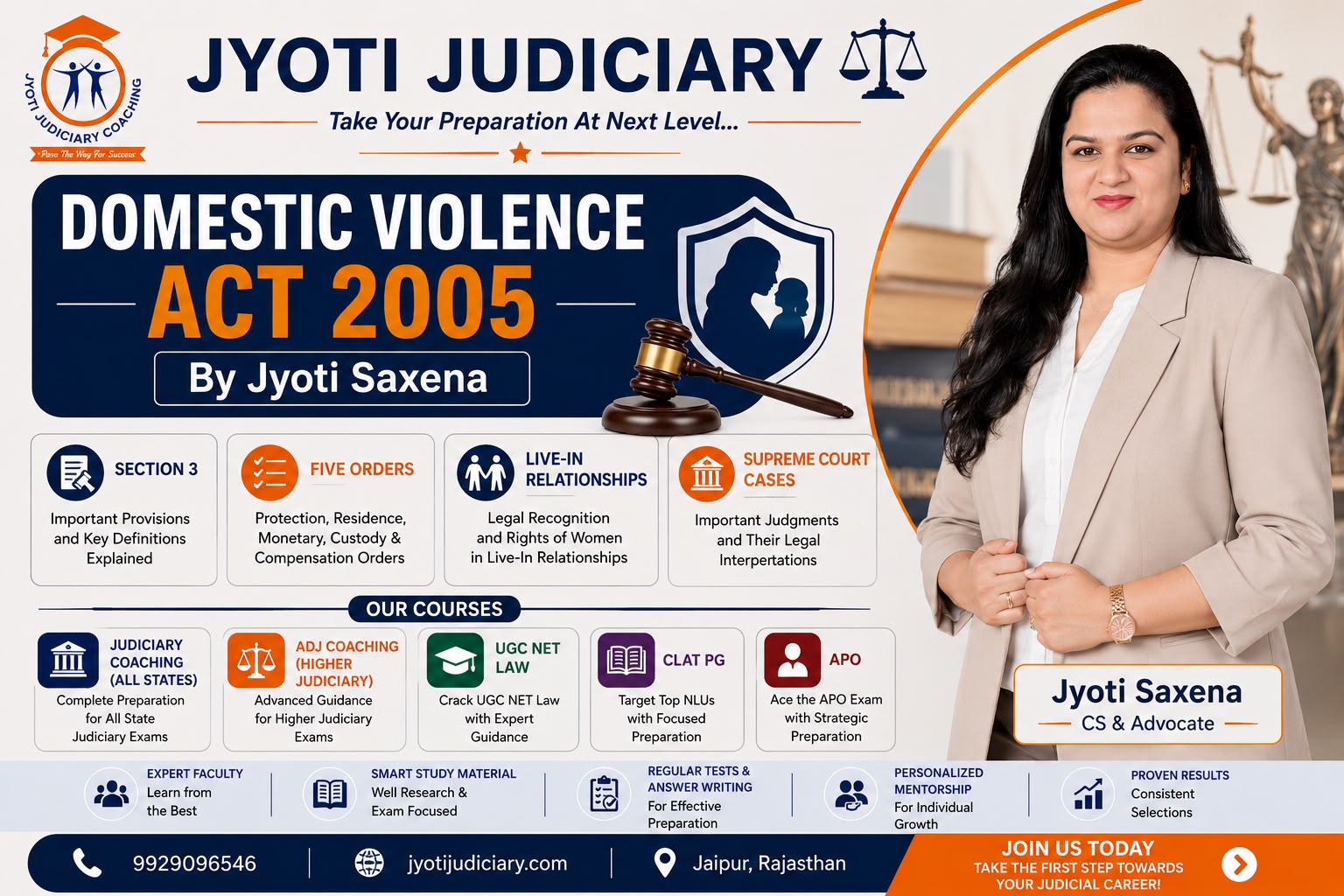
Domestic Violence Act 2005 | PWDVA | Section 3 Definition | Section 12 Application | Five Orders 18-22 | Protection Order | Residence Order | Monetary Relief | Live-In Relationship | SC Cases 2025 | Judiciary Exam Notes | July 2026
| Domestic Violence Act 2005 — Quick Reference: Full name: Protection of Women from Domestic Violence Act, 2005 Short: DV Act or PWDVA | Act No. 43 of 2005 Domestic Violence Act 2005 — Quick Reference: Full name: Protection of Women from Domestic Violence Act, 2005 Short: DV Act or PWDVA | Act No. 43 of 2005 Assented: 13 September 2005 | Commenced: 26 October 2006 Who can apply: Aggrieved person — Section 2(a) — any woman in a domestic relationship who is subject to domestic violence Four types of domestic violence — Section 3: (a) Physical abuse | (b) Sexual abuse (c) Verbal and emotional abuse | (d) Economic abuse Five orders available under the DV Act: Section 18 — Protection Order Section 19 — Residence Order Section 20 — Monetary Relief Section 21 — Custody Order Section 22 — Compensation Order Application filed before: Magistrate (Judicial Magistrate First Class) under Section 12 DV Act Breach of protection order: Section 31 — up to 1 year imprisonment or fine up to Rs. 20,000 or both |
The Protection of Women from Domestic Violence Act 2005 did something that Section 498A IPC alone could never do. Section 498A criminalises cruelty by a husband or his relatives — but it gives the wife no immediate place to stay, no quick order for money, no custody of her children, and no way to keep her husband away from her home while the criminal case drags on for years. The DV Act fills all of these gaps. It is a civil law that gives a woman in a domestic relationship immediate, practical relief — within days of filing an application — without waiting for a criminal conviction.
For judiciary exam candidates, the DV Act appears in Mains civil law papers (for states where it is in the syllabus), in current affairs questions based on recent SC judgments, and as a Prelims MCQ on section numbers and types of relief. The five types of orders — Sections 18 to 22 — are the most tested aspect. This article covers all of them precisely.
Key Definitions — Section 2 DV Act
| Term | Section | Definition |
| Aggrieved person | Section 2(a) | Any woman who is, or has been, in a domestic relationship with the respondent and who alleges to have been subjected to any act of domestic violence by the respondent. |
| Domestic relationship | Section 2(f) | A relationship between two persons who live or have, at any point of time, lived together in a shared household, when they are related by consanguinity, marriage, or through a relationship in the nature of marriage, adoption or are family members living together as a joint family. |
| Respondent | Section 2(q) | Any adult male person who is, or has been, in a domestic relationship with the aggrieved person and against whom the aggrieved person has sought any relief. Relatives of the husband or male partner are also included. |
| Shared household | Section 2(s) | A household where the person aggrieved lives or at any stage has lived in a domestic relationship either singly or along with the respondent, and includes such a household whether owned or tenanted, either jointly by the aggrieved person and the respondent, or owned or tenanted by either of them. |
| Domestic incident report | Section 2(e) | A report made in the prescribed form on receipt of a complaint of domestic violence from an aggrieved person, by a Protection Officer. |
Section 3 — What Is Domestic Violence? Four Types
Section 3 defines domestic violence. Any act, omission, or conduct by the respondent constitutes domestic violence if it falls into one or more of four categories.
| Type | What It Covers | Examples |
| Physical abuse | Any act or conduct which is of such a nature as to cause bodily pain, harm, or danger to life, limb, or health, or impairs the health or development of the aggrieved person, and includes assault, criminal intimidation, and criminal force. | Hitting, slapping, kicking, burning, strangling, pushing. |
| Sexual abuse | Any conduct of a sexual nature that abuses, humiliates, degrades, or otherwise violates the dignity of a woman. | Forcing the woman to watch pornography, forcing sexual acts, sexual insults. |
| Verbal and emotional abuse | Insults, ridicule, humiliation, name-calling, and insults specifically related to the woman not having a child or a male child; repeated threats to cause physical pain to any person in whom the aggrieved person is interested. | Constant criticism, threats to harm her family, insulting her in front of others, threats of divorce or second marriage. |
| Economic abuse | Deprivation of all or any economic or financial resources to which the aggrieved person is entitled; disposal of household effects, assets, stridhan, property; prohibition or restriction on continued access to resources or facilities which the aggrieved person is entitled to use. | Refusing to pay household expenses, taking away her salary or income, preventing her from working, disposing of stridhan. |
| Economic Abuse — The Most Under-Reported Type: Section 3 of the DV Act specifically includes economic abuse — this is a significant departure from the IPC/BNS which does not have a provision specifically addressing financial control within marriage. A husband who refuses to give household money, forces his wife to hand over her salary, prevents her from taking up employment, or disposes of her stridhan — is committing domestic violence under Section 3 DV Act. Exam point: Economic abuse is a distinct fourth type — it is separate from verbal/emotional abuse. Many candidates combine the two. They are separate. |
Section 12 — How to File an Application Under the DV Act
An aggrieved person, a Protection Officer, or any person on behalf of the aggrieved person may present an application to the Magistrate seeking one or more reliefs. The application may be filed before the Magistrate of the area where: (a) the aggrieved person permanently or temporarily resides or carries on business; (b) the respondent permanently or temporarily resides or carries on business; or (c) the cause of action arose.
The Magistrate must fix the date of first hearing within three days of receiving the application. On that date, the Magistrate may require the Protection Officer to prepare a Domestic Incident Report. The Domestic Incident Report (DIR) is not a mandatory pre-condition — the Orissa High Court confirmed in 2024 that a DIR is not required before the Magistrate can grant relief under Section 12.
Five Orders Under the DV Act — Sections 18 to 22
Section 18 — Protection Order
A protection order directs the respondent not to commit any act of domestic violence; not to enter the workplace or school of the aggrieved person or her children; not to communicate with the aggrieved person; not to alienate assets; and not to cause violence to the aggrieved person’s relatives or any person who provides assistance. A protection order, once made, remains in force until the aggrieved person applies for discharge — Section 25(1). Breach of a protection order is a criminal offence under Section 31 — up to 1 year imprisonment or fine up to Rs. 20,000 or both.
Section 19 — Residence Order
A residence order restrains the respondent from dispossessing or disturbing the possession of the aggrieved person from the shared household; directs the respondent to remove himself from the shared household; restrains the respondent or his relatives from entering the portion of the household used by the aggrieved person; directs the aggrieved person’s rent to be paid; and may direct the respondent to secure alternative accommodation for the aggrieved person.
| Right to Reside in Shared Household — Section 17: Every aggrieved person in a domestic relationship has the right to reside in the shared household — regardless of whether she has any right, title, or interest in the household. S.R. Batra v. Taruna Batra (2007 SC): The aggrieved person can claim residence in the shared household. But the shared household must be one where the husband has a right, title, or ownership. A house owned solely by the mother-in-law (not a shared household of the husband) is not covered. Exam point: The husband’s parents’ house is not automatically a “shared household” — it depends on whether the husband has a right in that house. |
Section 20 — Monetary Relief
The Magistrate may direct the respondent to pay monetary relief to meet the expenses incurred and losses suffered by the aggrieved person. This includes: loss of earnings, medical expenses, loss or damage to property, and maintenance for the aggrieved person and her children. Section 20(3) provides that the monetary relief granted must be adequate, fair, and reasonable — and consistent with the standard of living to which the aggrieved person is accustomed.
Key distinction: Maintenance under Section 20 of the DV Act is not linked to the wife’s inability to maintain herself — unlike Section 144 BNSS (was Section 125 CrPC) which requires proof that the wife cannot maintain herself. The Delhi High Court in X and Ors. v. The State and Anr. (2024) confirmed this. This is a direct Mains exam distinction.
Section 21 — Custody Order
The Magistrate may grant temporary custody of any child or children to the aggrieved person or any person making the application on her behalf. The custody order is temporary — it is effective for the duration of the DV proceedings. It does not determine permanent custody which is to be decided by a family court in a separate guardianship/custody proceeding.
Section 22 — Compensation Order
The Magistrate may direct the respondent to pay compensation and damages to the aggrieved person for the injuries — including mental torture and emotional distress — caused by the acts of domestic violence. This is in addition to any monetary relief under Section 20. Compensation under Section 22 is specifically for harm done — it is not maintenance.
| Order | Section | Key Feature | Breach Consequence |
| Protection Order | Section 18 | Restrains respondent from committing violence, entering workplace, communicating with aggrieved person | Section 31 — criminal offence — up to 1 year RI or Rs. 20,000 fine or both |
| Residence Order | Section 19 | Right to remain in shared household regardless of title; can direct respondent to leave | Enforced through Magistrate — respondent can be directed to provide alternative accommodation |
| Monetary Relief | Section 20 | Includes loss of earnings, medical expenses, maintenance for children — not limited by wife ability to maintain | Enforced as arrears of land revenue — Section 28 |
| Custody Order | Section 21 | Temporary custody during DV proceedings | Civil enforcement through Magistrate |
| Compensation Order | Section 22 | For injuries including mental torture and emotional distress | Civil enforcement through Magistrate |
DV Act and Live-In Relationships
The DV Act uses the phrase “relationship in the nature of marriage” — Section 2(f). This is the statutory basis for extending DV Act protection to women in live-in relationships. The question of what constitutes a “relationship in the nature of marriage” — and whether it covers all live-in arrangements or only those meeting specific conditions — has been extensively litigated.
| D. Velusamy v. D. Patchaiammal (2010) 10 SCC 469 — Live-In and DV Act: The Supreme Court held that a “relationship in the nature of marriage” requires: 1. The couple must hold themselves out to the world as if they are spouses. 2. They must be of legal age to marry. 3. They must be otherwise qualified to enter into a legal marriage. 4. They must have voluntarily cohabited and held themselves out as husband and wife for a significant period of time. A casual or walk-in/walk-out relationship does NOT constitute a relationship in the nature of marriage under the DV Act. A man who is already legally married to someone else and lives with a second woman — the second woman may or may not qualify depending on facts. Full case analysis: jyotijudiciary.com/the-case-of-d-velusamy-vs-d-patchaiammal-2010/ |
Indra Sarma v. V.K.V. Sarma (2013) 15 SCC 755 further expanded this — the Supreme Court held that the DV Act applies to a wider range of domestic relationships and cannot be read restrictively. The question of protection must be answered looking at the nature of the cohabitation and the vulnerability of the aggrieved person.
Latest Supreme Court Judgments — 2024 and 2025
1. S. Vijikumari v. Mowneshwarachari C. (2025 SC) — Modification of DV Orders
A bench of Justices B.V. Nagarathna and N. Kotiswar Singh held that for invocation of Section 25(2) of the DV Act — which allows modification or revocation of orders — the change in circumstances must occur after the order is passed. The respondent cannot rely on circumstances that already existed when the order was passed to seek modification. In this case, the Magistrate had ordered Rs. 12,000 per month maintenance and Rs. 1,00,000 as compensation. The respondent sought modification citing changed circumstances — but the SC found no post-order change in circumstances and upheld the original order.
2. DV Act Maintenance vs Section 144 BNSS — Delhi High Court (2024)
The Delhi High Court in X and Ors. v. The State and Anr. (2024) held that maintenance under Section 20(1)(d) of the DV Act is not linked to the wife’s ability or inability to maintain herself — unlike Section 144 BNSS (formerly Section 125 CrPC). Under Section 125 CrPC / Section 144 BNSS, maintenance requires proof that the wife cannot maintain herself. Under Section 20 DV Act, no such proof is needed — it is based on the standard of living and the domestic violence alone. This distinction is directly testable in judiciary Mains as a comparison question.
3. Section 31 — Breach of Protection Order (HP HC, 2025)
The Himachal Pradesh High Court in Akshay Thakur v. State of H.P. (2025) held that Section 31 of the DV Act — which criminalises breach of orders — applies only to protection orders under Section 18. It does not apply to non-compliance with maintenance orders (Section 20), compensation orders (Section 22), or residence orders (Section 19). For enforcement of those orders, the Magistrate has separate enforcement mechanisms under Section 28. This is an important distinction for Mains — Section 31 is a specific provision, not a general enforcement tool.
DV Act vs Section 498A IPC / Section 85 BNS — Key Differences
| Parameter | DV Act 2005 | Section 498A IPC / Section 85 BNS |
| Nature | Civil law — proceedings before Magistrate for civil relief | Criminal law — FIR, arrest, bail, trial, conviction, imprisonment |
| Purpose | Protection and relief — immediate orders to protect the woman | Punishment — criminalises cruelty by husband or relatives |
| Immediate relief | Yes — protection order, residence order can be passed within days | No — relief comes only after conviction which takes years |
| Who files | Aggrieved person, Protection Officer, or any person on her behalf | FIR filed by victim or by police (cognizable offence) |
| Burden of proof | Civil standard — balance of probabilities | Criminal standard — beyond reasonable doubt |
| Punishment for respondent | Section 31 — breach of protection order only — 1 year or Rs.20,000 | Section 85 BNS — imprisonment up to 3 years + fine on conviction |
| Can both be filed? | Yes — same facts can attract both. Section 498A/85 BNS FIR and DV Act application can run simultaneously. | Yes — filing DV Act application does not bar filing Section 498A/85 BNS complaint |
Frequently Asked Questions — Domestic Violence Act 2005
Domestic Violence Act 2005 kya hai? (What is the DV Act?)
Protection of Women from Domestic Violence Act 2005 — ya DV Act — ek civil kanoon hai jo vivahit ya domestic relationship mein rahne wali mahilaon ko ghar ke andar hone wali hinsa se bachata hai. Yeh 26 October 2006 se lagu hua. Iske antargat physical, sexual, verbal/emotional, aur economic — charon prakar ki hinsa covered hai. Peedit mahila Magistrate ke paas Section 12 ke antargat application daakhil karke 5 prakar ke orders pa sakti hai: protection order, residence order, monetary relief, custody order, aur compensation order.
What are the five orders available under the DV Act?
The five orders available under the Protection of Women from Domestic Violence Act 2005 are: (1) Protection Order under Section 18 — restrains the respondent from committing domestic violence or contacting the aggrieved person; (2) Residence Order under Section 19 — protects the aggrieved person’s right to remain in or be provided alternative accommodation in the shared household; (3) Monetary Relief under Section 20 — for expenses, loss of earnings, medical expenses, and maintenance; (4) Custody Order under Section 21 — temporary custody of children; (5) Compensation Order under Section 22 — for injuries including mental torture and emotional distress. All five can be sought in a single application under Section 12.
Does the DV Act apply to live-in relationships?
Yes. The DV Act uses the phrase “relationship in the nature of marriage” in the definition of domestic relationship under Section 2(f). This covers live-in relationships — but with conditions. The Supreme Court in D. Velusamy v. D. Patchaiammal (2010) 10 SCC 469 held that a “relationship in the nature of marriage” requires: the couple must hold themselves out as spouses, they must be of legal age to marry, both must be otherwise qualified to enter into a legal marriage, and they must have voluntarily cohabited for a significant period. A casual or temporary arrangement does not qualify.
What is the difference between DV Act maintenance and Section 144 BNSS maintenance?
Maintenance under Section 20(1)(d) of the DV Act does not require the wife to prove that she cannot maintain herself — it is based on the standard of living and the domestic violence. Maintenance under Section 144 BNSS (formerly Section 125 CrPC) requires proof that the wife is unable to maintain herself. The Delhi High Court confirmed this distinction in 2024. Both can be claimed simultaneously — a woman is not barred from claiming maintenance under the DV Act merely because she has claimed maintenance under Section 144 BNSS.
What is the punishment for breach of a protection order under the DV Act?
Section 31 of the DV Act makes breach of a protection order (Section 18) or an interim protection order a criminal offence. The punishment is imprisonment for up to one year or a fine up to Rs. 20,000 or both. The Himachal Pradesh High Court in Akshay Thakur v. State of H.P. (2025) clarified that Section 31 applies specifically to breach of protection orders — not to non-compliance with maintenance, compensation, or residence orders, which are enforced separately.
Related Articles
→ D. Velusamy v. D. Patchaiammal (2010) — Live-In Relationship and DV Act — Full case analysis — what qualifies as a relationship in the nature of marriage under DV Act
→ Dowry Death: Section 80 BNS, Section 304B IPC and Supreme Court Cases — DV Act and dowry death often overlap — Section 3 economic abuse connects to dowry demands
→ Zero FIR Meaning: Section 173 BNSS, How to File and 2025 Supreme Court Cases — DV Act applications can be supported by zero FIR under Section 173 BNSS
→ BNSS vs CrPC: Complete Section-Wise Comparison for Judiciary Exam — Section 144 BNSS maintenance vs DV Act Section 20 maintenance — key Mains comparison
→ Fundamental Rights in India: Articles 12 to 35 and Judiciary Exam Notes — Article 21 right to life and dignity — constitutional foundation of DV Act
→ RJS Online Coaching — Live Classes and Verified Results — DV Act is tested in RJS Mains civil law paper — live online preparation
→ Best Gujarat Judiciary Coaching — GJS Results — DV Act appears in GJS Mains personal laws and special laws paper
→ Best Haryana Judiciary Coaching — HJS Exam Pattern and Online Classes — DV Act is in HJS Mains Paper II under personal laws and special laws
All the best — from Jyoti Judiciary Coaching
Written by Advocate Jyoti Saxena — LLB, LLM, CS, Bar Council of Rajasthan, practising at Jaipur Family Court, Jaipur District Court, and the Rajasthan High Court. DV Act applications and protection order matters are part of family court practice in Rajasthan. All references verified from the Protection of Women from Domestic Violence Act 2005 (Act No. 43 of 2005). Supreme Court case citations verified from SCC Online and main.sci.gov.in. Contact: +91 99290 96546 | jyotijudiciary.com