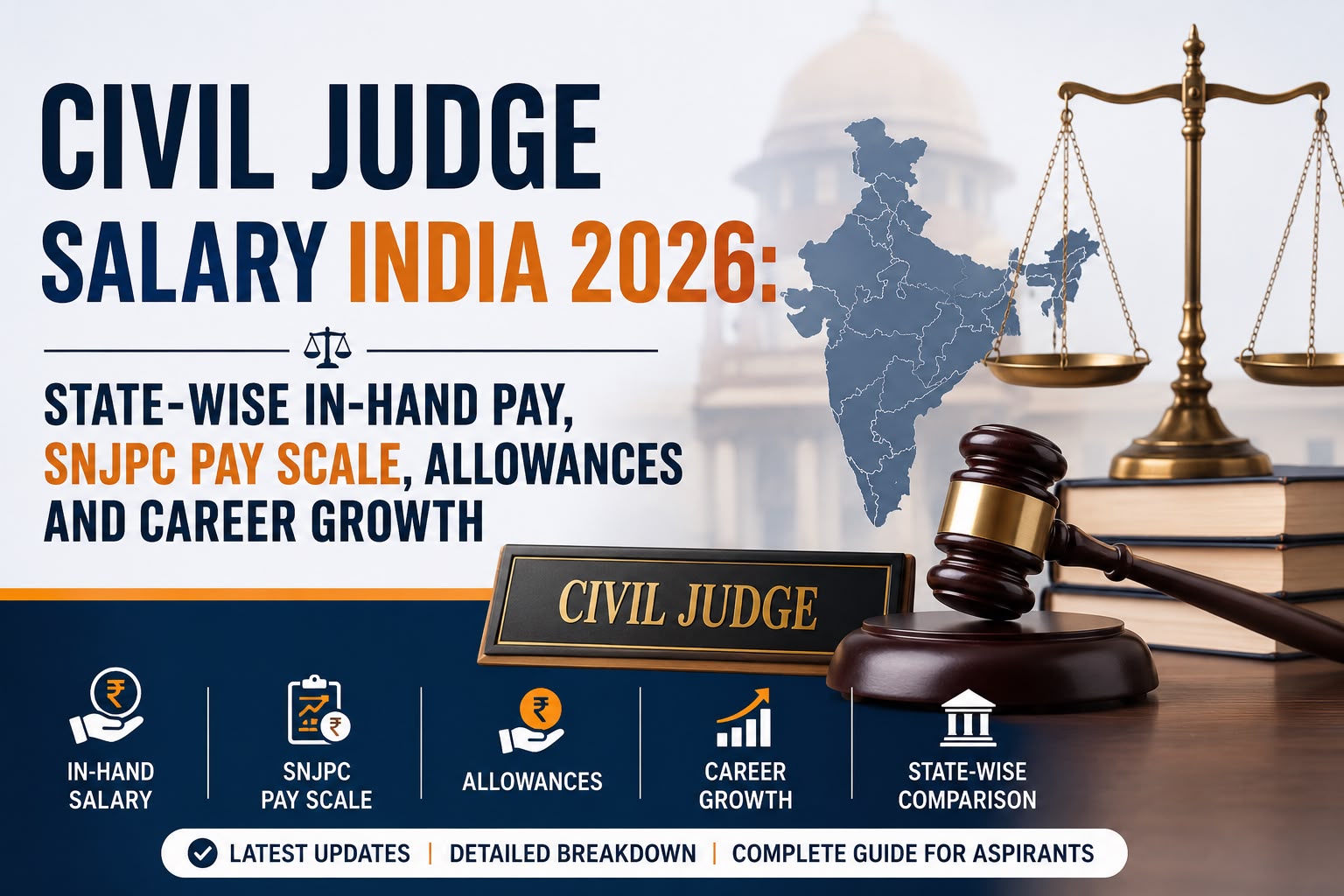
Civil Judge Salary India 2026: State-Wise In-Hand Pay, SNJPC Pay Scale, Allowances and Career Growth
Civil Judge Salary 2026 | Civil Judge Salary India | State Wise Salary | In-Hand Salary | SNJPC Pay Scale | RJS GJS HJS UP PCS J | Allowances Perks | Career Growth | District Judge Salary | Jyoti Judiciary | Last Updated July 2026
| Civil Judge Salary 2026 — Key Facts: Entry-level basic pay (all states): Rs. 77,840 per month Pay scale: Rs. 77,840 to Rs. 1,36,520 (Civil Judge Junior Division) Authority: Second National Judicial Pay Commission (SNJPC) — accepted by Supreme Court on 27 July 2022; review petition dismissed April 2023 Why basic pay is the same in all states: The SNJPC sets a uniform pay matrix for all district judiciary judges across India. A Civil Judge in Rajasthan, Gujarat, Haryana, UP, Bihar, Delhi — all draw the same basic pay of Rs. 77,840 at entry level. Gross monthly salary: Approximately Rs. 1,10,000 to Rs. 1,20,000 (basic + DA at current rate + allowances depending on posting city) In-hand salary (after deductions): Approximately Rs. 85,000 to Rs. 1,05,000 Key perks beyond salary: Government accommodation or HRA | Official vehicle Sumptuary allowance | Orderly/domestic helper | Medical benefits | Constitutionally protected security of tenure | Pension on retirement |
The first thing most people search for before deciding whether to prepare for the judiciary is the salary. That is a reasonable place to start — but the answer many sites give is wrong. Several coaching websites still show a basic pay of Rs. 27,700 for civil judges. That figure is outdated. It comes from the period before the Second National Judicial Pay Commission recommendations were implemented. The correct entry-level basic pay for a Civil Judge (Junior Division) in India as of 2026 is Rs. 77,840 per month — uniform across all states after SNJPC implementation.
This article gives you the verified pay structure, explains what differs state-wise (it is not the basic pay — it is the perks and allowances), and traces the full salary growth from Civil Judge to District Judge. Where the Jyotijudiciary.com Rajasthan civil judge salary page covers Rajasthan specifically, this page covers the national picture and the state-wise comparison.
Why All States Have the Same Basic Pay — SNJPC Explained
Before 2016, judicial pay varied state to state and the subordinate judiciary across India was significantly underpaid relative to its responsibilities. The Supreme Court in All India Judges Association v. Union of India directed the constitution of the Second National Judicial Pay Commission to address this. The Commission submitted its report recommending a uniform national pay matrix for district judiciary judges. The Supreme Court accepted the recommendations on 27 July 2022. A review petition was dismissed in April 2023, making the SNJPC pay structure final.
This is why a Civil Judge in Rajasthan and a Civil Judge in Bihar draw the same basic pay. The exam is different, the High Court conducting recruitment is different, the state rules for perks are different — but the basic pay follows the same SNJPC matrix everywhere. Coaching institutes and websites that still quote Rs. 27,700 as the civil judge basic pay are citing pre-SNJPC data that has not been updated.
| Common Wrong Data on Multiple Sites — Corrected: Wrong: Civil Judge basic pay = Rs. 27,700 Correct: Civil Judge (JD) entry basic pay = Rs. 77,840 (SNJPC) Wrong: Bihar civil judge salary is lower than Rajasthan Correct: Basic pay is the same — Rs. 77,840 — in Bihar and Rajasthan Wrong: 7th Pay Commission governs judicial salaries Correct: SNJPC (Second National Judicial Pay Commission) governs district judiciary pay — separate from the 7th CPC which governs executive and legislative government employees |
SNJPC Pay Scale — Civil Judge to District Judge
| Cadre / Post | Basic Pay Range (Rs.) | Pay Level |
| Civil Judge (Junior Division) — Entry Level | 77,840 — 1,36,520 | J-1 |
| Civil Judge (Junior Division) — ACP 1 (after approx. 5 years) | Increment within J-1 matrix | J-1 (advanced stage) |
| Civil Judge (Senior Division) — After promotion | 1,11,000 — 1,94,660 | J-2 |
| District Judge — Entry Level (through promotion from civil judge cadre) | 1,44,840 — 1,94,660 | J-3 |
| District Judge — Super Time Scale | 1,82,200 — 2,24,100 | J-4 |
| High Court Judge (appointed by President — not through exam) | 2,25,000 (fixed by Parliament) | Constitutional post |
| Chief Justice of High Court | 2,50,000 (fixed by Parliament) | Constitutional post |
| Supreme Court Judge | 2,50,000 (fixed by Parliament) | Constitutional post |
| Chief Justice of India | 2,80,000 (fixed by Parliament) | Constitutional post |
High Court and Supreme Court judges are not appointed through the district judiciary examination route. They are appointed by the President of India on the recommendation of the collegium. The pay of constitutional court judges is fixed by Parliament under the High Court Judges (Salaries and Conditions of Service) Act and the Supreme Court Judges (Salaries and Conditions of Service) Act as amended in 2018. These figures are shown above for career context — a civil judge entering at Rs. 77,840 can, over a career of 25-30 years, reach the District Judge Super Time Scale at Rs. 2,24,100 basic pay.
Gross Salary and In-Hand Salary — How the Numbers Work
Basic pay of Rs. 77,840 is only the starting point. The actual amount a civil judge receives each month is the result of adding allowances to the basic pay and then subtracting deductions.
| Component | Amount / Rate | Notes |
| Basic Pay | Rs. 77,840/month | Uniform SNJPC rate — entry level, all states |
| Dearness Allowance (DA) | ~50% of basic pay (as of mid-2026) | DA is revised twice a year — January and July. Rate changes with CPI index. Currently approximately Rs. 38,920/month at 50% DA. |
| House Rent Allowance (HRA) | 8% to 24% of basic pay depending on city category | X cities (Delhi): 24%. Y cities (state capitals): 16%. Z cities (other): 8%. NOT paid if government accommodation is provided. |
| Sumptuary Allowance | Rs. 3,500 to Rs. 7,000/month approximately (varies by state and cadre) | A fixed monthly allowance for the social obligations of a judicial officer — paid as cash. State rules differ. |
| Medical Allowance | As per state rules — typically Rs. 1,000–2,000/month fixed or full reimbursement | Some states have full medical reimbursement; others have fixed monthly amounts. |
| Travel Allowance | As per state rules for official duty travel | Not part of monthly take-home — reimbursed on actual travel. |
| Gross Salary (approx.) | Rs. 1,10,000 to Rs. 1,30,000/month | Varies by city category and DA rate. Higher in metro postings. |
| Deductions | NPS contribution (~10% of basic+DA) + Professional Tax + Income Tax | Total deductions typically Rs. 15,000–25,000/month at entry level. |
| In-Hand Salary (approx.) | Rs. 85,000 to Rs. 1,05,000/month | Net after all deductions. Higher in metro cities due to higher HRA. |
State-Wise Civil Judge Salary Comparison 2026
The basic pay is the same in all states. What differs is: (1) which city category the posting falls in — which determines HRA; (2) whether government accommodation is provided or HRA is paid; (3) the state-specific perks like orderly/domestic helper, petrol allowance, vehicle availability; and (4) whether the state follows the Old Pension Scheme (OPS) or the National Pension System (NPS).
| State / Exam | Basic Pay (Entry) | Approx. In-Hand | Key State-Specific Feature |
| Rajasthan (RJS) | Rs. 77,840 | Rs. 85,000 — Rs. 1,00,000 | NPS applies. Government accommodation or HRA. Orderly allowed. Sumptuary allowance. Petrol/vehicle allowance for official use. Full article: jyotijudiciary.com/rajasthan-civil-judge-salary-2026/ |
| Gujarat (GJS) | Rs. 77,840 | Rs. 85,000 — Rs. 1,05,000 | NPS applies. Government accommodation widely available. Gujarati language proficiency required for posting. Sumptuary allowance as per HC rules. |
| Haryana (HJS) | Rs. 77,840 | Rs. 85,000 — Rs. 1,05,000 | NPS applies. Government accommodation in district postings. Interview 200 marks — highest interview weightage among state judiciary exams. Upper age limit 42 years. |
| Uttar Pradesh (UP PCS J) | Rs. 77,840 | Rs. 85,000 — Rs. 1,10,000 | NPS applies. Free furnished government accommodation in most postings — HRA not paid when accommodation provided. Domestic helper and official vehicle available. Hindi/English interview. |
| Bihar (BPSC Judiciary) | Rs. 77,840 | Rs. 80,000 — Rs. 1,00,000 | NPS applies. Government accommodation available. State-specific local law paper makes preparation distinct. Some sources incorrectly cite Rs. 27,700 — that is pre-SNJPC outdated data. |
| Delhi (DJS) | Rs. 77,840 | Rs. 1,00,000 — Rs. 1,20,000 | NPS applies. X category city — HRA at 24% of basic = ~Rs. 18,682/month extra. Highest take-home among states due to metro HRA. Upper age limit 32 years — youngest eligibility age bar. |
| Madhya Pradesh (MPCJ) | Rs. 77,840 | Rs. 85,000 — Rs. 1,00,000 | NPS applies. Government accommodation in district postings. One of the largest subordinate judiciary cadres in India. |
| Maharashtra (MJS) | Rs. 77,840 | Rs. 85,000 — Rs. 1,05,000 | NPS applies. Mumbai postings get X category HRA. High cost of living in metro postings somewhat offset by higher HRA. |
| Why Delhi In-Hand Salary Is Highest — The HRA Difference: All civil judges get the same basic pay of Rs. 77,840. But Delhi is an X category city — HRA is 24% of basic pay. 24% of Rs. 77,840 = Rs. 18,682 per month extra in HRA alone. Compare with a Z category district posting in any state: HRA is 8% of Rs. 77,840 = Rs. 6,227 per month. The HRA difference alone = Rs. 12,455 per month between a Delhi posting and a small district posting in any state. However: If government accommodation is provided, HRA is not paid. Most district postings (outside metros) provide government accommodation. Delhi civil judges typically draw HRA because accommodation is scarce. |
Perks Beyond Salary — What the Money Cannot Show
The salary figures above are one part of the compensation picture. Civil judges receive a package of non-monetary perks that significantly add to the overall value of the position — and these are the things most salary articles do not explain properly.
| Perk | What It Means | State-Wise Variation |
| Government Accommodation | Furnished government bungalow or judicial officer quarters in the district of posting — at nominal or no rent | Available in most district postings. In metro cities (Mumbai, Delhi) it may not be available — HRA is paid instead. |
| Official Vehicle | Car provided for official use with driver, or petrol allowance for self-owned vehicle | Varies by state and cadre level. Civil Judge JD may get vehicle allowance; District Judges typically get a full vehicle with driver. |
| Orderly / Domestic Helper | One or more orderlies/helpers assigned to the judge for household assistance during the posting | All India Judges Association v. Union of India — SC has directed provision of domestic helpers for district judiciary. Implementation varies by state. |
| Security of Tenure | A Civil Judge cannot be removed except through a High Court Inquiry — constitutionally protected | Uniform across all states — Article 235 of the Constitution. This is one of the most significant aspects of judicial service compared to executive government employment. |
| Pension / Retirement | NPS (National Pension System) in most states — 10% of basic + DA contributed monthly, with matching state contribution. Some older states still follow OPS. | States that moved to NPS: Rajasthan (2004), UP (2005), Gujarat (2005). Bihar implemented NPS for new recruits. Check specific notification for the batch you are applying in. |
| Medical Benefits | Medical facilities for the judicial officer and eligible family members — typically covered under state government health scheme | Varies by state — some states have full reimbursement, others have CGHS equivalent, others have fixed monthly amounts. |
| Leave Benefits | Annual leave, casual leave, medical leave, maternity/paternity leave, earned leave encashment | Broadly follows state government rules but judicial officers have some specific leave provisions under High Court rules. |
| Judicial Training | Mandatory judicial training at state judicial academies before taking charge — during which stipend is paid | NLSIU Bangalore, state judicial academies — structured induction training programme. |
Career Growth — Civil Judge to District Judge
A Civil Judge entering at Rs. 77,840 basic pay does not stay at that salary for the whole career. The judicial career follows a defined promotion pathway.
| Stage | Typical Time | Basic Pay at Stage | How Promotion Happens |
| Civil Judge (Junior Division) | Entry — years 1 to 8 approximately | Rs. 77,840 to Rs. 1,36,520 (within JD scale via increments) | Entry through competitive exam — RJS, GJS, HJS, UP PCS J, etc. |
| Civil Judge (Senior Division) | After 8-12 years approximately — depends on state cadre rules | Rs. 1,11,000 to Rs. 1,94,660 | Promotion based on seniority-cum-merit through High Court evaluation. Three judgment assessment typically required. |
| District Judge (by promotion) | After 15-20 years of service approximately | Rs. 1,44,840 to Rs. 1,94,660 | Promotion from Senior Civil Judge cadre through High Court selection process. Competitive — not all Senior Civil Judges reach District Judge level. |
| District Judge (Super Time Scale) | After 25 years or more | Rs. 1,82,200 to Rs. 2,24,100 | Time-based increment within District Judge scale — seniority and performance. |
| High Court Judge | By Presidential appointment — collegium recommendation | Rs. 2,25,000 (fixed by Parliament) | Not through promotion from district judiciary as of right — selected by Supreme Court collegium. Only a fraction of District Judges reach this level. |
Civil Judge Salary vs Practicing Advocate Income — Honest Comparison
This is the comparison every aspirant actually wants — and almost no article gives it honestly. Should you leave practice to become a civil judge?
At the entry level of 2-5 years of practice, most advocates in non-metro cities earn between Rs. 20,000 and Rs. 60,000 per month from practice — including consultation fees, court appearances, and drafting. Very few earn more than Rs. 1 lakh at this stage in cities like Jaipur, Patna, or Nagpur. The civil judge salary of Rs. 85,000 to Rs. 1,05,000 in-hand is significantly more than what most advocates at 2-5 years earn.
At 7-10 years of practice, income varies widely. An advocate who has built a strong practice in commercial courts, high court, or a specialised area may earn Rs. 1.5 to 5 lakh per month. For such advocates, the civil judge salary is a step down in pure cash terms — but the security of tenure, pension, accommodation, and social standing offset the financial difference for many.
| What Jyoti Judiciary Coaching Candidates Have Said About This Question: Deepika Kacholia (5th Rank RJS 2024): Was in practice before RJS — the structured lifestyle and security of judicial service was the deciding factor. Aditya Gaur (1st Rank GJS 2022): Chose GJS over further corporate practice — the accommodation, judicial recognition, and long-term career clarity. The financial calculation is one input. The lifestyle, security, social standing, constitutional protection of tenure, and the nature of the work itself are factors that most candidates rate equally with or above the salary figure. Jyoti Judiciary Coaching | Vaishali Nagar, Jaipur | +91 99290 96546 Live online classes accessible from anywhere in India. |
Frequently Asked Questions — Civil Judge Salary India 2026
Civil judge ki salary kitni hoti hai India mein?
India mein ek Civil Judge (Junior Division) ki entry-level basic salary Rs. 77,840 per month hai — Second National Judicial Pay Commission (SNJPC) ke anusaar, jo Supreme Court ne 27 July 2022 ko accept kiya. DA aur allowances milane ke baad gross salary approximately Rs. 1,10,000 se Rs. 1,30,000 per month hoti hai. In-hand salary (deductions ke baad) approximately Rs. 85,000 se Rs. 1,05,000 per month hoti hai depending on posting city. Salary ke alawa government accommodation, official vehicle, sumptuary allowance, aur medical benefits bhi milte hain.
Kya civil judge salary sab states mein alag alag hoti hai?
Basic pay sab states mein same hai — Rs. 77,840 entry level. SNJPC ne ek uniform pay matrix banaya hai jo sab states mein lagu hai. Jo alag hota hai woh hai HRA rate (posting city ke hisaab se), government accommodation availability, aur state-specific perks jaise orderly, petrol allowance, aur pension scheme (NPS ya OPS). Delhi mein HRA zyada milta hai kyunki woh X category city hai. Isliye Delhi mein in-hand salary zyada hoti hai baaki states ke compared to.
What is the in-hand salary of a civil judge in 2026?
The approximate in-hand salary (after all deductions including NPS contribution, professional tax, and income tax) for a Civil Judge (Junior Division) at entry level in 2026 is Rs. 85,000 to Rs. 1,05,000 per month. The exact amount depends on the posting city — judges in X category cities like Delhi receive higher HRA (24% of basic) which increases in-hand pay, while judges in smaller district postings typically receive government accommodation instead of HRA. Where government accommodation is provided, HRA is not paid separately.
Is the Bihar civil judge salary different from Rajasthan?
No. After SNJPC implementation, the basic pay for civil judges in Bihar and Rajasthan is the same — Rs. 77,840 at entry level. Several websites incorrectly show Bihar civil judge salary as Rs. 27,700 — that is pre-SNJPC outdated data. The SNJPC uniform pay matrix applies to Bihar as much as it does to Rajasthan, Gujarat, or any other state. What differs between Bihar and Rajasthan postings is the availability of government accommodation, state-specific perks, and whether the posting is in a higher or lower HRA category city.
What are the perks of a civil judge beyond salary?
Beyond the monthly salary, a Civil Judge receives: government furnished accommodation in the district of posting (or HRA if accommodation is not available), official vehicle with driver or petrol allowance, sumptuary allowance of approximately Rs. 3,500 to Rs. 7,000 per month, domestic helper/orderly assigned to the residence, medical benefits for self and eligible family, constitutionally protected security of tenure (cannot be removed except through a High Court inquiry), pension on retirement, and various leave benefits. The non-monetary value of these perks — particularly the accommodation, security of tenure, and pension — is substantial.
Related Articles
→ How to Become a Judge in India: Complete 2026 Guide with the 3-Year Practice Rule — Step-by-step career path from LLB to Civil Judge — eligibility, exam, and career progression
→ Judiciary Exam Eligibility 2026: State-Wise Age Limit and 3-Year Practice Rule — Age limits, 3-year practice requirement, domicile rules — all states compared
→ Best Haryana Judiciary Coaching — HJS Exam Pattern and Online Classes — HJS age limit 42 years — highest among major states — and salary same as others
→ Best Gujarat Judiciary Coaching — GJS Results — GJS salary structure and Aditya Gaur 1st Rank GJS 2022 — Jyoti Judiciary results
→ BNSS vs CrPC: Complete Section-Wise Comparison for Judiciary Exam — New criminal codes for judiciary exam — essential preparation alongside salary research
→ RJS Online Coaching — Live Classes and Verified Results — Deepika Kacholia 5th Rank RJS 2024 — live online coaching for judiciary aspirants
All the best — from Jyoti Judiciary Coaching
Written by Advocate Jyoti Saxena — LLB, LLM, CS, Bar Council of Rajasthan, practising at Jaipur Family Court, Jaipur District Court, and the Rajasthan High Court. 12 years of judiciary coaching experience. 468+ total selections across RJS, GJS, UKJS, Bihar Judiciary, and UP PCS J. All salary data based on SNJPC pay matrix as accepted by the Supreme Court on 27 July 2022. Contact: +91 99290 96546 | jyotijudiciary.com | B/135, Chitrakoot, Vaishali Nagar, Jaipur 302021.
Salary data is based on the Second National Judicial Pay Commission (SNJPC) pay matrix as accepted by the Supreme Court on 27 July 2022 in All India Judges Association v. Union of India, and confirmed after dismissal of review petition in April 2023. DA and HRA figures are approximate based on rates applicable as of July 2026. Verify current DA rates from official state government notifications before relying on gross/in-hand salary estimates.