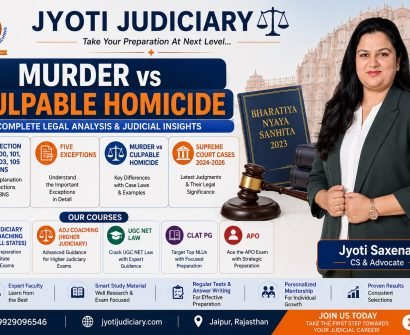
Murder vs Culpable Homicide: Section 100, 101, 103, 105 BNS, Five Exceptions and Supreme Court Cases
Murder vs Culpable Homicide | Section 100 101 103 105 BNS | Section 299 300 302 304 IPC | Difference | Five Exceptions | Rarest of Rare | SC Cases | Judiciary Exam Notes | Last Updated July 2026
| Murder vs Culpable Homicide — Quick Reference: Culpable homicide: Section 100 BNS (was Section 299 IPC) Murder: Section 101 BNS (was Section 300 IPC) Punishment for murder: Section 103 BNS (was Section 302 IPC) Punishment for culpable homicide not amounting to murder: Section 105 BNS (was Section 304 IPC) Fundamental rule: All murders are culpable homicides. But not all culpable homicides are murders. Culpable homicide = genus | Murder = species What converts culpable homicide into murder: Section 101 BNS — four clauses What converts murder back to culpable homicide: Section 101 BNS — five exceptions Punishment — Section 103 BNS (Murder): Death penalty OR imprisonment for life + fine Punishment — Section 105 BNS (Culpable homicide not amounting to murder): Part I (intention to cause death): Life OR 5-10 years + fine Part II (knowledge without intention): Up to 10 years + fine |
The single question that determines whether an accused hangs or goes home in ten years is this: was the killing a murder under Section 101 BNS or culpable homicide not amounting to murder under Section 100 BNS? The difference is not about how many wounds were inflicted or how brutal the act was. It is about the precise degree of intention and knowledge the accused carried at the moment of the act. Courts have spent over a century — first under IPC and now under BNS — trying to locate that line. The Supreme Court cases below show how the line is actually drawn in practice.
Section 100 BNS — What Is Culpable Homicide?
Section 100 of the Bharatiya Nyaya Sanhita 2023 defines culpable homicide as causing the death of a person by doing an act: (a) with the intention of causing death; or (b) with the intention of causing such bodily injury as is likely to cause death; or (c) with the knowledge that the act is likely to cause death.
These three mental states — intention to cause death, intention to cause fatal injury, and knowledge that death is likely — are the entire foundation of culpable homicide. Every killing that is not accidental, self-defensive, or legally justified will fall into one of these three categories. Once it falls into one of these three, it is culpable homicide. The next question is whether it is murder.
| Section 100 BNS — Three Explanations (Direct Prelims MCQ Points): Explanation 1: A person who causes bodily injury to another who is suffering from a disorder or disease, and death results from the combined effect of the bodily injury and the pre-existing condition — has caused the death. Explanation 2: Where death is caused by bodily injury, the person who causes the injury is liable even if by resorting to proper medical treatment or surgical treatment the death might have been prevented. Explanation 3: Causing the death of an unborn child is not homicide under Section 100. BUT if any part of the child has been brought forth — even if the child has not breathed — causing that death may amount to culpable homicide. |
Section 101 BNS — When Does Culpable Homicide Become Murder?
Section 101 BNS identifies four situations where culpable homicide crosses over into murder. If any one of the four applies, the killing is murder under Section 103 BNS.
| Clause | When Culpable Homicide = Murder | What This Means |
| Clause 1 (Intention to cause death) | The act by which death is caused is done with the intention of causing death. | Straightforward — person intends to kill. If A shoots B in the head intending to kill, it is murder. |
| Clause 2 (Intention to cause fatal bodily injury) | The act is done with the intention of causing such bodily injury as the offender knows to be likely to cause the death of the person to whom the harm is caused. | Accused knows the specific injury they intend to inflict on this specific person will likely cause death. Established in Virsa Singh v. State of Punjab (AIR 1958 SC 465). |
| Clause 3 (Intention to cause sufficient bodily injury) | The act is done with the intention of causing bodily injury to any person, and the bodily injury intended to be inflicted is sufficient in the ordinary course of nature to cause death. | The intended injury is objectively sufficient to cause death in the ordinary course of nature — even if the accused did not know it. Objective test. |
| Clause 4 (Knowledge of imminently dangerous act) | The person committing the act knows that it is so imminently dangerous that it must in all probability cause death, or such bodily injury as is likely to cause death, and commits such act without any excuse for incurring the risk. | Highest degree of knowledge — the accused knows the act will in all probability cause death but does it anyway without any excuse. |
Five Exceptions to Murder — Section 101 BNS
Even where all four clauses of Section 101 are met, the law gives the accused five escape routes. If any exception applies, the killing is not murder — it falls back to culpable homicide not amounting to murder under Section 105 BNS. The death penalty falls away. These five exceptions are the most tested aspect of this topic in judiciary Prelims and Mains.
| Exception | When It Applies | Key Condition | Leading Case |
| Exception 1 — Grave and Sudden Provocation | The offender was deprived of self-control by grave and sudden provocation and caused the death of the person who gave the provocation, or of any other person by mistake or accident. | The provocation must be grave AND sudden. Self-induced provocation does not qualify. Provocation by words alone can qualify only if of an exceptional nature. | K.M. Nanavati v. State of Maharashtra (AIR 1962 SC 605) — provocation must be sudden. A cooling period between provocation and killing defeats this exception. |
| Exception 2 — Private Defence Exceeded | The offender, in good faith, exceeded the power given by law in exercising the right of private defence of person or property, and caused death without premeditation and without intending to cause more harm than necessary. | Good faith is essential. Premeditation defeats this exception. The right of private defence must genuinely exist — only the degree was exceeded. | The right of private defence itself must exist. Fabricating a self-defence situation and then claiming to have exceeded it does not attract Exception 2. |
| Exception 3 — Act of Public Servant | A public servant or person aiding a public servant, acting in the lawful exercise of their power, causes death believing in good faith that the act was necessary for the discharge of duty. | Good faith is essential. The act must be one the law permits. An unlawful order from a superior does not protect a subordinate. | Applied in cases where police officers use force beyond what is strictly necessary but genuinely believe the act was necessary for discharge of duty. |
| Exception 4 — Sudden Fight | The death was caused in a sudden fight in the heat of passion upon a sudden quarrel, without premeditation, and the offender did not take undue advantage and did not act in a cruel or unusual manner. | No premeditation. No undue advantage. Fight must be sudden — not a continuation of a pre-existing dispute. It is immaterial who struck first. | Reg v. Govinda (1876) 1 Bom 342 — the foundational case distinguishing sudden fight from premeditated murder. |
| Exception 5 — Consent of Deceased | The death was caused of a person above 18 years who suffered death or took the risk of death with their own consent. | Consent must be free and informed. The deceased must be above 18 years. Consent obtained by fraud or coercion does not qualify. | Suicide pacts, mercy killing — the application of Exception 5 is contested. Courts have generally held that abetting suicide is a separate offence and Exception 5 is narrowly applied. |
| Common Exam Trap — Exception 1 (Grave and Sudden Provocation): Exception 1 does NOT apply if: → The provocation was self-induced by the offender → The provocation was given by something done in obedience to the law → The provocation was given by something done by a public servant in the lawful exercise of powers Time gap between provocation and killing is critical: → K.M. Nanavati (1962): Naval officer killed wife’s lover hours after learning of the affair. SC held there was time for passion to cool — Exception 1 did not apply. Conviction for murder upheld. Exam point: If the facts show a time gap between provocation and killing, Exception 1 will not apply. The word “sudden” is decisive. |
Section 103 BNS — Punishment for Murder
Section 103 BNS prescribes two punishments for murder: death penalty, or imprisonment for life — in both cases with fine. The court chooses between the two. The death penalty is not mandatory for murder in India — it is the maximum available, reserved through the “rarest of rare” doctrine for the most aggravated cases.
Section 103(2) BNS is entirely new — it prescribes death penalty or life imprisonment for mob lynching: where a group of five or more persons, acting in concert on grounds of race, caste, sex, place of birth, language, or personal belief, commits murder. This provision has no equivalent in the IPC.
Section 105 BNS — Punishment for Culpable Homicide Not Amounting to Murder
Section 105 BNS (was Section 304 IPC) prescribes two different punishments depending on the mental state involved.
| Part | Mental State | Punishment |
| Part I | Act done with the intention of causing death OR with the intention of causing such bodily injury as is likely to cause death | Imprisonment for life OR imprisonment not less than 5 years up to 10 years + fine |
| Part II | Act done with the knowledge that it is likely to cause death, but without any intention to cause death or to cause such bodily injury as is likely to cause death | Imprisonment up to 10 years + fine (no minimum prescribed) |
The distinction between Part I and Part II of Section 105 hinges entirely on the word “intention” — Part I requires intention to cause death or fatal injury; Part II requires only knowledge that death is likely, without that intention. This distinction is directly tested in Mains problem questions where the facts describe a killing and the question is: under which part of Section 105 is the accused liable, and why?
Murder vs Culpable Homicide — Complete Comparison
| Parameter | Culpable Homicide (S.100/105 BNS) | Murder (S.101/103 BNS) |
| Definition section | Section 100 BNS (was Section 299 IPC) | Section 101 BNS (was Section 300 IPC) |
| Punishment section | Section 105 BNS (was Section 304 IPC) | Section 103 BNS (was Section 302 IPC) |
| Relationship | Genus — the broader category | Species — a specific type of culpable homicide |
| Mental state | Intention to cause death OR fatal injury OR knowledge that death is likely | Clauses 1-4 of Section 101 — higher degree of intention or knowledge |
| Five exceptions | Not applicable at this stage — exceptions are to Section 101 | If any of 5 exceptions under Section 101 applies, murder falls back to culpable homicide |
| Maximum punishment | Life imprisonment (Part I) or 10 years (Part II) + fine | Death penalty or life imprisonment + fine |
| Death penalty? | No | Yes — reserved for rarest of rare cases |
| Triable by | Sessions Court | Sessions Court |
| Bailable? | Non-bailable | Non-bailable |
Important Supreme Court Cases
1. Virsa Singh v. State of Punjab (AIR 1958 SC 465) — Clause 2 of Section 101 BNS
This is the foundational Supreme Court case on Clause 2 (now Clause 2 of Section 101 BNS — was Clause 2 of Section 300 IPC). Justice Vivian Bose held that for Clause 2 to apply, the prosecution must establish: (a) that the accused intended to cause bodily injury; (b) that the injury actually inflicted was the injury intended; (c) that the injury was sufficient in the ordinary course of nature to cause death. Each element is separate. If the accused inflicted an injury other than the one intended, Clause 2 is not made out. This is the most cited SC case on murder in India and the starting point for any Mains answer on Clause 2.
2. K.M. Nanavati v. State of Maharashtra (AIR 1962 SC 605) — Grave and Sudden Provocation
Commander Kawas Manekshaw Nanavati, a naval officer, shot his wife’s lover Prem Ahuja dead after his wife confessed the affair. He claimed grave and sudden provocation under Exception 1. The Supreme Court held that the provocation, though grave, was not sudden at the time of the killing — Nanavati had driven away, gone to his ship, collected his revolver, returned, and then shot Ahuja. The intervening time allowed for passion to cool. Exception 1 did not apply. The conviction for murder was upheld. This case definitively established that the element of “sudden” in Exception 1 is temporal — a cooling period defeats it.
3. Bachan Singh v. State of Punjab (AIR 1980 SC 898) — Rarest of Rare Doctrine
A Constitution Bench of five judges established the “rarest of rare” doctrine for the death penalty. Section 103 BNS (then Section 302 IPC) gives the court a choice between death and life imprisonment. Bachan Singh held that the death penalty should be imposed only in the rarest of rare cases — where the alternative of life imprisonment is unquestionably foreclosed. The court must consider both aggravating and mitigating circumstances. No single factor is decisive. The crime and the criminal must both be examined. This doctrine governs every Section 103 BNS sentencing today.
4. Aman Singh v. State of Bihar (2026 INSC 424, decided 27 April 2026) — Death Penalty Procedure
A three-judge bench of Justices Vikram Nath, Sandeep Mehta, and Vijay Bishnoi — the most recent Supreme Court judgment on murder sentencing — laid down mandatory directions for all trial courts and High Courts in death penalty cases. The Court held that a trial court cannot convict for murder and immediately pronounce the death sentence in the same proceeding. Once a conviction is recorded, the court must separately call for a report on aggravating and mitigating circumstances, hear the parties on those circumstances, and only then determine the sentence. High Courts must follow the same procedure when admitting a death reference. The National Legal Services Authority was directed to frame standard guidelines for mitigation reports.
| Aman Singh v. State of Bihar (2026 INSC 424) — Key Directions: A. Trial courts must call for aggravating and mitigating circumstances report upon conviction — before sentencing. Not after. B. If the trial court has not called for the report, the High Court must mandatorily do so at the stage of admission of the death reference. C. Reports must be detailed, verified, and furnished within a stipulated time. D. Every convict facing death penalty must have a dedicated legal team. E. NALSA to frame standard guidelines for mitigation inquiries. Exam angle: Freshest SC case (April 2026) on Section 103 BNS sentencing. The Bachan Singh rarest of rare doctrine is now procedurally reinforced — courts must gather mitigating material before choosing between life and death. |
Mains Answer Format — Murder vs Culpable Homicide Problem Question
| Step | What to Write |
| Step 1 | Identify whether it is culpable homicide. Apply Section 100 BNS — was there intention to cause death, intention to cause fatal injury, or knowledge that death was likely? If none, it is not culpable homicide. |
| Step 2 | If it is culpable homicide, apply Section 101 BNS — do any of the four clauses convert it into murder? Identify which clause applies to the specific facts. |
| Step 3 | Check the five exceptions. Even if a clause of Section 101 applies, does any exception reduce it back to culpable homicide not amounting to murder? Apply each relevant exception to the specific facts. |
| Step 4 | If murder: apply Section 103 BNS — punishment is death penalty or life imprisonment + fine. Apply Bachan Singh rarest of rare doctrine if the question involves sentencing. Cite Aman Singh (2026) if the question involves the sentencing procedure. |
| Step 5 | If culpable homicide not amounting to murder: apply Section 105 BNS — identify whether Part I (intention) or Part II (knowledge without intention) applies. State the correct punishment. |
| Step 6 | Cite the relevant Supreme Court cases: Virsa Singh (Clause 2 test), K.M. Nanavati (Exception 1), Bachan Singh (rarest of rare), Aman Singh 2026 (sentencing procedure). |
Related Articles
→ BNS Bharatiya Nyaya Sanhita 2023: Sections, IPC Comparison and Exam Notes — Complete IPC to BNS section mapping — Section 299/300/302/304 IPC to BNS equivalents
→ Mob Lynching Meaning, Law and Cases: BNS Section 103(2) Explained — Section 103(2) BNS — mob lynching as aggravated murder — new provision with no IPC equivalent
→ BNSS vs CrPC: Complete Section-Wise Comparison for Judiciary Exam — Criminal procedure for murder trials under BNSS 2023
→ Zero FIR Meaning: Section 173 BNSS, How to File and 2025 Supreme Court Cases — FIR registration in murder cases — Section 173 BNSS procedure
→ Bilkis Bano Case: 2024 INSC 24, Remission Quashed and Per Incuriam Explained — Section 473 BNSS remission — applies after Section 103 BNS murder conviction
→ Fundamental Rights in India: Articles 12 to 35 and Judiciary Exam Notes — Article 21 right to life — constitutional dimension of murder law
→ RJS Online Coaching — Live Classes and Verified Results — Murder and culpable homicide is tested in RJS Prelims and Mains criminal law paper every cycle
→ Best Gujarat Judiciary Coaching — GJS Results — Section 103 and 105 BNS — directly tested in GJS Mains criminal law paper
→ Best Haryana Judiciary Coaching — HJS Exam Pattern and Online Classes — Murder vs culpable homicide is a HJS Prelims MCQ topic and Mains short note topic
All the best — from Jyoti Judiciary Coaching
Written by Advocate Jyoti Saxena — LLB, LLM, CS, Bar Council of Rajasthan, practising at Jaipur Family Court, Jaipur District Court, and the Rajasthan High Court. Murder and culpable homicide are part of active criminal court practice. All BNS references verified from the Bharatiya Nyaya Sanhita 2023 (Act No. 45 of 2023). Supreme Court case citations verified from AIR, SCC Online, and main.sci.gov.in. Contact: +91 99290 96546 | jyotijudiciary.com