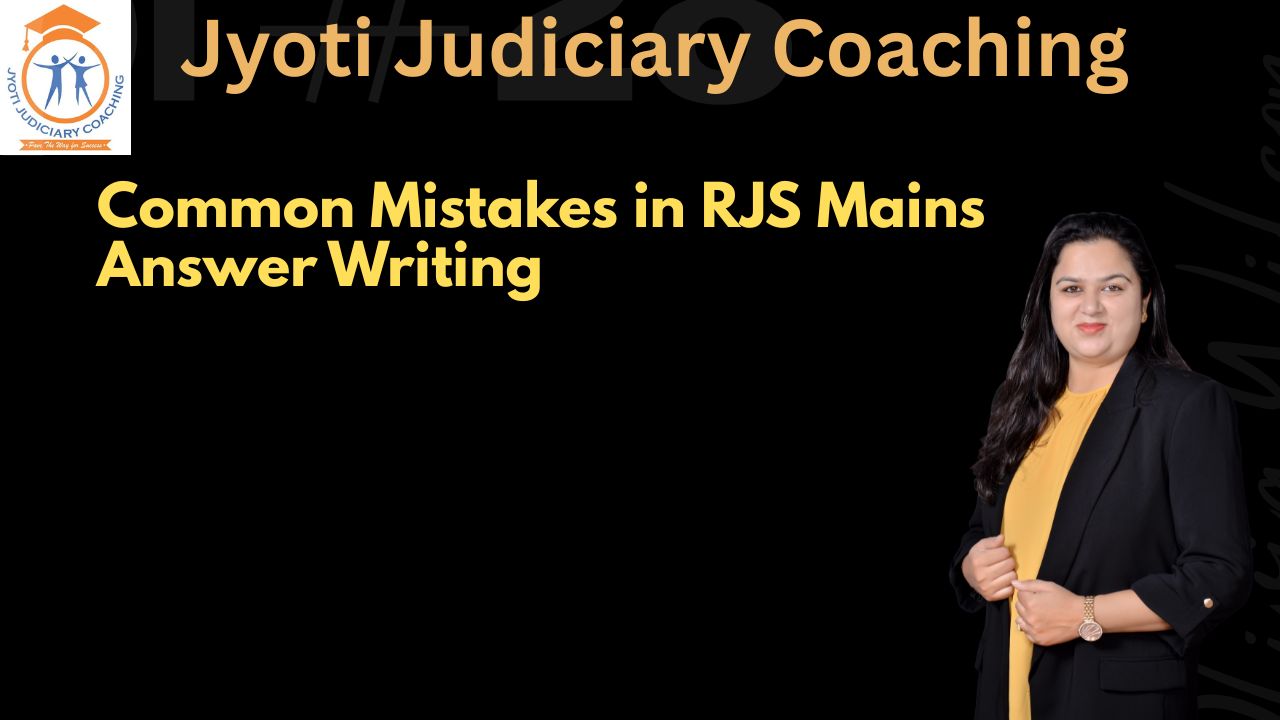
The Rajasthan Judicial Services mains examination is the stage where most serious aspirants lose marks, not because they lack knowledge of law, but because they fail to present that knowledge effectively on paper. Every year, many candidates clear prelims confidently, yet struggle in mains due to avoidable answer writing errors.
RJS mains answer writing is not an extension of law school writing. It demands judicial thinking, structured presentation and precise application of law. Writing answers like a university exam or reproducing textbook language does not help in judiciary mains.
At Jyoti Judiciary Coaching, Jyoti Ma’am repeatedly emphasizes that mains answers must reflect the mindset of a judge, not that of a student. Understanding common mistakes in RJS mains answer writing is the first step toward meaningful improvement.
Mistake One Writing Answers Without a Clear Structure
One of the most common mistakes in RJS mains is writing answers without a proper structure. Many aspirants write whatever comes to mind, resulting in scattered and confusing answers.
Even when the content is legally correct, lack of structure makes it difficult for the examiner to award marks. Judiciary examiners read hundreds of copies and naturally prefer answers that are easy to follow.
At Jyoti Judiciary Coaching, students are trained to follow a disciplined answer format. This includes stating the relevant legal provision, explaining it briefly, applying it to the facts and ending with a clear conclusion. This structured approach significantly improves readability and scoring potential.
Mistake Two Writing Lengthy and Unnecessary Introductions
Many aspirants believe that a long introduction creates a strong impression. In reality, lengthy introductions waste valuable time and space.
In Rajasthan judiciary mains answer writing, marks are awarded for relevance, not background explanations. The examiner expects the candidate to address the question directly.
Jyoti Ma’am guides students to begin answers straight with the applicable provision or legal principle. This approach saves time and immediately signals clarity.
Mistake Three Not Mentioning Legal Provisions
Failing to quote sections is a serious mistake in RJS mains answer writing. Even well-reasoned answers appear weak when legal provisions are missing.
Judiciary mains is a law-based examination. Answers without statutory support lack authority and precision.
At Jyoti Judiciary Coaching, students are trained to develop the habit of naturally mentioning provisions. Through regular practice, this becomes instinctive, reducing the risk of omission in the exam.
Mistake Four Ignoring Case Laws or Using Them Incorrectly
One crucial yet often overlooked mistake is either not using case laws at all or using them mechanically without relevance.
Case laws play a supportive role in RJS mains. They strengthen answers by clarifying legal principles, but they should not be forced into every answer. What matters is relevance, not quantity.
Jyoti Ma’am teaches students how to use case laws strategically. Students learn when a landmark judgment is required and how to briefly explain its ratio instead of merely writing the case name. A short, relevant reference often carries more weight than a long, unnecessary discussion.
Mistake Five Poor Application of Law to Facts
Many candidates explain the law correctly but fail to apply it properly to the given facts. This is one of the most damaging mistakes in Rajasthan judiciary mains answer writing.
Judiciary exams test application, not memorisation. An answer that remains theoretical does not demonstrate judicial reasoning.
At Jyoti Judiciary Coaching, special emphasis is placed on fact-based application. Through weekly writing practice and Saturday mains tests, students learn how to connect legal principles directly to the facts provided.
Mistake Six Ignoring or Misreading the Facts of the Question
Another common mistake is ignoring key facts mentioned in the question. Some aspirants write generic answers that do not address the specific factual situation.
Examiners can easily identify such answers and award fewer marks.
Jyoti Ma’am trains students to underline and analyse facts before writing. Every paragraph of the answer is linked back to those facts, ensuring relevance throughout.
Mistake Seven Using Complicated and Heavy Language
Many aspirants believe that complex language and long sentences reflect intelligence. In judiciary mains, clarity matters far more than vocabulary.
Complicated language often creates confusion and obscures legal reasoning. Clear, simple language reflects clear thinking.
Jyoti Judiciary Coaching offers exclusive English medium training where Jyoti Ma’am focuses on clarity of expression rather than decorative language. Students are trained to write like judges, using precise and professional language.
Mistake Eight Lack of Regular Answer Writing Practice
One of the biggest reasons for poor performance in RJS mains is the absence of regular writing practice. Reading books alone cannot develop writing skills.
Many aspirants delay writing practice until the syllabus is completed. When mains approach, they struggle with speed, structure and confidence.
At Jyoti Judiciary Coaching, answer writing begins early. Every Saturday, mains tests are conducted, and answers are evaluated in detail. Because batches are small, personal feedback is possible, helping students improve consistently.
Mistake Nine Using Outdated Law or Old Provisions
With recent legal changes, using outdated provisions has become a serious error. Answers that fail to reflect current law lose credibility.
Judiciary examiners expect candidates to be updated and precise.
Jyoti Ma’am teaches new and old provisions comparatively, ensuring that students understand changes clearly and apply the correct law in mains answers.
Mistake Ten Weak or Directionless Conclusions
Many answers start well but end without a clear conclusion. A vague or missing conclusion weakens the overall impact of the answer.
A good conclusion summarises the legal application and provides a clear outcome. It reflects decisiveness and judicial balance.
At Jyoti Judiciary Coaching, students are trained to end every answer with a logical and confident conclusion, even in complex problem questions.
How Jyoti Judiciary Coaching Helps Students Overcome These Mistakes
Correcting these mistakes requires continuous guidance and evaluation. Jyoti Judiciary Coaching focuses on developing strong answer writing habits through
small batch sizes
personal attention by Jyoti Ma’am
exclusive English medium classes
weekly mains tests every Saturday
daily prelims quizzes
daily current affairs quizzes
regular updates through Telegram channel
interactive online classes where students can unmute and ask questions
online and offline modes of teaching
offline classes conducted in Jaipur
preparation for all state judiciary examinations
Students from top law colleges such as Bangalore NLU, NALSAR Hyderabad, Delhi NLU, GNLU Gujarat, Symbiosis, Jindal, Nirma and UPES Dehradun choose Jyoti Judiciary Coaching because judiciary preparation demands specialised training beyond law school academics.
Why Correcting These Mistakes Early Matters
The longer these mistakes remain uncorrected, the harder they become to eliminate. What can be improved during practice becomes irreversible in the examination hall.
Jyoti Ma’am believes that answer writing improves gradually with the right guidance and honest self-assessment. With consistent effort, even average writers can develop strong judiciary-level answers.
A Closing Perspective
RJS mains answer writing excellence is not the result of shortcuts or luck. It is built through disciplined practice, clear understanding of law, intelligent use of case laws and continuous correction of mistakes.
Aspirants who consciously work on their weaknesses develop answers that reflect balance, clarity and judicial reasoning. When writing becomes structured and law application becomes natural, answers begin to speak for themselves.
Judiciary mains ultimately tests judgment, not memory. And judgment is revealed not by how much is written, but by how thoughtfully each word is placed on the page.
FAQs – Common Mistakes in RJS Mains Answer Writing
1. Why do many students fail in RJS mains despite good preparation
Most students fail due to poor answer structure, lack of application of law, weak conclusions and insufficient writing practice rather than lack of legal knowledge.
2. Is writing long answers necessary to score well in RJS mains
No. Quality matters more than quantity. Clear, structured and relevant answers score higher than lengthy but unfocused answers.
3. How important is mentioning sections in RJS mains answers
Mentioning correct legal provisions is very important. Answers without sections appear incomplete and less authoritative.
4. Are case laws compulsory in every RJS mains answer
Case laws are not compulsory in every answer. They should be used where they add value by clarifying a legal principle or strengthening application.
5. What is the biggest mistake students make in judiciary answer writing
The biggest mistake is writing theory without applying the law to the facts given in the question.
6. Does handwriting and presentation matter in RJS mains
Yes. Clear handwriting, proper spacing and neat presentation make answers easier to read and positively influence evaluation.
7. How often should one practice answer writing for RJS mains
Regular practice is essential. Writing answers consistently, along with evaluation, helps improve structure, speed and confidence.
8. Can outdated law reduce marks in RJS mains
Yes. Using outdated provisions or old laws can lead to loss of marks, especially when new laws are applicable.
9. How does personal feedback improve answer writing
Personal feedback helps identify specific mistakes in structure, content and application, allowing focused improvement.
10. Is coaching necessary to avoid mistakes in RJS mains
Coaching is not mandatory, but structured guidance and regular evaluation help aspirants avoid common mistakes and prepare more efficiently.