Hindu Succession Act 1956: Sections, Daughter Rights, 2005 Amendment and Supreme Court Cases
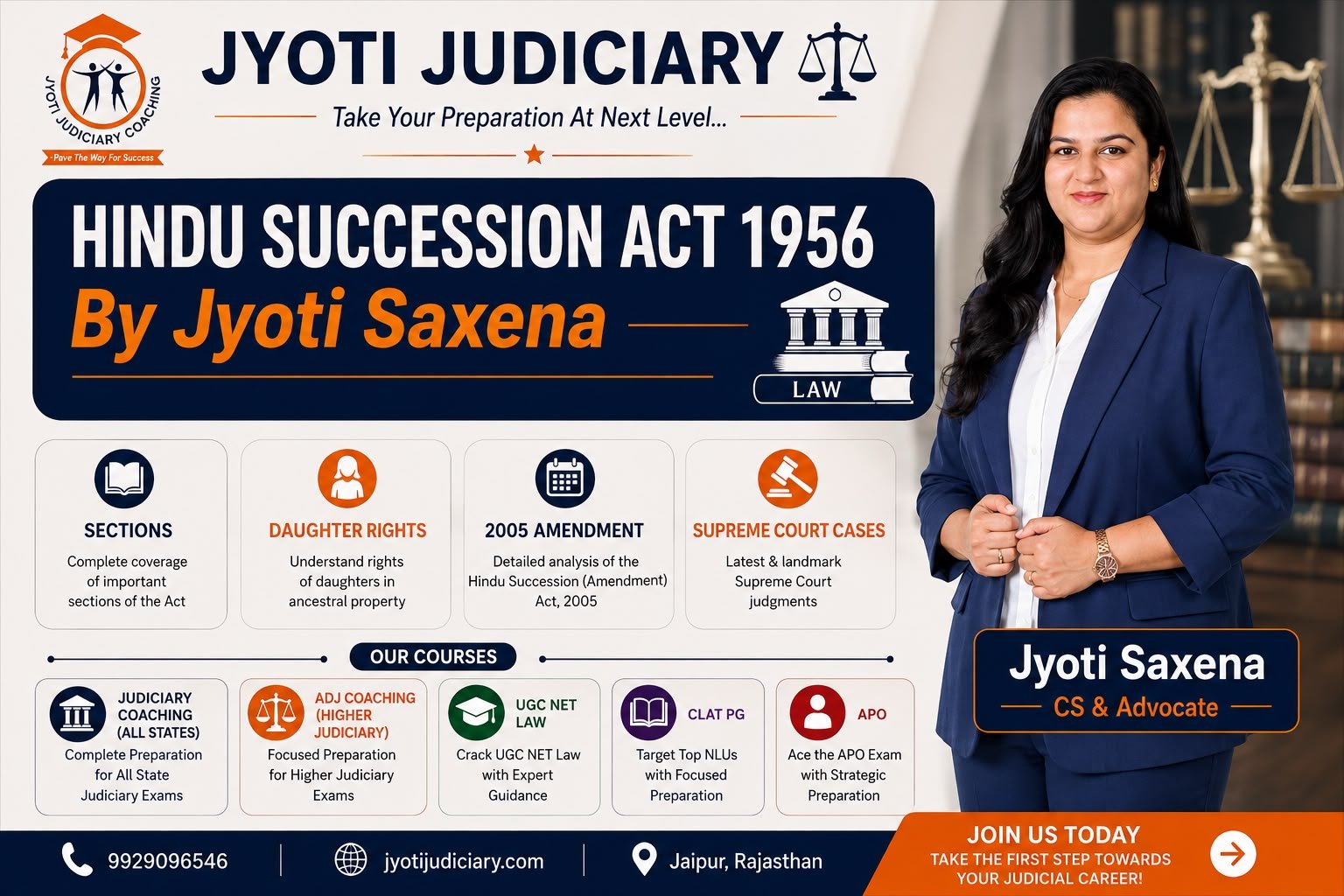
Hindu Succession Act 1956 | Daughter Rights | Section 6 Coparcenary | 2005 Amendment | Class I II Heirs | Section 8 14 15 | Vineeta Sharma 2020 | SC Cases 2025 | Intestate Succession | Judiciary Exam Notes | July 2026
| Hindu Succession Act 1956 — Quick Reference: Full name: The Hindu Succession Act, 1956 (Act 30 of 1956) Enacted: 17 June 1956 | Applies to: Hindus, Buddhists, Jains, Sikhs Does not apply to: Muslims, Christians, Parsis, Jews Amended: Hindu Succession (Amendment) Act 2005 — in force 9 September 2005 Two types of succession covered: Intestate succession — when Hindu dies without a will Testamentary succession — when Hindu dies leaving a valid will (Section 30) Key sections: Section 6 — Devolution of coparcenary property (daughter as coparcener) Section 8 — General rules of succession for Hindu males Section 14 — Property of Hindu female to be her absolute property Section 15 — General rules of succession for Hindu females Section 23 — (Deleted by 2005 amendment) — was a restriction on daughter Section 30 — Testamentary succession — Hindus can make a will Landmark case: Vineeta Sharma v. Rakesh Sharma (2020) 9 SCC 1 Daughter is coparcener by birth — father need not be alive on 9.9.2005 |
The Hindu Succession Act 1956 governs how property passes when a Hindu person dies — with or without a will. Before this Act, Hindu succession was governed by uncodified customary law split between the Mitakshara school (most of India) and the Dayabhaga school (Bengal and Assam). Both schools excluded daughters from coparcenary property — the joint family estate that sons inherited by birth. The 1956 Act started the process of reform and the 2005 Amendment completed it — making daughters coparceners in the same way as sons. The Supreme Court in Vineeta Sharma v. Rakesh Sharma (2020) settled every remaining question about how that 2005 Amendment operates. For judiciary exam candidates, Hindu Succession Act is tested in Prelims MCQs on section numbers and heir classes, and in Mains short notes on daughter rights and the Vineeta Sharma judgment.
Who Does the Hindu Succession Act Apply To?
Section 2 of the Hindu Succession Act 1956 defines who it applies to. The Act covers any person who is a Hindu by religion — including Virashaivas, Lingayats, followers of Brahmo, Prarthana, or Arya Samaj. It also applies to Buddhists, Jains, and Sikhs. It does not apply to Muslims, Christians, Parsis, or Jews — who have their own personal laws on succession. A Hindu who has converted to another religion is not covered, and the Act does not apply to Scheduled Tribe members unless the Central Government so notifies.
Section 6 — Daughter as Coparcener (The Most Important Section)
Section 6 of the Hindu Succession Act, as substituted by the 2005 Amendment, provides that a daughter of a coparcener shall by birth become a coparcener in her own right in the same manner as a son — and shall have the same rights and liabilities in the coparcenary property as she would have had if she had been a son. The daughter is a coparcener by birth — not because her father gave her the right, and not because she asked for it, but because she was born into the coparcenary.
| Vineeta Sharma v. Rakesh Sharma (2020) 9 SCC 1 — Key Holdings: Case decided: 11 August 2020 Bench: Justices Arun Mishra, S. Abdul Nazeer, M.R. Shah 1. Daughter is a coparcener BY BIRTH — the right exists from birth, not from the date of the 2005 Amendment. 2. Father need NOT be alive on 9 September 2005 for the daughter to get coparcenary rights. Even if the father died before 2005, the daughter gets her share. 3. Prakash v. Phulavati (2016) — which had held the father must be alive on 9.9.2005 — was expressly OVERRULED. 4. The right is equal to that of a son — same interest in coparcenary property, same right to seek partition, same liability for debts. 5. Exception: If a partition was completed by a registered deed or a court decree before 20 December 2004 (date of introduction of the Amendment Bill), the settled partition is not disturbed. July 2025 update: SC again reiterated that daughters enjoy coparcenary rights equivalent to sons irrespective of the father’s status at the time of partition or death — 2005 amendment intent is to eliminate gender-based discrimination in joint family holdings. |
Section 8 — Class I and Class II Heirs (Male Hindu Dying Intestate)
Section 8 lays down the general rules of succession when a Hindu male dies without a will. Property goes first to Class I heirs. Only if there are no Class I heirs does it go to Class II heirs. Only if there are no Class II heirs does it go to agnates, and then to cognates.
| Category | Who Is Included |
| CLASS I HEIRS (First Priority) | Son | Daughter | Widow | Mother | Son of a predeceased son | Daughter of a predeceased son | Son of a predeceased daughter | Daughter of a predeceased daughter | Widow of a predeceased son | Son of a predeceased son of a predeceased son | Daughter of a predeceased son of a predeceased son | Widow of a predeceased son of a predeceased son |
| CLASS II HEIRS (Only if no Class I heir) | Father | (Son’s daughter’s son, son’s daughter’s daughter, brother, sister) | (Daughter’s son’s son, daughter’s son’s daughter, daughter’s daughter’s son, daughter’s daughter’s daughter) | (Brother’s son, sister’s son, brother’s daughter, sister’s daughter) | Father’s father, father’s mother | Father’s widow, brother’s widow | Father’s brother, father’s sister | Mother’s father, mother’s mother | Mother’s brother, mother’s sister |
| AGNATES (Only if no Class I or II heir) | Person related by blood or adoption wholly through males |
| COGNATES (Only if no agnate) | Person related by blood or adoption but not wholly through males |
| Common Exam Trap — Class I Heirs: Father is NOT a Class I heir. Father is Class II heir — Entry I. Mother IS a Class I heir. Widow IS a Class I heir — but a remarried widow loses rights. When there are multiple Class I heirs — each takes simultaneously. There is NO priority among Class I heirs — son does not get more than daughter, widow does not get more than mother. Exception: Section 10 — rules for distribution among Class I heirs when multiple heirs exist (e.g., widow gets one share, all children together take one share). |
Section 14 — Hindu Female’s Property Is Her Absolute Property
Section 14 abolished the concept of “limited estate” for Hindu women. Before the Hindu Succession Act 1956, a Hindu woman could only hold property as a “limited owner” — she could use it during her lifetime but could not sell, gift, or will it. Section 14 changed this completely: any property possessed by a Hindu female — whether acquired before or after the 1956 Act — is held by her as full owner. She can sell, gift, mortgage, or will it exactly as a male owner can. This includes stridhan (gifts received at or after marriage), inherited property, and property received through partition.
Section 15 — Succession to Property of a Female Hindu
Section 15 lays down how property of a Hindu woman passes when she dies intestate. The order of succession for a Hindu female’s property is different from a Hindu male’s — and this difference is tested directly in Prelims MCQs.
| Priority | Heirs | Condition |
| First | Sons, daughters (including children of any predeceased son or daughter), and husband | Simultaneously — equal shares among them |
| Second | Heirs of husband | Only if no heir in first category |
| Third | Mother and father | Only if no heir in first or second category |
| Fourth | Heirs of father | Only if no heir above |
| Fifth | Heirs of mother | Only if no heir above |
| Section 16 — Special Rule for Property Inherited by Female from Husband or Father-in-Law: If a woman inherits property from her husband or father-in-law, and dies intestate without children, that specific property goes to the heirs of the husband — not to her own parents or their heirs. Similarly, property inherited by a woman from her father or mother goes to the heirs of her father if she dies intestate without children. Exam trap: The source of the property matters for Section 16. Property inherited from husband → goes to husband’s heirs if wife dies without children. Her own self-acquired property → follows Section 15. |
Section 30 — Testamentary Succession
Section 30 of the Hindu Succession Act allows any Hindu to dispose of their property by will or other testamentary document. Coparcenary property can also be disposed of by will — a male Hindu can will his undivided share in coparcenary property. This was a significant change from classical Hindu law where a coparcener could not will his undivided share. After the 2005 Amendment, daughters too can will their coparcenary share.
FAQs — Hindu Succession Act 1956
Kya beti ko pita ki property meinhissamiltahai? (Can daughters claim ancestral property?)
Haan. Hindu Succession (Amendment) Act 2005 kebaad, Section 6 keantargat, beti ko janm se hi coparcener maanajatahai — bilkulbete ki tarah. Vineeta Sharma v. Rakesh Sharma (2020) mein Supreme Court ne safkar diya ki yeh haqjanm se miltahai — pita ka 9 September 2005 ko jeevithonazaroorinahihai. Agar pita 2005 se pehlebhi mar gayethi, tohbhibeti ka hissa coparcenary property meinbantahai — jab tak koi registered partition ya court decree 20 December 2004 se pehlenahitha.
Who are Class I heirs under the Hindu Succession Act?
Class I heirs under the Hindu Succession Act 1956 include: son, daughter, widow, mother, son of a predeceased son, daughter of a predeceased son, son of a predeceased daughter, daughter of a predeceased daughter, widow of a predeceased son, son of a predeceased son of a predeceased son, daughter of a predeceased son of a predeceased son, and widow of a predeceased son of a predeceased son. All Class I heirs take simultaneously — there is no priority among them. Importantly, the father is NOT a Class I heir. The father falls under Class II heirs (first entry).
What did Vineeta Sharma v. Rakesh Sharma (2020) hold?
Vineeta Sharma v. Rakesh Sharma (2020) 9 SCC 1, decided by a three-judge bench of Justices Arun Mishra, S. Abdul Nazeer, and M.R. Shah on 11 August 2020, held that: (1) a daughter is a coparcener by birth under the amended Section 6 of the Hindu Succession Act; (2) the father need not be alive on 9 September 2005 (the date the 2005 Amendment came into force) for the daughter to get coparcenary rights; (3) the earlier judgment in Prakash v. Phulavati (2016), which had imposed the father-alive condition, was expressly overruled; (4) the daughter’s right is equal to that of a son — same share, same right to seek partition, same liabilities.
What is the difference between intestate and testamentary succession under HSA?
Intestate succession under the Hindu Succession Act applies when a Hindu dies without leaving a valid will — property then passes to the heirs listed in Sections 8-16 based on the schedule of Class I and Class II heirs. Testamentary succession under Section 30 applies when a Hindu dies leaving a valid will — the property passes according to the will, subject to the Indian Succession Act 1925 for formalities. A Hindu male or female can will any property they own, including their undivided share in coparcenary property. Where there is a valid will, the intestate succession provisions of the Hindu Succession Act do not apply to the willed property.
Related Articles
→ Hindu Marriage Act Divorce: Section 13 Grounds, SC Cases and Exam Notes — Hindu personal law — HMA divorce and HSA succession are tested together in family law paper
→ Res Judicata: Section 11 CPC, Constructive Res Judicata and Judiciary Exam Notes — Partition decrees and succession disputes — res judicata frequently applies
→ Transfer of Property Act 1882: Complete TPA Notes for Judiciary Exam — Property transfer during lifetime vs succession on death — TPA and HSA together
→ Fundamental Rights in India: Articles 12 to 35 and Judiciary Exam Notes — Article 14 equality — constitutional basis for the 2005 amendment giving daughters equal rights
→ RJS Online Coaching — Live Classes and Verified Results — Hindu Succession Act is a tested subject in RJS Mains civil law paper — Paper I
→ Best Gujarat Judiciary Coaching — GJS Results — HSA succession rules — tested in GJS Mains civil law paper
→ Best Haryana Judiciary Coaching — HJS Exam Pattern and Online Classes — HSA 1956 is in HJS Mains Paper II under personal laws
All the best — from Jyoti Judiciary Coaching
Written by Advocate Jyoti Saxena — LLB, LLM, CS, Bar Council of Rajasthan, practising at Jaipur Family Court, Jaipur District Court, and the Rajasthan High Court. Hindu succession disputes — partition suits, coparcenary claims, and property devolution — are part of daily civil court practice. All references verified from the Hindu Succession Act 1956 as amended by Hindu Succession (Amendment) Act 2005. SC citations verified from SCC Online. Contact: +91 99290 96546 | jyotijudiciary.com