Why Most Students Fail RJS in the First Attempt: 10 Patterns Jyoti Saxena Has Observed in 12 Years of RJS Coaching
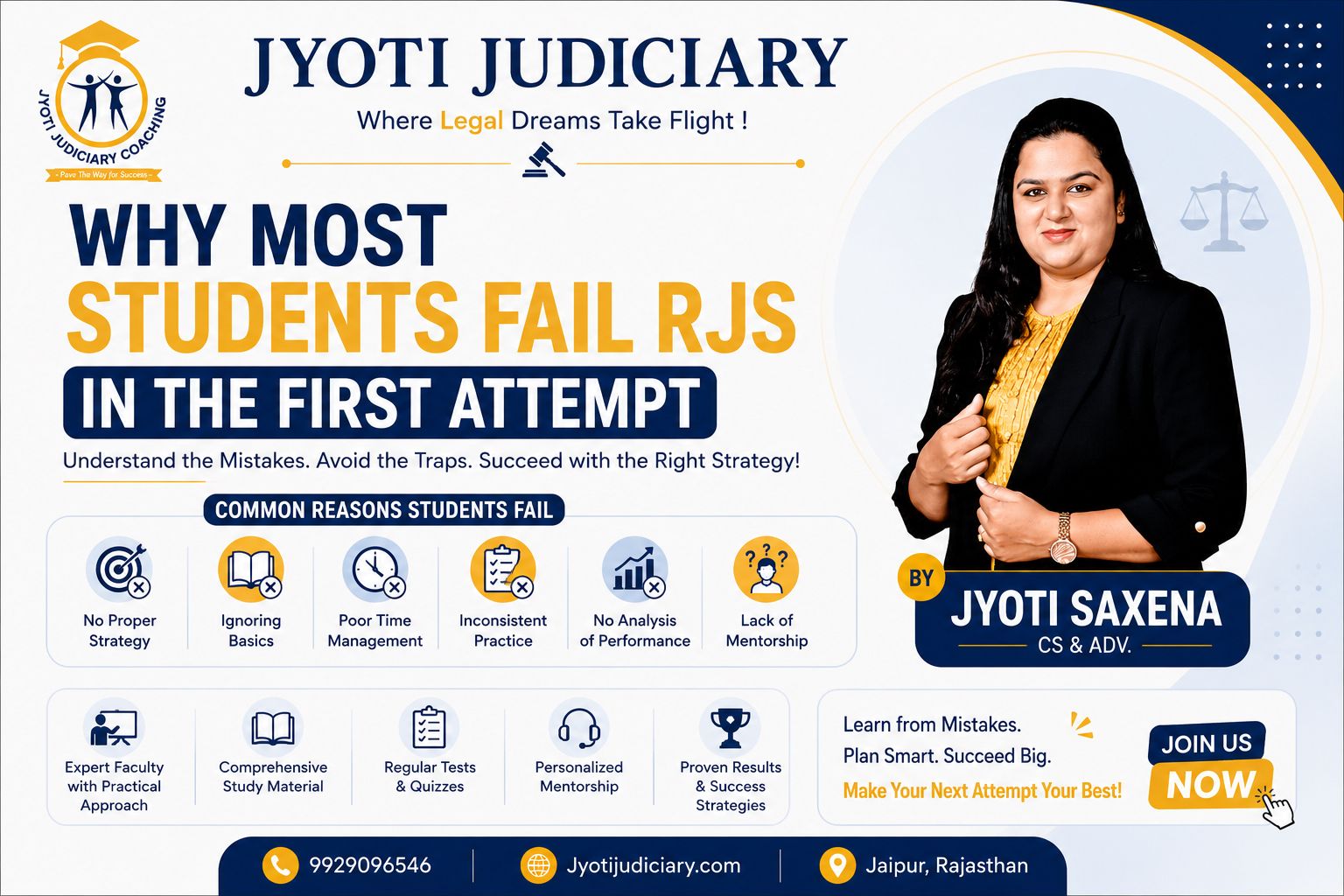
Every year, thousands of aspirants search: why do students fail RJS? Twelve years. Hundreds of candidates. Dozens of RJS cycles. When you sit across from that many aspirants — watching who clears and who returns for another attempt — patterns stop being coincidences. The reasons most students fail RJS in the first attempt are not random. They are specific, recurring, and — this is the frustrating part — almost always correctable if caught early enough.
This is not a list of generic study tips about why students fail the RJS exam. Every failure pattern in this article comes from direct observation at Jyoti Judiciary Coaching across RJS batches since 2012 — from reviewing answers that should have scored but did not, from watching candidates with deep legal knowledge underperform on the Mains paper, and from debriefing students after each RJS cycle. If you are preparing for RJS 2026, read this carefully. Not because it is discouraging — but because knowing exactly why most students fail RJS means you can stop doing those specific things before they cost you a full cycle.
Why Is the RJS So Difficult to Clear — Especially in the First Attempt?
The RJS exam is not impossibly difficult. Its selection rate — under 1% of total applicants in most cycles — does not reflect the difficulty of the paper. It reflects the difficulty of consistent, correctly directed preparation over nine to twelve months. The exam itself tests applied legal reasoning, not encyclopaedic recall. A candidate who understands Order 14 CPC deeply enough to frame issues on fresh facts will outscore a candidate who has memorised three CPC commentaries but never written a judgment.
What makes the Rajasthan judiciary exam genuinely hard to clear in the first attempt is the combination of three factors: the breadth of the syllabus, the 35% per paper minimum qualifying threshold in the Mains, and the judgment writing skill — which takes months to build and cannot be crammed in the final sprint. Most candidates manage the syllabus reasonably well. They stumble on the other two. That is where the RJS exam failure reasons are concentrated.
| The Most Important Number in RJS Preparation: 35 — the minimum percentage required in each Mains paper independently. Not just in aggregate. In EACH paper separately. Law Paper I: minimum 35 out of 100. Law Paper II: minimum 35 out of 100. Hindi Essay: minimum 17.5 out of 50. English Essay: minimum 17.5 out of 50. Miss this threshold in even ONE paper and you are eliminated — regardless of your total score. This single rule is responsible for more RJS failures than any other factor in the examination. |
Why Students Fail RJS in the First Attempt — 10 Patterns of RJS Exam Failure
Pattern 1: They Treat the Prelims as the Real Exam — The Most Damaging First Attempt Mistake
This is the most common RJS preparation mistake — and the most damaging. The Prelims is qualifying only. Its marks do not appear in the final merit list. The final selection is based entirely on Mains marks (300) and Interview marks (35). Yet across twelve years of RJS batches at Jyoti Judiciary Coaching, Jyoti Saxena has observed that the majority of first-attempt candidates allocate seven or eight months to Prelims preparation and two or three months to Mains. That is a preparation plan optimised for the wrong stage.
The candidates who clear RJS in the first attempt prepare for the Mains from Month 1. They read bare acts with Mains application in mind. They write answers from Month 2. The Prelims clears itself when your Mains preparation is deep — because both tests draw from the same legal knowledge base. The reverse is not true: being good at Prelims MCQs does not prepare you for Mains descriptive answers.
Pattern 2: They Start Judgment Writing in Month 9 — The Single Biggest RJS Mains Mistake
Of all the why-students-fail-RJS patterns that Jyoti Saxena has tracked across multiple cycles, this one is the most consistent. Candidates who fail the RJS Mains almost always started writing practice in Month 9, 10, or even two weeks before the exam. Candidates who clear it almost always started in Month 2.
Judgment writing is not a topic you revise before the exam. It is a skill — built through repetition, feedback, correction, and more repetition. A civil judgment has twelve specific steps under CPC Order 20. A criminal judgment has a separate structure under BNSS 2023. Step-marking means every correctly completed step earns marks independently. The candidate who has written fifty judgments by exam day completes all twelve steps in 27 minutes without thinking about format. The candidate who started in Month 9 is still trying to recall the structure while the clock runs.
| The Judgment Writing Rule at Jyoti Judiciary Coaching: Start in Month 2. Write two answers per week through Month 9. Write one full civil judgment and one full criminal judgment every day in Months 10, 11, and 12. Get every single answer checked with written mentor feedback — not just a score. Candidates who follow this schedule walk into the RJS Mains knowing the judgment writing format the way they know their own name. Candidates who do not, do not clear. |
Pattern 3: They Ignore the Language Paper Until It Is Too Late
The RJS Mains Language Paper — Hindi Essay (50 marks) and English Essay (50 marks) — is the silent killer of first-attempt RJS success and one of the most overlooked failure reasons in Rajasthan judiciary preparation. of RJS preparation. The 35% minimum qualifying threshold applies here too: you need at least 17.5 out of 50 in each language paper, independently. And ‘at least 17.5’ is not as easy as it sounds when you have spent eleven months exclusively on law subjects and have written perhaps three Hindi essays in your entire preparation.
Every RJS preparation mistake article focuses on law subjects. None of them tell you that the Language Paper is where Mains eliminations happen more often than in the law papers. At Jyoti Judiciary Coaching, language paper practice is built into the preparation schedule from Month 3 — not because essays are difficult, but because writing a 1000-word structured essay on a socio-legal topic in timed conditions is a skill that does not develop in two weeks.
Pattern 4: They Study Old Criminal Laws as Primary Texts in 2026
Since 1 July 2024, BNS has replaced IPC, BNSS has replaced CrPC, and BSA has replaced the Indian Evidence Act. The RJS 2026 syllabus tests these new criminal codes as primary law. A candidate who has spent six months studying IPC and CrPC as their main criminal law texts is preparing for an exam that no longer exists.
This is one of the most damaging RJS preparation mistakes for 2026. It is not that IPC and CrPC are useless — knowing the old provisions helps you understand what changed and why. But treating them as the primary text and BNS as a supplementary update is exactly backwards. In any RJS Mains criminal judgment writing answer, citing Section 302 IPC instead of Section 103 BNS signals to the examiner that the candidate has not updated their preparation for the current syllabus.
Pattern 5: They Collect Too Many Books — A Classic RJS Preparation Mistake
Five books on CPC. Three commentaries on IPC. Two constitutional law texts. Four ‘quick revision’ guides. This is one of the most common RJS exam failure patterns — and it is easy to understand why it happens. Every coaching centre sells books. Every online recommendation adds another title. The result is a candidate who has bought everything and finished nothing.
One good book per subject, read deeply and revised three times, produces better Mains performance than five books read once. The RJS Mains does not reward breadth of reading. It rewards depth of understanding applied to specific facts. Depth comes from returning to the same text multiple times — not from covering more titles.
Pattern 6: They Write Answers Without Getting Them Checked
Self-evaluated answer writing is one of the most widespread RJS preparation mistakes — and one of the hardest to correct because candidates do not realise they are making it. When you evaluate your own answer, you know what you meant to write. You read your reasoning charitably. You fill in gaps from your own knowledge. The examiner does neither.
Across twelve years of reviewing RJS mains answers at Jyoti Judiciary Coaching, Jyoti Saxena has found that candidates who self-evaluate consistently repeat the same structural errors — wrong issue framing, missing operative parts, applying the wrong BNS section — because nothing in the self-evaluation process forces them to see the error. Written mentor feedback on every answer forces that correction. Two answers checked per week produce more improvement than ten answers self-evaluated.
Pattern 7: They Underestimate the RJS Interview
The RJS Interview carries 35 marks out of 335 total — approximately 10.4% of the final score. In competitive cycles where candidates are separated by narrow Mains margins, 7 to 10 marks of interview differential can shift a rank by dozens of positions. Candidates who treat the interview as a formality and prepare for two weeks before the date consistently underperform candidates who build their interview file from Month 6.
The RJS viva voce panel consists of sitting Rajasthan High Court judges — the same judges who decide civil judge selections. They test Rajasthan-specific legal and cultural awareness — including proficiency in Rajasthani dialects and knowledge of social customs — that cannot be crammed in two weeks. The Rajasthan judiciary exam failure at the interview stage is almost always a failure of insufficient preparation time, not insufficient knowledge.
Pattern 8: They Attempt Mock Tests Without Reviewing Them
A mock test that is not reviewed is a waste of three hours. The value of a mock test is not in taking it — it is in the error analysis that follows. Which questions did you get wrong? Was it a knowledge gap or a reading error? What was the correct reasoning? Which section applies to that fact pattern?
At Jyoti Judiciary Coaching, every mock test is followed by a mandatory review session — because a mock test without review reinforces the same errors the candidate came in with. Candidates who take fifteen mocks without serious review improve their exam stamina slightly. Candidates who take eight mocks and review each one carefully improve their accuracy significantly. In RJS Prelims, accuracy on the law questions is what puts you comfortably above the cut off.
Pattern 9: They Memorise Case Names Instead of Learning Their Ratios
‘Kesavananda Bharati’ is not a case law citation — it is a name. What matters in an RJS Mains answer is the ratio: the basic structure doctrine holds that certain fundamental features of the Constitution cannot be amended even by Parliament. ‘Sharad Birdhi Chand Sarda’ is not useful unless you can state that circumstantial evidence must form a complete chain pointing exclusively to the accused’s guilt and excluding every other hypothesis.
Dropping case names with no application is a marker that RJS examiners notice negatively. A candidate who cites three cases correctly — with ratio applied specifically to the question’s facts — will score better than a candidate who names fifteen cases with no application. This is a common RJS preparation mistake that is easy to fix: for every case you study, write the ratio in one sentence and then write a sentence connecting it to a fact pattern. That exercise is more valuable than any case law list.
Pattern 10: They Switch States or Exams Mid-Preparation
RJS and UP PCS J share core law subjects but differ significantly in their Mains structure, state-specific laws, and interview formats. UP PCS J has a 150-mark local law paper (Zamindari Abolition, Panchayat Raj, Urban Buildings Rent Act) that has nothing to do with RJS preparation. RJS has Rajasthan-specific legislation that is irrelevant for UP PCS J. A candidate who spends months alternating between the two ends up covering 60% of each and 100% of neither.
The most consistent Rajasthan judiciary exam failure analysis from Jyoti Judiciary Coaching’s twelve years of observation: candidates who commit to one state exam from Day 1 and prepare exclusively for that exam have significantly higher first-attempt success rates than candidates who hedge between two exams. Decide in Week 1. Commit for twelve months. Target the second state in the following cycle if needed.
What RJS Mains Failure Data Shows — Rajasthan Judiciary Cycle Analysis
The RJS Mains failure data from recent Rajasthan judiciary cycles tells you exactly where eliminations happen. In the 2024 RJS cycle, only four candidates were provisionally shortlisted after the Mains — not because the paper was unusually difficult, but because the 35% per paper minimum threshold eliminated the vast majority of candidates who appeared. This is the clearest evidence of what the actual RJS exam failure reasons are: not insufficient legal knowledge, but insufficient performance across all papers simultaneously.
A candidate who scored 72 in Law Paper I and 33 in Law Paper II was eliminated — despite scoring above 35% in aggregate on the law papers combined. A candidate who scored 68 in Law Paper I, 42 in Law Paper II, 20 in Hindi Essay, and 20 in English Essay cleared all four thresholds and proceeded to the merit list. The lesson from the RJS failure data is not to be brilliant in your strongest subject — it is to be competent in every subject, including the ones you find less interesting.
How to Avoid Common RJS Preparation Mistakes — Corrections That Work
Identifying the failure patterns is only useful if it changes what you do next. Here are the specific corrections to each pattern, drawn from the preparation adjustments that worked for candidates who cleared RJS after an initial unsuccessful attempt at Jyoti Judiciary Coaching.
- Treat Mains as the primary exam from Month 1. Allocate 70% of your preparation time to Mains depth and 30% to Prelims readiness. Read bare acts with Mains application in mind, not just Prelims recall.
- Start judgment writing in Month 2. Two answers per week, every week, checked by a mentor. Do not wait for the syllabus to be complete. Write on whatever subjects you have covered so far.
- Add language paper practice from Month 3. One Hindi essay and one English essay per week — on socio-legal and general topics. Timed. Reviewed. The language papers require the same practice discipline as the law papers.
- Switch to BNS, BNSS, and BSA as your primary criminal law texts immediately. Build an IPC-to-BNS and CrPC-to-BNSS comparison chart as your primary revision tool, not as an afterthought.
- Choose one book per subject and finish it before touching any other text on that subject. One Takwani finished and revised three times beats two Takwanis and a Mulla read once each.
- Submit every answer to a mentor for written feedback. Not a score — written feedback. If you do not have access to a mentor, join a structured programme that provides this. Unchecked writing reinforces errors.
- Start building your interview file from Month 6. One Rajasthan High Court judgment per week, summarised by legal issue, holding, and relevance to a civil judge’s work. This takes thirty minutes a week and is the most high-return investment in your interview preparation.
- After every mock test, spend at least as much time reviewing it as you spent taking it. Mark every wrong question, identify the category of error (knowledge gap, reading error, section confusion), and update your concept tracker.
- For every case law you study, write the ratio in one sentence. Then write a fact pattern where that ratio would apply. This exercise converts name recognition into usable knowledge.
- Choose one exam — RJS or UP PCS J — and commit to it for twelve months. Do not divide your preparation between two state exams simultaneously.
Frequently Asked Questions — Why Students Fail RJS and Common Preparation Mistakes
What Are the Most Common RJS Exam Failure Reasons in the First Attempt?
Based on twelve years of observation at Jyoti Judiciary Coaching, the most common RJS exam failure reasons are: starting judgment writing practice too late (Month 9 instead of Month 2), treating the Language Paper as secondary until it is too late, focusing the majority of preparation on Prelims instead of Mains, and writing practice answers without getting them checked by a mentor. The 35% per paper minimum qualifying threshold in the Mains is the most important rule that most candidates fail to prepare for specifically.
Why is the RJS exam difficult to clear in the first attempt?
The RJS is not a difficult exam in the sense of requiring extraordinary intelligence. It is difficult to clear in the first attempt because it tests applied legal reasoning — not recall — across four Mains papers simultaneously, each with an independent minimum qualifying threshold. Most candidates prepare strong law knowledge but weak expression of that knowledge in judicial format. The judgment writing skill, the language paper competence, and the interview preparation are what most first-attempt failures trace back to.
Is there a difference between candidates who fail RJS and those who clear it?
Yes — and it is not legal knowledge. Candidates who clear RJS in the first attempt start writing earlier, get their answers checked regularly, treat all four Mains papers seriously including the language papers, and prepare for the interview from Month 6. Candidates who fail tend to know more law but write less, self-evaluate their answers, neglect language papers, and treat the interview as a formality. The gap is in preparation discipline, not in intelligence or legal knowledge.
Can Common RJS Preparation Mistakes and Failure Reasons Be Fixed Mid-Preparation?
Yes — if caught early. The most correctable mistakes are late judgment writing start (start immediately, regardless of which month you are in), neglected language papers (begin one essay per week from this week), and self-evaluated answer writing (find a mentor or structured feedback programme this month). The hardest to correct mid-preparation is studying old criminal law as primary texts — switching to BNS, BNSS, and BSA requires time and should be done before the Mains, not the week before the exam.
Which coaching is best to avoid RJS exam failure?
The coaching that starts your judgment writing in Month 2, not Month 9. The coaching that returns your answers with written feedback, not just scores. The coaching whose faculty understands the RJS from inside a courtroom — not just from teaching it. At Jyoti Judiciary Coaching, Jyoti Saxena’s active practice before the Rajasthan High Court means every failure pattern she identifies in student answers has been observed against the standard of what judges actually expect to read. That is the foundation of the RJS coaching model at Jyoti Judiciary Coaching — and it is why the corrections it produces in student preparation translate into selections.
How many attempts does it take to clear RJS on average?
There is no official published data on average attempts for RJS. What Jyoti Judiciary Coaching’s twelve years of tracking shows is that candidates who correct the ten failure patterns identified in this article — particularly the judgment writing start date and the language paper neglect — significantly improve their odds in the second attempt if the first was unsuccessful, and show measurably higher first-attempt success rates when preparation is structured correctly from the beginning.
All the best — from Jyoti Judiciary Coaching
Written by Advocate Jyoti Saxena — LLB, LLM, CS, enrolled with the Bar Council of Rajasthan, actively practising at Jaipur Family Court, Jaipur District Court, and the Rajasthan High Court. The ten failure patterns in this article are drawn from twelve years of reviewing RJS mains answers and tracking candidate preparation outcomes at Jyoti Judiciary Coaching, Jaipur — not from general coaching literature.
Jyoti Judiciary Coaching | Vaishali Nagar, Jaipur | +91 99290 96546 | jyotijudiciary.com
Note: RJS cycle data referenced in this article is based on officially published Rajasthan High Court results. Always verify current RJS notification details from hcraj.nic.in