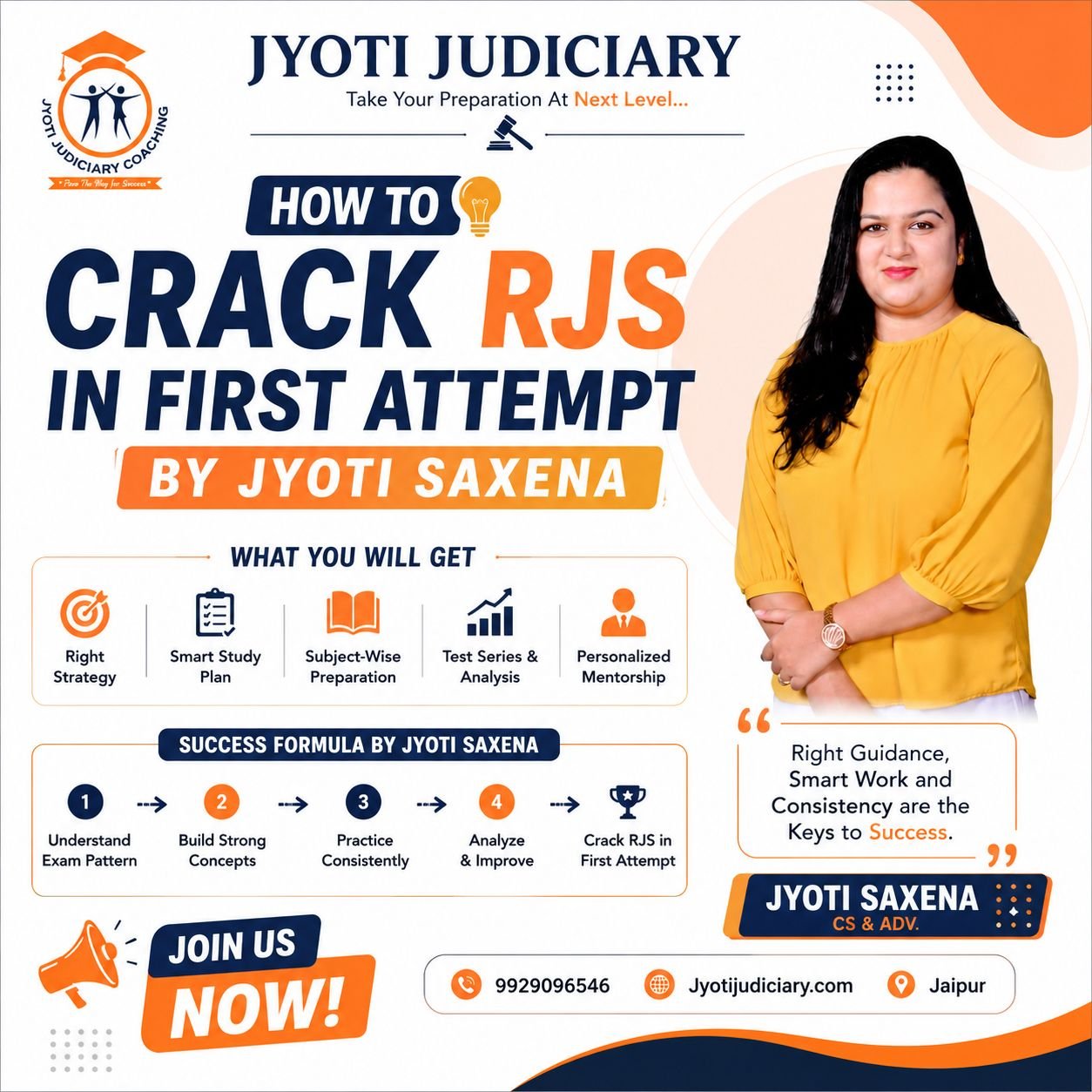
Every RJS aspirant wants to know how to crack RJS in the first attempt. Very few do. The Rajasthan Judiciary selection rate across all attempts is under 1% in most cycles. That number sounds intimidating until you understand what it actually means. It does not mean the exam is impossible to crack in the first attempt. It means the majority of candidates prepare in the wrong direction — spending months on what does not decide their rank and weeks on what does.
In twelve years of mentoring candidates for the Rajasthan judiciary exam at Jyoti Judiciary Coaching, this pattern repeats without exception: first-attempt qualifiers prepare differently from repeat aspirants — not harder, differently. This guide explains exactly what those differences are, drawn from watching real first-attempt selections come through and understanding what set them apart from the rest.
What Percentage of Candidates Crack RJS in the First Attempt?
There is no official published data on first-attempt success rates for the RJS civil judge exam. What the available data does show is that the RJS is competitive at every stage. In the 2024 cycle, 181 posts were announced. Only 4 candidates cleared the Mains examination. That is not a typo — four candidates cleared the Mains in that cycle, primarily because of the 40% minimum qualifying marks per paper rule in the Mains.
What this tells a serious first-attempt aspirant is not that the exam is impossible — it tells you exactly where the difficulty lies and therefore where your preparation must focus. The Mains examination, specifically the 40% minimum per paper rule, is the actual elimination point. Not the Prelims. Not the syllabus breadth. The Mains qualifying threshold — and specifically, the Language Paper minimum — is where most candidates fall short. Knowing this changes how you prepare from Day 1.
| The Only Statistic That Matters for First-Attempt Strategy: Final selection in RJS is based entirely on Mains marks + Interview marks. Prelims marks count for nothing in the merit list. The minimum qualifying marks in Mains are 40% aggregate AND 35% per paper. In the 2024 cycle — only 4 candidates cleared these thresholds out of all who sat. Your first-attempt strategy must be built around the Mains qualifying floor, not around the breadth of the syllabus. |
Is It Possible to Crack RJS in First Attempt?
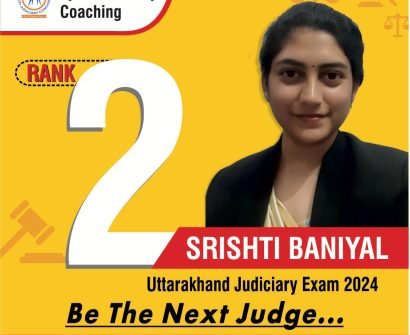
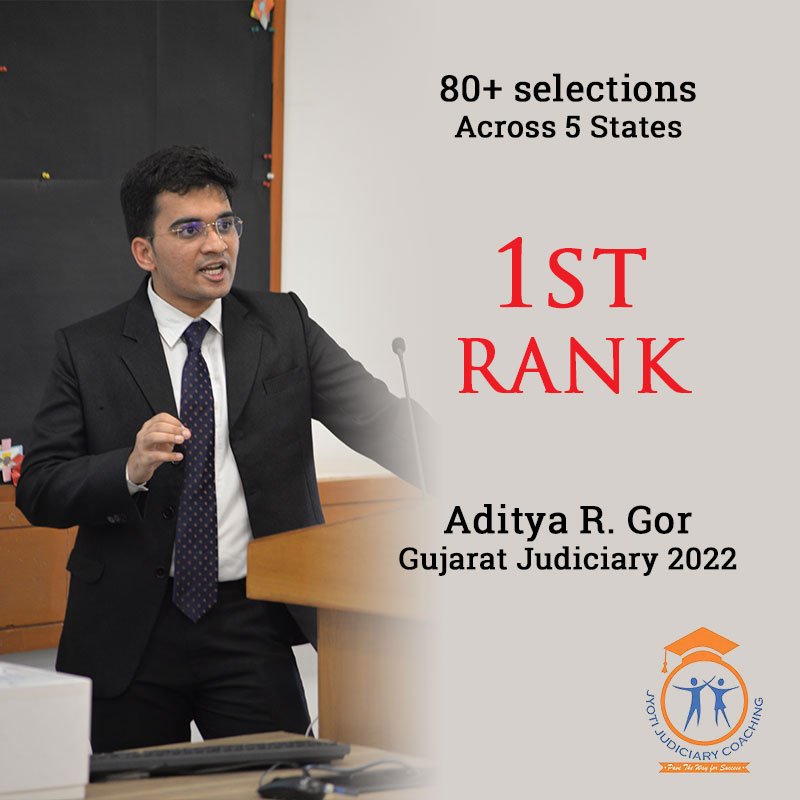
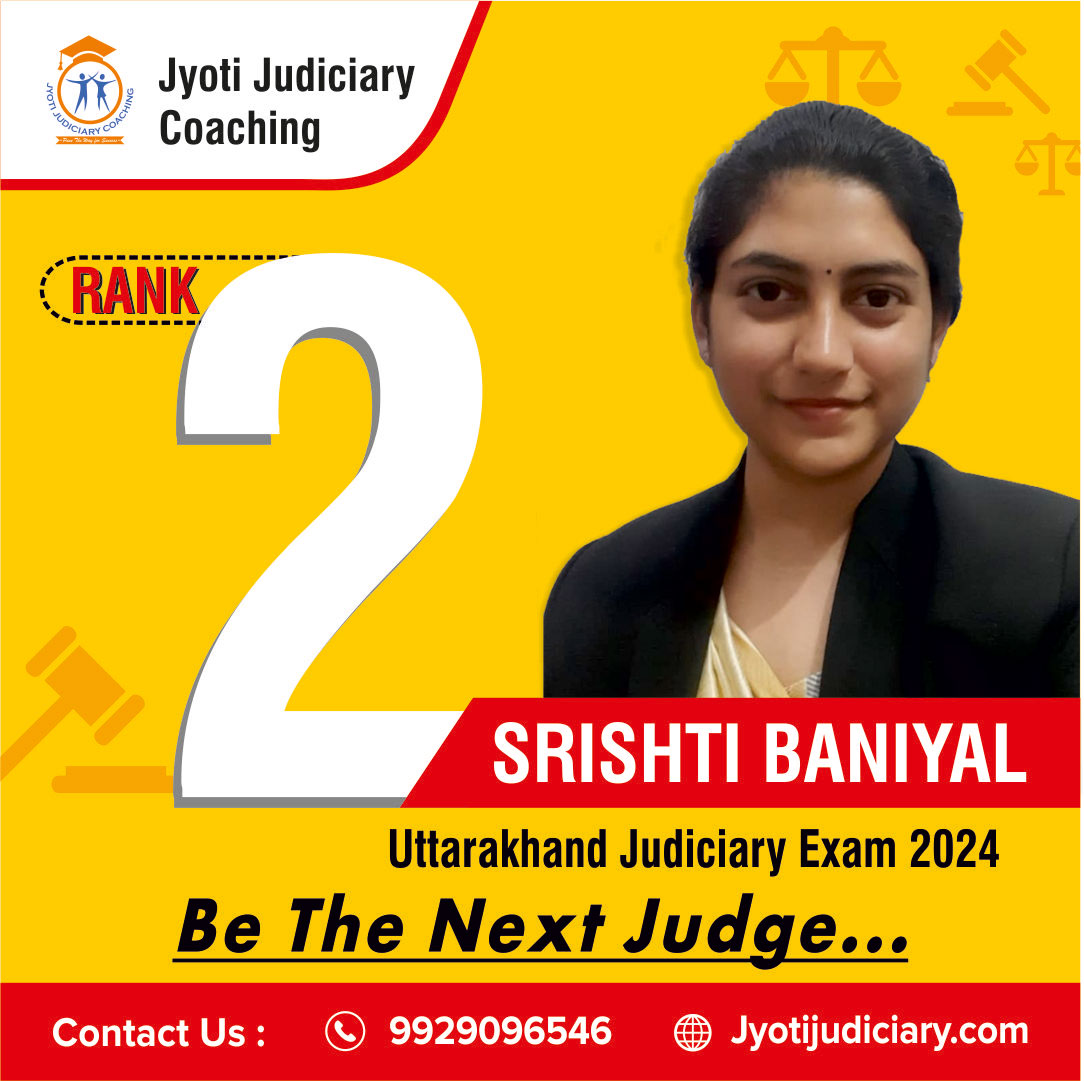
Yes — cracking the Rajasthan judiciary civil judge exam in the first attempt is achievable, and the Jyoti Judiciary Coaching results demonstrate it directly. First-attempt selections mentored at Jyoti Judiciary Coaching include 1st Rank in GJS 2022, 2nd Rank in UK PCSJ 2023, 5th Rank in RJS 2024, and 179th Rank in RJS, 2024. These were not candidates with exceptional academic backgrounds that set them apart from the field. They were candidates who followed a structured preparation approach, started writing three months before most candidates thought about it, and treated the Mains as the real exam from Month 1 — not Month 9.
The difference between a first-attempt RJS qualifier and a repeat aspirant is rarely knowledge. Twelve years of observing both groups at Jyoti Judiciary Coaching makes this clear: repeat aspirants almost always know more law than first-attempt qualifiers when measured in volume of content studied. What first-attempt qualifiers have that repeat aspirants lack is the skill of expressing that knowledge in judicial format under time pressure — and the strategic clarity to focus on what the RJS examiner actually rewards.
What Do RJS First Attempt Toppers Do Differently? — 7 Real Patterns
This is the question every serious RJS aspirant should ask — and the answer is not ‘study harder’ or ‘study more hours.’ Based on first-attempt qualifiers mentored at Jyoti Judiciary Coaching, seven specific habits consistently separate them from the field.
1. They Decide Their Target Exam in Week 1 and Never Switch
Every wasted month in RJS preparation can be traced to one cause — indecision about which exam to target. RJS and UP PCS J share core subjects but differ significantly in local laws, language requirements, and Mains structure. A candidate who spends months ‘preparing for judiciary’ without committing to RJS specifically is covering 60% of what they need and missing 40% of what will decide their result. First-attempt qualifiers commit to RJS from Day 1, understand the exact paper structure, and align every hour of preparation to that specific exam.
2. They Treat the Mains as the Real Exam from Month 1
The most common preparation mistake in RJS is treating Prelims as the primary target and Mains as something to prepare after clearing the first stage. The Prelims is qualifying-only — its marks do not appear in the merit list. The Mains decides everything. First-attempt qualifiers understand this structurally and allocate their preparation time accordingly: 30% to prelims readiness, 70% to mains depth. They read bare acts with mains application in mind, not just prelims recall.
3. They Start Writing in Month 2 — Not Month 9
This is the single most consistent differentiator in Rajasthan judiciary first-attempt success that Jyoti Saxena has observed over twelve years at Jyoti Judiciary Coaching: every first-attempt qualifier who cleared the RJS Mains started structured answer writing in Month 2 of their preparation. Not after the full syllabus was complete. Not after the Prelims. Month 2. They wrote two answers per week from Month 2, increased to three per week by Month 6, and wrote daily in the final three months. The format became instinct. The step-marking discipline became natural. By exam day, nothing about the judgment writing format surprised them.
4. They Build a Case Law Bank — Not a Case Law List
Jyoti Saxena observes this pattern consistently in how first-attempt qualifiers approach case law preparation versus repeat aspirants:
There is a difference between knowing that a case exists and knowing its ratio well enough to apply it correctly in an exam answer. Repeat aspirants build lists of fifty cases and name-drop them in answers with no real application. First-attempt qualifiers build a bank of eight to ten cases per paper — civil and criminal separately — know each one by its precise legal ratio, and apply them specifically to the facts in the question. Three well-applied cases outscore ten names every time under RJS step-marking.
5. They Prepare BNS, BNSS, and BSA as Primary Law — Not Supplements
From 1 July 2024, BNS replaced IPC, BNSS replaced CrPC, and BSA replaced the Indian Evidence Act. The RJS 2026 syllabus tests these as the primary criminal law. A first-attempt qualifier preparing for the 2026 exam reads BNS, BNSS, and BSA as the main texts and uses the old IPC/CrPC comparison as a reference tool — not the other way around. In Mains answers they cite BNS and BNSS section numbers correctly and add the old provision in brackets to demonstrate awareness of the transition. Candidates who still treat BNS as an ‘additional topic’ are preparing for the wrong exam.
6. They Get Every Answer Checked — Not Self-Evaluated
Writing without feedback is the most common waste of preparation time in RJS mains answer writing preparation. A candidate who writes fifty answers and self-evaluates all of them improves their writing speed. A candidate who writes twenty answers and gets each one returned with specific written feedback — on issue framing, evidence appreciation, section accuracy, operative part completeness — improves their writing quality. First-attempt qualifiers consistently report that mentor feedback was the single most impactful part of their preparation. Self-evaluation has an inherent ceiling because you cannot see what you cannot see.
7. They Prepare for the Interview from Month 6 — Not the Final Week
The RJS Interview carries 35 marks and is evaluated by sitting judges on the Rajasthan High Court panel. It tests judicial temperament, Rajasthan-specific legal and cultural awareness, ethical reasoning, and communication quality. First-attempt qualifiers begin building their interview file from Month 6 — a running document of recent Rajasthan High Court judgments, Rajasthan-specific legal and social knowledge, and ethical dilemma responses. The candidate who opens their interview file for the first time in the week before the viva is the candidate who underperforms on 35 marks they could have owned.
How Many Hours Daily Do You Need to Crack RJS in First Attempt?
The honest answer: fewer than most preparation guides suggest, but with more focus than most aspirants manage. Twelve hours of distracted study produces less than five hours of active recall, answer writing, and problem-solving. The question is not how many hours but what those hours are spent on.
| Months 1–5 (Foundation) | 5–6 focused hours daily | 2 hours bare act reading | 2 hours subject-specific MCQ | 1–2 hours answer writing (from Month 2) |
| Months 6–9 (Consolidation) | 6–7 hours daily | 3 hours revision + MCQ | 2 hours answer writing | 1 hour language paper | 30 min interview file |
| Months 10–12 (Mains Intensive) | 7–8 hours daily | 1 full civil judgment + 1 full criminal judgment daily | 2 long-format law answers | essay practice | mock viva |
| Working Advocates | 3–4 focused hours daily | court work counts as active revision of procedural law | weekend intensive writing sessions |
The concept tracker is non-negotiable regardless of daily hours — a running log of every question answered incorrectly, the correct answer, and the reason for the error. Reviewed every three days. This single habit has the highest return per hour of anything in a first-attempt RJS preparation strategy.
How Long Does It Take to Crack RJS Civil Judge Exam in First Attempt?
Nine to twelve months for a focused full-time aspirant. This is not a coaching promise — it is the timeframe that the structure of the exam itself demands. The RJS Mains has four papers requiring descriptive analytical writing across 300 marks of law and 100 marks of language. Developing the writing skill to perform at Mains level, across all subjects, to the 40% minimum qualifying threshold per paper — takes a minimum of nine months of structured preparation with consistent daily writing.
Attempting the RJS exam in the first cycle after completing your LLB, with two months of preparation, is not a first attempt — it is an expensive reconnaissance exercise. Candidates who ‘attempt to get a feel of the exam’ without serious preparation rarely gain useful insight and often lose confidence. A genuine first-attempt strategy means entering the exam with preparation that gives you a realistic chance of clearing all three stages. That requires nine to twelve months minimum for most aspirants.
The First-Attempt Preparation Roadmap — Month by Month
This is the preparation sequence that first-attempt qualifiers at Jyoti Judiciary Coaching have consistently followed. It is not the only sequence that works — but it is a sequence built on twelve years of watching what clears the RJS Mains in the first attempt.
| Month 1 | Constitution of India — complete. Begin 30 MCQs daily. Start building concept tracker. |
| Month 2 | BNS 2023 — complete bare act. Build IPC-to-BNS comparison chart. START ANSWER WRITING — 2 short answers per week, checked by mentor. |
| Month 3 | BNSS 2023 — FIR to judgment procedural flow. BSA 2023 — electronic evidence, admissibility. 2 charge-framing exercises per week. |
| Month 4 | CPC Part 1 — jurisdiction, pleadings, Orders VII–XIV. 2 civil judgment drafts per week. Evidence appreciation in BSA. |
| Month 5 | CPC completion. Contract Act, Specific Relief Act, Transfer of Property Act. 3 full civil judgments per week with costs and decree. |
| Month 6 | Hindu Law, Muslim Law. Rajasthan-specific Acts. BEGIN INTERVIEW FILE — RHC recent judgments, Rajasthan social and legal awareness. |
| Months 7–9 | Revision + Prelims mocks. Full-length RJS Prelims every 3 days. Weekly 3 mains answers. Language paper preparation. |
| Months 10–12 | Mains intensive — 1 civil judgment + 1 criminal judgment daily. All answers mentor-checked with written feedback. Mock viva 3+ times. |
Common Mistakes That Prevent First-Attempt Success in RJS
- Collecting too many books — reading three books on CPC means covering one-third of each. One authoritative text read deeply and revised multiple times outperforms three books read once.
- Treating the Language Paper as secondary — in the 2024 cycle, the Language Paper minimum (35% per paper) eliminated more candidates than the Law papers. Hindi essay and English composition must be practised from the first month of preparation, not the last.
- Starting judgment writing after the Prelims result — by which point you have eight weeks to build a skill that takes eight months. First-attempt qualifiers start in Month 2.
- Studying BNS, BNSS, and BSA as additions to IPC, CrPC, and Evidence Act — the new codes ARE the primary law for RJS 2026. The old codes are the reference point, not the other way around.
- Attempting mock tests without review — a mock test that is not reviewed and corrected is a waste of three hours. Every mock requires error analysis and concept tracker update before the next test.
- Ignoring the Interview until shortlisting — the interview panel includes Rajasthan High Court judges who will probe your Rajasthan-specific legal and cultural knowledge. This cannot be crammed in one week.
Frequently Asked Questions — Cracking RJS in First Attempt
Can I crack RJS in first attempt without coaching?
Self-preparation is possible for the Prelims and for building legal knowledge. The part that is genuinely difficult to do effectively without guidance is mains answer writing — specifically, getting your judgment writing checked and corrected by someone who knows what the RJS examiner looks for. Reading independently is fine. Writing independently without feedback has an inherent ceiling. Many first-attempt qualifiers supplement self-study with structured answer writing evaluation, even if not full coaching programmes.
Is the RJS exam difficult to crack in the first attempt?
The RJS is competitive, not impossible. The difficulty is concentrated at the Mains stage — specifically the 40% aggregate and 35% per paper minimum qualifying marks, including the Language Paper. Candidates who build their Mains preparation from Month 1, start writing from Month 2, and treat the Language Paper with the same seriousness as the Law Papers have a genuine shot at first-attempt success. Candidates who spend nine months on syllabus and three weeks on writing practice will find the Mains genuinely difficult.
What percentage of RJS aspirants clear in the first attempt?
Official first-attempt specific data is not published by the Rajasthan High Court. What is available shows overall selection rates are under 1% of total applicants in competitive cycles. The 2024 RJS cycle saw only 4 candidates clear the Mains across all attempt categories. The first-attempt success rate is not a function of the exam difficulty alone — it is directly correlated with when the candidate started writing practice and how seriously they prepared the Language Paper alongside the Law papers.
How is the RJS first attempt different from subsequent attempts?
Structurally, there is no difference in the exam. The strategic difference is psychological — first-attempt candidates have no prior failure to analyse and correct. This is both an advantage and a risk. The advantage is a clean, forward-looking preparation mindset. The risk is that first-attempt candidates sometimes underestimate the Mains because they have not experienced it. Using someone else’s experience — through mentorship or detailed post-exam analysis from qualified candidates — compensates for that lack of direct experience.
What is the best strategy to crack RJS prelims in first attempt?
Since the Prelims has no negative marking, every question must be attempted. The 70% law weightage means your Mains preparation is already your Prelims law preparation — there is no separate Prelims-only syllabus. The 30% language component is where many law-heavy candidates lose marks. Start language MCQ practice from Month 3. Do full-length mock prelims from Month 7 onwards with timed conditions. Target a score comfortably above the expected cut-off — clearing narrowly creates unnecessary anxiety going into the Mains sprint.
The One Decision That Decides How to Crack RJS in First Attempt
Every RJS aspirant who has cleared in the first attempt made one decision early that repeat aspirants delay: they decided that the Mains was the real exam, started writing in Month 2, and built a preparation plan around the 40% per paper qualifying threshold rather than around syllabus completion. Syllabus completion is a means to an end. The end is scoring above 35% in each Mains paper and 40% in aggregate. Build your preparation around the end, not the means.
The first attempt is the most valuable attempt you will have — because it comes with the highest motivation, the freshest energy, and the most time. Do not spend it on a preparation strategy that has been shown to fail. Build the writing skill early, understand the new criminal codes as primary law, treat the Language Paper as equally important as the Law Papers, and enter the RJS Mains examination hall knowing that you have done the specific preparation the exam rewards.
Note: RJS is conducted by the Rajasthan High Court at hcraj.nic.in. Selection data references the 2024 RJS cycle. All BNS/BNSS/BSA references are based on provisions in force from 1 July 2024. Verify current exam dates and notification details from hcraj.nic.in.