RJS Coaching for RJS Mains Rajasthan-Specific Acts: Section-Wise Notes and Preparation Strategy
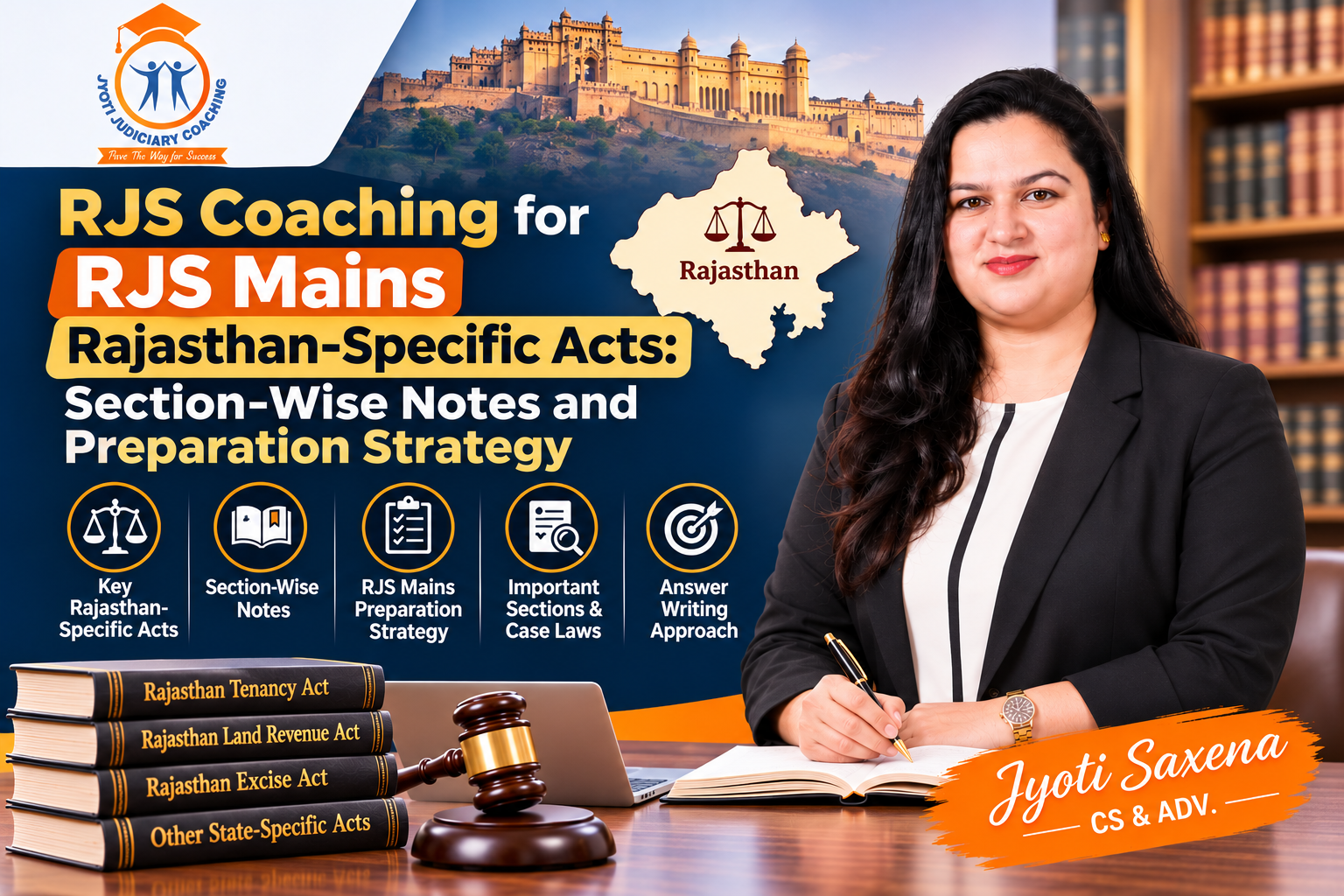
Rajasthan-specific acts are one of the most neglected parts of RJS Mains preparation — and one of the most scoring. Most candidates spend months on central legislation like CPC, IPC, and Evidence Act, and then rush through the state-specific acts in the final weeks. That approach costs marks. These acts carry dedicated questions in both Law Paper I and Law Paper II, and because fewer candidates prepare them well, even an average preparation here can put you ahead.
This guide covers all four Rajasthan-specific acts in the RJS Mains syllabus — with section-wise breakdowns, high-priority areas, and a preparation approach that works alongside your broader mains study.
Which Rajasthan-Specific Acts Are in the RJS Mains Syllabus?
The RJS Mains syllabus includes four state-specific acts. Three fall under Law Paper I (Civil Law) and one under Law Paper II (Criminal Law):
| Act | Year | Paper |
| Rajasthan Land Revenue Act | 1956 | Law Paper I (Civil) |
| Rajasthan Rent Control Act | 2001 | Law Paper I (Civil) |
| Rajasthan Court Fees & Suits Valuation Act | 1961 | Law Paper I (Civil) |
| Rajasthan Excise Act | 1950 | Law Paper II (Criminal) |
Rajasthan Land Revenue Act, 1956 — Section-Wise Notes
This is the most expansive of the four acts and carries the highest weight in Law Paper I. It governs land administration, revenue records, survey operations, settlement, and recovery of land revenue across Rajasthan. Candidates practising in subordinate courts in Rajasthan deal with this Act directly — making it both an exam subject and a practical one.
High-Priority Sections:
- Section 3 — Definitions: Nazul land, village, land, chahi land. These definitions appear repeatedly in exam questions and in court proceedings. Know each one precisely.
- Section 4 — Board of Revenue: Composition, bench powers, and how split decisions are handled. The Board of Revenue is the apex revenue court in Rajasthan — its jurisdiction frequently comes up in mains answers.
- Section 20-A — Revenue Appellate Authority: Powers and jurisdiction. Understand how this sits between the district level and the Board of Revenue.
- Sections 30–34 — Revenue Officers: Patwari circles, Patwaris, GirdawarQanungos, and Sadar Qanungos — their roles, appointment, and duties. Questions on these are predictable.
- Sections 75–78 — Appeals and Limitation: Which orders are appealable, which are not, and the limitation period for each. Non-appealable orders under this Act are a direct exam topic.
- Sections 88–98 — State Land Ownership: State ownership of land, minerals, and forests. Section 90-A covers non-agricultural use; Section 91 deals with unauthorised occupation. These sections have produced questions in multiple RJS Prelims and Mains papers.
- Section 101 — Allotment of Agricultural Land: Priority rules for allotment. Know the order of priority and exceptions.
- Sections 106–121 — Survey and Record Operations: Boundary disputes, record of rights, and khatauni. These provisions connect directly to land record litigation in Rajasthan courts.
- Sections 142–176 — Settlement Operations: Rent-rate criteria, enhancement limits, and settlement term. Settlement questions appear regularly at the mains stage.
- Sections 224–246 — Recovery of Land Revenue: Revenue as a charge on land, recovery of arrears, and setting aside revenue sales. These connect to execution proceedings and are frequently tested.
Rajasthan Rent Control Act, 2001 — Section-Wise Notes
The Rajasthan Rent Control Act, 2001 governs landlord-tenant relations in municipal areas of Rajasthan. It is a procedurally rich act — Rent Tribunals, eviction grounds, timelines, appeals, and mesne profits all carry marks in the mains examination. Many of the time limits in this act are specific enough to appear as standalone MCQ or short-answer questions.
High-Priority Sections:
- Section 2 — Definitions: Tenant, landlord, premises, senior citizen, amenities, municipal area. The definition of tenant is especially important — it includes certain family members after the original tenant’s death.
- Section 3 — Exemptions: Government premises, local bodies, Wakf and Devasthan properties, universities, PSUs, and foreign missions are excluded from Chapters II and III. Know this list.
- Section 9 — Grounds for Eviction: This is the most tested section. Grounds include non-payment for four months, wilful damage, unauthorised subletting, denial of landlord’s title, bona fide need, and non-use for six months. A 30-day notice is required for arrears-based eviction.
- Section 10 — Immediate Possession: Available to retired/discharged armed forces personnel, government servants, and senior citizens (after three years of letting). Re-letting is barred for three years after recovery.
- Section 13 — Rent Tribunals: Presiding Officer must be from the Rajasthan Judicial Service (Civil Judge Senior Division or above), appointed by the High Court. This directly concerns the RJS cadre.
- Sections 15–16 — Timelines: Eviction petitions disposed within 240 days (Sec. 15). Immediate possession petitions within 120 days (Sec. 16). Certificates not executable for three months (six months for commercial premises).
- Section 18 — Exclusive Jurisdiction: Civil courts are completely barred. Rent Tribunals have exclusive jurisdiction over matters under this Act.
- Section 19 — Appeals: Appeal to the Appellate Rent Tribunal within 60 days. Decision is final. No second appeal.
- Section 20 — Mesne Profits: After three months of holding over: 2x rent for residential, 3x rent for commercial or immediate possession certificates. An appeal does not protect the tenant from mesne profit liability unless specifically ordered.
- Sections 22-B and 22-C — Written Tenancy Agreement: Tenancy must be in writing and registered with the Rent Authority. A tenancy that ends without renewal continues month-to-month for up to six months.
- Section 22-F — Security Deposit: Capped at one month’s rent. Must be refunded within one month of vacation, less lawful deductions.
Rajasthan Court Fees & Suits Valuation Act, 1961 — Section-Wise Notes
This is a procedural act that every practising lawyer in Rajasthan uses daily, yet it is under-prepared for mains. Court fee computation, suit valuation, refunds, and exemptions are all examinable topics. A judicial officer applying this Act incorrectly at the subordinate court level creates appealable errors — which makes it important both for the exam and for practice.
High-Priority Sections:
- Section 6 — Multifarious Suits: When a plaint joins multiple claims, fee is computed on each claim separately. This is a regular source of exam questions and practical errors.
- Section 11 — Court Decides Fee Disputes: When the plaintiff’s valuation is disputed, the court determines the correct fee. Know the procedure.
- Section 15 — Fee on Appeals: Fee calculation on appeal memoranda. Interlocutory appeals have a separate computation.
- Section 21 — Money or Damages Suits: Defamation suits are capped at Rs. 25,000 for court fee purposes. This specific cap is frequently tested.
- Section 32 — Mortgages: Fee computation for mortgage suits. Important for civil court practice in Rajasthan.
- Section 35 — Partition Suits: Fee computation for partition and separate possession. Partition suits are one of the most common suit types in Rajasthan courts.
- Sections 61–63 — Refunds: Refund when a plaint is rejected under Order VII Rule 11 CPC, on remand, or for fees paid by mistake. Candidates must know which grounds trigger a refund and which do not.
- Section 65 — Reduction or Remission: For inability to pay. The court’s discretionary power here is tested in written answers.
- Section 49 — Objections on Valuation in Appeal: Valuation objections cannot be raised for the first time in appeal unless they go to jurisdiction. A clear rule with direct exam relevance.
Rajasthan Excise Act, 1950 — Section-Wise Notes
The Rajasthan Excise Act, 1950 sits in Law Paper II (Criminal Law) and covers manufacture, sale, transport, and possession of liquor and excisable articles. Given the frequency of excise cases in Rajasthan’s criminal courts, this act is both practically important and heavily tested. Penalty sections, presumptions, and officer powers are the three areas where mains marks are made or lost.
High-Priority Sections:
- Section 3 — Definitions: Liquor, spirit, fermented liquor, excisable article, intoxicating drug, manufacture, still, tari, and pachawai. These definitions form the foundation of every offence provision and must be memorised precisely.
- Section 9-A — Appeals Against Officers’ Orders: 60-day limit with 25% pre-deposit. Revision lies to the Division Bench of the Rajasthan Tax Board within 30 days.
- Section 19 — Possession Limits: Possession above the State-prescribed quantity without permission is an offence. Know the threshold and exceptions.
- Section 34 — Suspension and Cancellation of Licences: Grounds include non-payment of duty, breach of conditions, unauthorised transfer, and conviction under the NDPS Act. This section is directly tested.
- Section 54 — Main Penalty Provision: Unlawful manufacture, possession, or transport: 6 months to 3 years and fine of ₹20,000 or 5 times the duty loss. Above 50 bulk litres: 3 to 5 years and 10 times the duty loss. Know both thresholds.
- Section 54-B — Adulteration of Liquor: Penalty escalates based on whether the adulteration causes death (up to life), grievous hurt, or other harm. This is the most serious offence in the Act.
- Section 54-C — Compensation: Seller liable to pay compensation — ₹3 lakh for death, ₹2 lakh for grievous hurt or disability, ₹20,000 for others. Appeal lies to the High Court within 30 days.
- Section 54-D — Criminal Conspiracy: Punished the same as the principal offence. No reduction for mere conspiracy.
- Section 68 — Presumption of Guilt: Once possession or transport is proved, guilt is presumed until the contrary is shown. Reverse burden of proof — directly important for criminal law mains answers.
- Section 69 — Confiscation: Excisable articles, stills, and conveyances used in the offence are liable to confiscation.
- Section 70 — Compounding: Most offences can be compounded. Offences under Section 54 cannot. This distinction is a common exam question.
How to Prepare Rajasthan-Specific Acts for RJS Mains
The preparation approach for state-specific acts is different from central legislation. These acts are shorter, more procedural, and test specific numbers — time limits, penalty amounts, fine quantum, deposit percentages. Here is what works:
- Read the bare act first, not notes: State-specific acts are short enough to read in full. Start with the bare act to understand the structure, then use section-wise notes for revision.
- Make a numbers sheet: Time limits, penalty figures, fine amounts, pre-deposit percentages — these are the most tested specifics in Rajasthan acts. Compile them on one sheet and revise weekly.
- Connect to central law: The Rajasthan Rent Control Act cross-references CPC. The Excise Act cross-references CrPC/BNSS. Understanding these connections strengthens both subjects simultaneously.
- Solve previous year RJS questions on these acts: Past questions reveal exactly which sections the examiners return to repeatedly. Questions on Sec. 9 of the Rent Control Act, Sec. 54 of the Excise Act, and Sec. 88–98 of the Land Revenue Act appear in multiple years.
- Write answers using the correct section numbers: In RJS Mains written answers, citing the correct section number is the difference between full marks and partial marks. Never write “the Act provides” without citing the section.
At Jyoti Judiciary Classes, these four acts are taught with section-wise coverage and weekly practice questions. Students preparing through our Best RJS & Judiciary Coaching in Jaipur | Jyoti Judiciary batches cover all Rajasthan-specific acts as a dedicated module — not as an afterthought in the final month. With 468+ selections across state judiciaries, the structured approach to local legislation has made a measurable difference in mains scores.
Frequently Asked Questions
Which Rajasthan-specific acts are asked in RJS Mains?
Four acts: Rajasthan Land Revenue Act 1956, Rajasthan Rent Control Act 2001, and Rajasthan Court Fees & Suits Valuation Act 1961 in Law Paper I; and Rajasthan Excise Act 1950 in Law Paper II.
How much time should I give to Rajasthan-specific acts in RJS Mains preparation?
At least 3 to 4 weeks of dedicated study across all four acts, followed by regular revision. These acts are shorter than central legislation but more specific — the marks come from knowing exact section numbers, time limits, and penalty figures, which requires repeated revision, not just one reading.
Is the Rajasthan Tenancy Act 1955 also in the RJS Mains syllabus?
The Rajasthan Tenancy Act 1955 is not separately listed in the current RJS Mains syllabus. The Rajasthan Land Revenue Act 1956 and Rajasthan Rent Control Act 2001 are the two land and tenancy-related acts in the syllabus. However, Tenancy Act concepts are sometimes tested indirectly through revenue court jurisdiction questions.
Which section of the Rajasthan Excise Act is most important for RJS Mains?
Section 54 (main penalty provision), Section 54-B (adulteration), Section 68 (presumption of guilt), Section 69 (confiscation), and Section 70 (compounding — with the note that Sec. 54 offences cannot be compounded) are the most frequently examined provisions in the criminal paper.
Does Jyoti Judiciary Classes cover Rajasthan-specific acts in its RJS Mains batches?
Yes. All four Rajasthan-specific acts are covered as a dedicated module with section-wise teaching, previous year question analysis, and mains answer writing practice. Both online and offline batches include this coverage.