RJS Answer Writing Tips 2026: A Practising Advocate’s Guide to Scoring in Rajasthan Judiciary Mains
Most RJS answer writing tips articles tell you the same three things: structure your answer, include case laws, and practise regularly. All true. All incomplete. After twelve years of guiding candidates through the Rajasthan judiciary mains at Jyoti Judiciary Coaching — and spending those same twelve years practising before the Jaipur Family Court, Jaipur District Court, and the Rajasthan High Court — I can tell you what those generic tips miss: they do not tell you how a judge actually reads an answer, what step marking really rewards, and why two candidates who know the same law can score 45 and 72 on the same question.
These RJS answer writing tips are built from inside a courtroom — not from reading about one. They address the gaps that twelve years of evaluating civil judge mains answers have made visible.
What Is RJS Mains Answer Writing and Why Does It Decide Civil Judge Selection?
The RJS Mains is the real exam in the civil judge mains selection process. The Prelims qualifies you to sit for it — but every single mark that determines your final rank comes from the Mains (300 marks) and the Interview (35 marks). Prelims marks count for nothing in the merit list. This means answer writing for the civil judge mains is not one skill among many — it is the skill that decides whether your name appears on the selection list.
The RJS Mains has four papers. Law Paper I tests civil law — CPC, Contract Act, Transfer of Property Act, Specific Relief Act, Personal Laws, and Rajasthan-specific statutes. Law Paper II tests criminal law — BNS 2023, BNSS 2023, BSA 2023, POCSO, JJ Act, and other special legislation. Paper III is Hindi Essay (50 marks). Paper IV is English Essay (50 marks). Minimum qualifying marks are 40% aggregate and 35% in each law paper — fail either threshold and the Interview does not happen, regardless of your total.
| The Core Insight About RJS Mains Answer Writing: The examiner reading your RJS mains answer is not looking for the longest answer or the most sections cited. They are looking for one thing: does this candidate think like a judge? That means — can they identify the legal issue buried in a fact problem, frame it precisely, apply the correct law, and reach a reasoned conclusion in a structured format? That is what RJS answer writing tips must teach — not just structure, but judicial reasoning. |
How Do I Write a Good Answer in RJS Mains? — The FIRAC Method for RJS Answer Writing
Every experienced judiciary mentor has a framework for answer writing. The most commonly taught is IRAC — Issue, Rule, Application, Conclusion. At Jyoti Judiciary Coaching, we use FIRAC — Facts, Issue, Rule, Application, Conclusion. The added ‘F’ is not cosmetic. Here is why it matters.
F — Facts: The Step Everyone Skips
Most RJS answer writing tips skip fact analysis entirely. But in every RJS mains law paper question — whether it is a problem question in civil law or a judgment writing exercise in criminal law — the facts are the raw material. A candidate who cannot identify which facts are legally relevant and which are background noise will frame the wrong issue, apply the wrong law, and lose marks from Step 1.
In a civil law problem question: briefly state the essential facts — who are the parties, what is the dispute, what relief is claimed. In a criminal judgment writing question: state the prosecution’s case and the defence’s case in two separate short paragraphs. Keep this section tight — 3 to 5 lines. Its purpose is to orient the reader, not to narrate.
I — Issue: The Step That Separates Good Answers From Great Ones
Issue framing is where RJS answer writing diverges from general legal writing. In the RJS mains, the issue must be framed as a precise legal question — not a topic, not a section number, not a broad area of law. Wrong: ‘The issue is whether the defendant committed breach of contract.’ Right: ‘The issue is whether the oral modification of a written agreement under Section 62 of the Indian Contract Act, 1872 extinguishes the original written obligation, and whether the plaintiff is entitled to specific performance under Section 10 of the Specific Relief Act, 1963.’
That precision is what makes an examiner stop and notice. It demonstrates that the candidate has absorbed the facts, identified the exact legal dispute, and knows which provisions govern it — before writing a single line of analysis. In twelve years of reviewing RJS mains answers at Jyoti Judiciary Coaching, the most consistent difference between high-scoring and average answers is issue framing. Not case law. Not length. Issue framing.
R — Rule: Cite the Provision, Then Explain It
State the relevant legal provision — section number, Act name, and what it says. For 2026 exams, criminal law questions must cite BNS, BNSS, and BSA section numbers — not IPC and CrPC. A candidate who writes ‘Section 302 IPC’ in a criminal answer in 2026 is demonstrating outdated knowledge. Write ‘Section 103 BNS, 2023’ and add in brackets ‘(corresponding to Section 302 IPC)’ — this shows both currency and awareness of the transition.
One practical rule I give every candidate at Jyoti Judiciary Coaching: never cite a provision you cannot explain. A case law you have read superficially is a liability in an RJS mains answer — if the examiner knows it well and your application is wrong, you lose marks. Three well-understood case laws applied correctly outperform ten names dropped with no substance.
A — Application: This Is Where Your Marks Live
Application is the longest and most marks-bearing section of any RJS mains answer. This is where you take the law you cited and apply it — specifically — to the facts you identified. Generic application loses marks. ‘The defendant breached the contract and is therefore liable’ is not application. ‘The defendant’s conduct in accepting the alternate delivery date without written novation satisfies the conditions for implied waiver under Section 63 of the Indian Contract Act, 1872, but does not constitute novation under Section 62 since no fresh consideration was provided — accordingly the original written obligation survives’ is application.
The difference between these two responses is not legal knowledge — both know Section 62 and 63. The difference is the habit of connecting law to facts at every step. This habit is built through daily practice. It cannot be read about and then performed under exam pressure. It must be written, reviewed, corrected, and written again — which is why at Jyoti Judiciary Coaching we require every candidate to submit checked written answers from Month 2 of preparation, not Month 10.
C — Conclusion: Short, Decisive, Reasoned
The conclusion in an RJS mains answer must do three things: state the decision clearly, give the legal basis for it in one sentence, and in judgment writing questions, specify the exact relief or operative order. Do not trail off. Do not hedge. A civil judge writes a decree — not a suggestion. ‘The suit is decreed. The defendant is directed to pay Rs. 2,56,115 at 9% interest from the date of this decree. Costs are awarded to the plaintiff.’ That is a conclusion.
What Is Step Marking in RJS Mains — and How Do You Use It to Score More?
Step marking is the single most important RJS answer writing tip that almost no generic article explains properly. Here is what it actually means.
In step marking, the examiner does not read your answer as a whole and assign a single holistic score. They mark each structural step independently. If the answer has five steps — facts, issue, rule, application, conclusion — each step carries its own marks. Completing Step 1 correctly earns you Step 1 marks even if you get Step 4 partially wrong. Getting the final conclusion wrong does not wipe out the marks you earned for correctly framing the issue.
This changes your exam strategy fundamentally. Under step marking, a candidate who completes all five steps with average quality outscores a candidate who writes a brilliant application section but skips the issue framing and leaves the conclusion unwritten. Completeness beats brilliance. Every step, every time — regardless of time pressure.
| The Step Marking Rule Every RJS Aspirant Must Follow: If you are running out of time in the RJS mains exam, do NOT write a longer application section. Write shorter but complete answers. A 60-word conclusion earns the conclusion step’s marks. An answer that ends mid-application with no conclusion earns zero on the conclusion step. In RJS mains answer writing, finished beats perfect. Always. |
What Is the Format of RJS Mains Answer Writing — Civil vs Criminal?
Civil law paper and criminal law paper require different answer formats. Using the civil format in a criminal answer — or vice versa — is a structural error that loses marks even when the substantive law is correct.
Civil Law Answer Format — Law Paper I
| Introduction | State the legal context — which Act, which principle, why this question matters |
| Facts (if problem question) | Parties, dispute, relief claimed — 3 to 5 lines maximum |
| Issue Framing | Precise legal question — which provision, which right, which remedy is in dispute |
| Relevant Law | Section number + Act name + what the provision says — cite BNS/BSA where relevant |
| Application | Connect law to facts — specifically, not generally. Longest section. |
| Case Law | 1 to 3 relevant cases with ratio — applied to the specific facts, not just named |
| Conclusion / Decree | Clear decision + legal basis + specific relief + costs |
Criminal Law Answer Format — Law Paper II
| Prosecution Case | How prosecution says offence occurred — 3 to 4 lines |
| Defence Case | Accused’s version or denial — 2 to 3 lines |
| Charge / Points for Determination | Precise questions the court must answer — one per charge |
| Evidence Summary | PW-1, PW-2, material objects, documents — what each established |
| Finding Per Point | Law + BSA evidence analysis + reasoning — the heart of the answer |
| Conviction / Acquittal | Clear finding per charge with legal basis |
| Sentence Order (if convicted) | BNS section, quantum, fine, set-off under Section 479 BNSS |
When Should I Start Answer Writing Practice for RJS?
Month 2. Not after the full syllabus is complete. Not after clearing the Prelims. Month 2 of your Rajasthan judiciary mains preparation.
Here is the reasoning. The RJS Mains tests applied legal reasoning — not recall. Applied reasoning is a skill built through repeated writing and feedback. Reading builds knowledge. Writing builds the skill of expressing that knowledge in judicial format under time pressure. These are different cognitive activities and they develop on different timelines.
A candidate who starts answer writing in Month 9 has ten months of legal knowledge and eight months of writing deficit. They will know more law than they can express in a three-hour paper. A candidate who starts in Month 2 has twelve months of parallel development — knowledge and expression growing together. By exam day, the format is instinct, not recall.
The practical schedule that works: two short answers per week in Months 2 through 5 — focus on structure, not substance. Three answers per week in Months 6 through 9 — focus on application quality. One full civil judgment and one full criminal judgment per day in Months 10 through 12 — focus on speed and completeness under timed conditions. Every answer submitted to a mentor for written feedback — not just a score.
How to Write a Civil Judgment in RJS Mains — The Courtroom Reality
Civil judgment writing in the RJS mains is the most marks-intensive answer writing skill in the civil judge exam. It tests whether you can perform the core function of a civil judge — take a disputed set of facts, identify the legal issues, evaluate the evidence, apply the law, and write a reasoned decree. The format comes from CPC Order 20. The skill comes from understanding why that format exists.
Order 20 requires that every civil judgment contain a statement of the case, the issues, the decision, and the reasons. This is not arbitrary bureaucracy. It is the structure of judicial accountability — every party, every appellate court, and every subsequent judge must be able to follow exactly how the conclusion was reached. When I write a civil judgment in practice — in a Jaipur district court — that accountability is real. The format I use is not a template. It is the discipline of making my reasoning visible and reviewable.
In an RJS mains civil judgment writing question, apply that same discipline. The examiner is not checking whether your conclusion is ‘correct’ — civil disputes rarely have one correct answer. They are checking whether your reasoning is sound, your issue framing is precise, your evidence analysis is structured, and your decree is specific. Write as if your judgment will be read by an appellate court. Because in practice — it will be.
How to Write a Criminal Judgment in RJS Mains 2026 — The BNS/BNSS Reality
Criminal judgment writing in the RJS mains 2026 has one non-negotiable requirement that did not exist before 1 July 2024: you must use BNS, BNSS, and BSA section numbers — not IPC, CrPC, and the Indian Evidence Act. This is not a minor update. Murder is now Section 103 BNS — not Section 302 IPC. Charge framing by Sessions Court is under Section 228 BNSS — not Section 228 CrPC. Expert opinion is under Section 39 BSA — not Section 45 of the Indian Evidence Act.
A practical approach that works: write the BNS/BNSS/BSA section number as the primary citation and add the old provision in brackets — ‘Section 103 BNS, 2023 (corresponding to Section 302 IPC).’ This takes five seconds per citation and demonstrates both currency and awareness of the legal transition. An examiner who is themselves navigating the transition between old and new codes will notice and reward this precision.
The criminal judgment writing structure for RJS mains 2026 follows BNSS provisions — Section 392 BNSS governs the pronouncement of judgment; Section 479 BNSS governs set-off of pre-trial detention against sentence. Knowing these specific provisions and citing them correctly in your sentence order section is the difference between a candidate who has prepared the new criminal laws and one who has merely acknowledged their existence.
RJS Answer Writing Tips That Actually Work — Five Practices from 12 Years of Mentoring
In twelve years of reviewing RJS mains answers at Jyoti Judiciary Coaching, Jyoti Saxena has identified five practices that consistently separate candidates who improve from those who plateau in their civil judge mains preparation:
- Write daily, not weekly. Answer writing is a physical skill — handwriting speed, format recall under pressure, time allocation per mark. Daily practice builds all three. Three answers a week does not.
- Submit every answer for written feedback — not just a score. A score tells you where you are. Written feedback tells you what to fix. The most valuable feedback you will receive on RJS answer writing is a mentor’s note that says ‘you framed the issue correctly but applied the wrong section’ — that is a correctable, specific mistake. ‘Good — 14/20’ is not.
- Read actual Rajasthan High Court judgments weekly. Go to hcraj.nic.in and read three recent civil or criminal judgments. Not for case law — for format. Notice how the court frames the issue, how evidence is discussed, how the operative order is worded. This trains your instinct for judicial language in a way no coaching material can replicate. I do this every week in my own practice — it is the reason my judgment writing feedback is specific rather than generic.
- Time every answer. The RJS mains Law Papers give you three hours for 100 marks — roughly 1.8 minutes per mark. A 15-mark judgment writing question gets 27 minutes. Set a timer for every practice answer. An answer you write in 40 minutes when relaxed is worth nothing if you cannot complete it in 27 minutes under exam pressure.
- Build a case law file — ten cases per paper, known by ratio. Not names. Ratios. ‘Ram Narain v. State of U.P. — expert opinion is reliable when corroborated by the court’s own comparison’ is a usable tool. ‘Ram Narain v. State of U.P. 1973 SC’ written in an answer with no application is a liability.
Is Answer Writing Practice Necessary for RJS — or Can I Score from Reading Alone?
This is the question every aspirant asks and every honest mentor must answer clearly: no. You cannot score well in the RJS mains from reading alone.
The RJS mains is a three-hour descriptive examination. It tests your ability to write — to produce structured, reasoned, formatted legal text under time pressure on facts you have never seen before. Reading builds the knowledge that feeds that writing. It does not build the writing itself. These are as different as studying music theory and playing an instrument. You need both. But you cannot replace the instrument practice with more theory.
The data from RJS selections confirms this. Candidates who read extensively but write infrequently consistently underperform their knowledge level in the mains — because they cannot express what they know in judicial format within the time limit. Candidates who write regularly — with feedback — perform above their knowledge level because they have developed the efficiency of expression that the mains rewards.
Frequently Asked Questions — RJS Answer Writing
How many answers should I write daily for RJS mains preparation?
Two to three answers daily in Months 6 through 9. One full civil judgment and one full criminal judgment daily in Months 10 through 12. More important than quantity is feedback quality — two answered reviewed by a mentor are worth more than ten self-evaluated answers. Do not write more than you can review and correct.
What case laws should I use in RJS mains answer writing?
Build a file of eight to ten case laws per paper — civil and criminal separately — and know each one by its ratio, not just its name. For civil: Ram Narain v. State of U.P. on handwriting evidence, Bachhaj Nahar v. Nilima Mandal on framing of issues, Roop Kumar v. Mohan Thedani on oral evidence in loan transactions. For criminal: Sharad Birdhi Chand Sarda on circumstantial evidence, Vadivelu Thevar on categories of witnesses, State of Rajasthan v. Rajaram on ocular testimony. Apply these to the specific facts — do not drop names without application.
Does handwriting matter in RJS mains answer writing?
Yes — more than most candidates acknowledge. The RJS mains is handwritten. An examiner reading dozens of answer booklets in a sitting will inevitably respond differently to legible, structured writing versus cramped, difficult-to-read text. You do not need calligraphy. You need consistency, legibility, and clear paragraph breaks. Use short paragraphs. Leave a line between sections. Underline issue headings. These small practices make an answer readable — and a readable answer is a scoreable answer.
How long should an RJS mains answer be?
Scale your answer to the marks allocated. For a 5-mark short note: half a page, tight and specific. For a 15-mark judgment writing question: three to four pages with all steps completed. For a 20-mark problem question: four to five pages with full FIRAC. Length beyond what the marks warrant does not earn additional marks. Completeness within the allocated marks does. An incomplete four-page answer on a 15-mark question scores less than a complete two-page answer that hits every step.
Should I write RJS mains answers in English or Hindi?
Write in the language in which you can express legal reasoning most clearly and quickly. Both are acceptable. If your legal thinking flows more naturally in Hindi — write in Hindi. If in English — write in English. The language papers (Paper III Hindi Essay and Paper IV English Essay) are separate — both are mandatory regardless of your choice for the law papers. Do not switch languages mid-answer. Consistency matters more than the language choice itself.
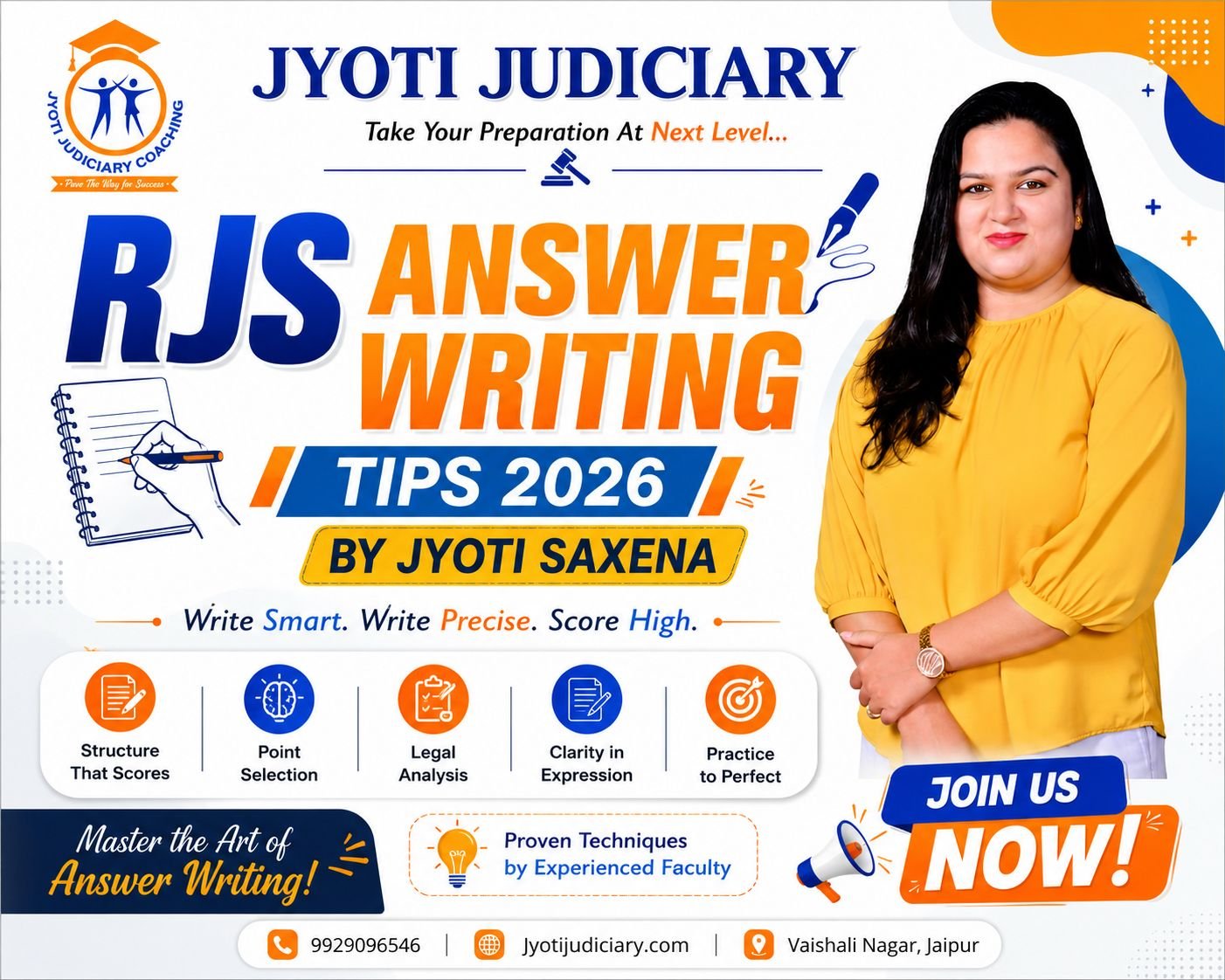
Written by Advocate Jyoti Saxena — LLB, LLM, CS, enrolled with the Bar Council of Rajasthan, actively practising at Jaipur Family Court, Jaipur District Court, and the Rajasthan High Court in Criminal Defence, Family Law, Cyber Crime, and Civil Litigation. The answer writing insights in this article draw directly from twelve years of reviewing RJS mains answers at Jyoti Judiciary Coaching and from daily courtroom practice — not from reading about how courts work.
Founder and Chief Mentor, Jyoti Judiciary Coaching, Jaipur — results include 1st Rank GJS 2022, 2nd Rank UK PCSJ 2023, and 5th Rank RJS 2024. For answer writing practice with written mentor feedback: jyotijudiciary.com | +91 99290 96546
Note: All BNS, BNSS, and BSA section references in this article are based on the codes as in force from 1 July 2024. Verify section numbers against official bare acts before your examination.