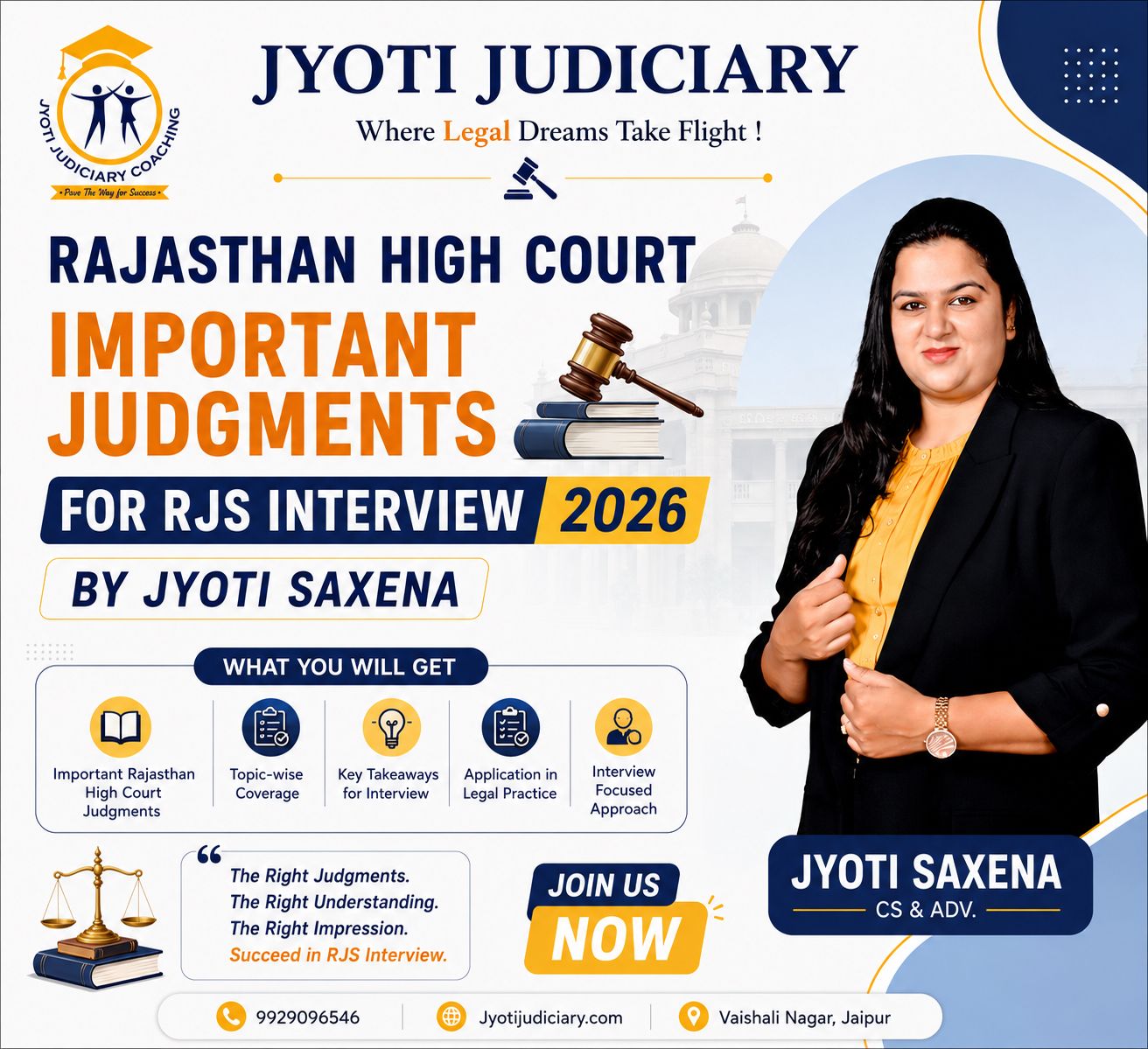
Rajasthan High Court Important Judgments for RJS Interview 2026 by Jyoti Saxena
Every Rajasthan judiciary important judgments for RJS interview guide tells you to ‘be familiar with recent Rajasthan High Court judgments.’ Not one of them tells you which judgments, why they matter, what the holding was, and — most importantly — how to use each judgment to answer a viva voce question from a panel of sitting RHC judges.
The RJS interview carries 35 marks. The panel consists of sitting judges of the Rajasthan High Court. They test Rajasthan-specific legal awareness — not just national case laws you read in textbooks, but judgments from the court you are applying to join. A candidate who has read and understood five recent Rajasthan High Court judgments walks into the viva voce with a specific advantage that no amount of general preparation can replicate.
I am Advocate Jyoti Saxena. I practise before the Rajasthan High Court — in the same building, before many of the same judges who will sit on the RJS interview panel. The judgments in this guide are not chosen from a database search. They are chosen because they have come up in actual Rajasthan High Court proceedings, because they reflect the issues that Rajasthan’s courts are actively grappling with, and because — from twelve years of preparing RJS candidates at Jyoti Judiciary Coaching — these are the types of decisions that interview panels reference when they ask candidates about legal awareness. Use this list, understand each judgment by its ratio, and know how to apply it in a viva voce answer.
Why Rajasthan High Court Important Judgments Matter More in the RJS Interview Than General Case Laws
Most Rajasthan judiciary aspirants build their case law preparation around Supreme Court landmark judgments — Kesavananda Bharati, Maneka Gandhi, Vishaka. These matter, and the RJS interview will test them. But the panel will also test your awareness of what is happening in the Rajasthan High Court specifically — because a Civil Judge in Rajasthan operates within the jurisdiction of this court, is bound by its precedents, and will see parties who bring exactly the kinds of disputes this court has recently decided.
At Jyoti Judiciary Coaching, Jyoti Saxena’s preparation for the RJS interview includes a dedicated current judgments module — built around recent Rajasthan High Court decisions — precisely because this is the gap that separates average viva voce performance from standout performance. A candidate who can say ‘In Reena v. State of Rajasthan (2025), Justice Anoop Kumar Dhand held that live-in relationships fall within Article 21 personal liberty — a principle directly relevant to the family disputes I will see in district court’ is demonstrating exactly the applied legal awareness the interview panel is looking for.
| How to Use These Judgments in the RJS Interview: Do not memorise judgments as lists. Know each one by: (1) The legal issue — what question did the court have to answer? (2) The holding — what did the court decide? (3) The ratio — what legal principle does this establish? (4) Relevance to a Civil Judge — how does this affect the cases a district court judge will see in Rajasthan? If you can answer those four questions for each judgment below, you are prepared to use it in the RJS viva voce. |
Rajasthan High Court Important Judgments for RJS Interview 2024–2026 — Compiled by Jyoti Saxena
These judgments are selected from Rajasthan High Court decisions reported in LiveLaw (Raj), SCC Online, and Legal Bites between 2024 and 2026. Each is presented with its ratio and its specific relevance to an RJS interview question.
Section 1: Constitutional Law and Fundamental Rights
| Reena v. State of Rajasthan (2025) Citation: 2025 LiveLaw (Raj) — Justice Anoop Kumar Dhand Bench: Rajasthan High Court, Single Bench Facts in Brief: A couple in a live-in relationship sought police protection from familial threats. The question before the court was whether such couples are entitled to state protection and whether live-in relationships attract constitutional protection. Held: The court reiterated that consensual live-in relationships between adults are not per se illegal and fall within the ambit of personal liberty under Article 21 of the Constitution. The State has a duty to protect individuals in such relationships from illegal threats and interference. The court noted the absence of specific legislation governing live-in relationships and called for legislative clarity. Why It Matters for RJS Interview: The panel may ask: ‘What are the constitutional dimensions of live-in relationships in Rajasthan?’ or ‘As a Civil Judge hearing a maintenance application from a live-in partner, what law applies?’ This judgment shows the interface between Article 21, personal liberty, and the gap in statutory law — directly relevant to family court practice. |
| Victim v. State of Rajasthan & Ors. (2025) Citation: 2025 LiveLaw (Raj) — Justice Anoop Kumar Dhand Bench: Rajasthan High Court, Single Bench Facts in Brief: A minor girl in a government shelter home, who had earlier given birth, sought admission to a government school. The State had not facilitated her education. The question was whether institutional placement extinguishes a child’s fundamental right to education. Held: The Rajasthan High Court held that Article 21A (right to free and compulsory education) and the Right of Children to Free and Compulsory Education Act, 2009 impose a constitutional obligation on the State to ensure education for every child, including institutionalised and disadvantaged children. The State bears all educational expenses and must ensure continuous monitoring by child protection authorities. Why It Matters for RJS Interview: The panel may ask: ‘What is Article 21A and how has the Rajasthan High Court applied it recently?’ or ‘As a Civil Judge hearing a POCSO matter involving a minor in State custody, what obligations does the court have regarding the child’s welfare and education?’ This judgment connects Article 21A, POCSO, and the JJ Act in a live Rajasthan context. |
Section 2: Criminal Law — Evidence and Procedure
| Rajasthan High Court — Acquittal in Patwari Bribery Case (March 2026) Citation: Judgment dated 19 March 2026 — Rajasthan High Court, Jaipur Bench Bench: Rajasthan High Court Facts in Brief: A Patwari (revenue officer) was convicted for accepting a bribe. The conviction rested primarily on the recovery of cash from the accused. The question was whether recovery alone, without independent proof of demand, is sufficient to sustain a conviction under the Prevention of Corruption Act. Held: The Rajasthan High Court acquitted the accused, holding that mere recovery of money is not sufficient proof of bribery without independent proof of demand and acceptance. Recovery without demand does not establish the offence. This principle is well-settled in Supreme Court precedent and the Rajasthan High Court’s 2026 decision reaffirms it in the context of revenue officer corruption cases in Rajasthan. Why It Matters for RJS Interview: Panel may ask: ‘What is the essential ingredient of a corruption offence — can recovery alone lead to conviction?’ This judgment directly tests your knowledge of anti-corruption law and the standard of proof in criminal cases, both of which are relevant to a Civil Judge hearing revision petitions from criminal courts. |
| State of Rajasthan v. Sampat & Anr. — Acquittal in Murder Case Citation: D.B. Criminal Appeal No. 363/2002 — Rajasthan High Court, Division Bench Bench: Rajasthan High Court, Division Bench Facts in Brief: The State appealed against acquittal in a murder case. The prosecution’s case rested on circumstantial evidence. The question was whether contradictory circumstantial evidence and unexplained delay in FIR registration were sufficient to sustain a conviction. Held: The Rajasthan High Court upheld the acquittal, holding that contradictory circumstantial evidence and unexplained delay in FIR registration created reasonable doubt that could not be resolved against the accused. The five golden principles from Sharad Birdhi Chand Sarda v. State of Maharashtra (1984 SC) were applied — the chain of circumstances must be complete and exclude all hypotheses except guilt. Why It Matters for RJS Interview: Panel may ask: ‘What is the standard for conviction on circumstantial evidence?’ This case applies the Sharad Sarda principles — which every RJS aspirant must know — in a specific Rajasthan criminal appeal context, demonstrating that you understand both the Supreme Court standard and how the Rajasthan High Court applies it. |
| Arrest Warrant Conversion — Bailable vs Non-Bailable in Economic Offences (2025) Citation: 2025 LiveLaw (Raj) — Justice Anoop Kumar Dhand — Larger Bench Reference Bench: Rajasthan High Court Facts in Brief: A Single Judge found conflicting Division Bench views on whether arrest warrants can be converted into bailable warrants in economic or heinous offences. The matter was referred to a Larger Bench to resolve the conflict. Held: The court identified a conflict between two Division Bench decisions of equal strength on the same issue. A Larger Bench reference was made. The case highlights the active development of criminal procedure jurisprudence in Rajasthan courts following the BNSS 2023 transition, particularly on bail and warrant powers. Why It Matters for RJS Interview: Panel may ask: ‘What is the difference between bailable and non-bailable warrants under BNSS 2023?’ or ‘How does a Magistrate decide whether to issue a bailable or non-bailable warrant?’ The fact that this issue has generated conflicting RHC Division Bench views shows the practical complexity of this question — knowing this makes your answer three-dimensional. |
Section 3: Family Law and Maintenance
| Automatic Inflation Adjustment in Maintenance — BNSS Section 144 (2025) Citation: Building on Rakhi Sadhukhan (SC 2025) and Kiran Jyoti Maini v. Anish Pramod Patel (SC 2024) Bench: Supreme Court — with direct application to Rajasthan courts under BNSS 2023 Facts in Brief: The Supreme Court held that maintenance orders should include automatic inflation adjustment — a 5% increase every two years — to prevent erosion of maintenance value without requiring repeated litigation. The court integrated BNSS Section 144 (criminal maintenance) with Section 25 of the Hindu Marriage Act (civil permanent alimony) in a framework for unified maintenance determination. Held: Maintenance awards must include automatic inflation adjustment. BNSS Section 144 (formerly Section 125 CrPC) for criminal maintenance and HMA Section 25 for civil permanent alimony serve different policy objectives but must be coordinated to prevent inconsistent outcomes. The distinction between quick preventive maintenance (BNSS) and full civil relief under HMA reflects different judicial functions. Why It Matters for RJS Interview: Critical for RJS interview because: Civil Judges hear maintenance applications daily. Panel may ask: ‘What is the difference between maintenance under BNSS Section 144 and maintenance under HMA Section 25?’ or ‘Should maintenance orders be time-limited or subject to automatic revision?’ This judgment gives you both the legal framework and a practical answer about judicial efficiency — directly relevant to the court you are applying to join. |
| From Jyoti Saxena’s Courtroom Practice — Why These Judgments Are Chosen: These are not judgments selected from a keyword search. They are selected because I have seen the legal issues they address come up in actual proceedings before the Rajasthan High Court, the Jaipur Family Court, and the Jaipur District Court. The maintenance inflation adjustment judgment matters because I file maintenance applications in family court where this principle now applies. The live-in relationship protection case matters because similar pleas come before Rajasthan courts regularly. The bribery acquittal matters because demand-and-acceptance proof issues arise in criminal cases that reach High Court revision. At Jyoti Judiciary Coaching, the interview preparation module is updated as new Rajasthan High Court judgments are delivered — because the interview panel includes the judges who wrote them. |
Important Supreme Court Judgments for RJS Interview 2026 — Selected for RHC Context
The RJS interview tests both Rajasthan High Court awareness and key Supreme Court developments. These Supreme Court judgments are specifically selected because they have direct implications for a Civil Judge in Rajasthan — they will come up in proceedings, they connect to the RHC judgments above, and they are the cases interview panels reference when asking about constitutional and criminal law developments.
All India Judges Association v. Union of India (2025 SC)
The Supreme Court restored the three-year mandatory practice requirement for civil judge examination eligibility. Practice is counted from the date of provisional Bar Council enrolment. Law clerk experience counts. A certificate from a ten-year advocate endorsed by a judicial officer is required as proof. This judgment directly affects every RJS aspirant in 2026 and the interview panel will expect you to know its exact holding, ratio, and practical implications for judicial recruitment.
Electoral Bonds Case — Association for Democratic Reforms v. Union of India (2024 SC)
A five-judge constitution bench unanimously struck down the Electoral Bonds Scheme as unconstitutional. The court held that anonymous electoral funding violates voters’ right to information under Article 19(1)(a) and the basic structure principle of free and fair elections. This is a landmark Basic Structure and fundamental rights case directly relevant to constitutional law questions in the RJS interview — particularly on the right to information, transparency in democracy, and judicial review of electoral legislation.
Rakhi Sadhukhan v. Biswanath Sadhukhan (2025 SC) — Maintenance and Inflation
The Supreme Court held that maintenance orders must include automatic inflation adjustment — 5% increase every two years — to prevent the practical erosion of maintenance value. This judgment builds on Rajnesh v. Neha (2020) and directly applies to BNSS Section 144 maintenance proceedings in Rajasthan courts. A Civil Judge will hear Section 144 BNSS applications in their first posting — knowing this judgment demonstrates practical readiness for that function.
Arnesh Kumar v. State of Bihar (2014 SC) — Still Relevant Under BNSS 2023
Though from 2014, this judgment — holding that police must record specific reasons before arresting in offences punishable up to seven years — remains actively applied in Rajasthan courts under BNSS Section 35 (formerly Section 41 CrPC). The RHC regularly applies Arnesh Kumar principles in bail and custody matters. A Civil Judge sitting as a Magistrate will refer to this standard when evaluating arrest legality.
How to Prepare Rajasthan High Court Judgments for RJS Interview Preparation
Knowing these important Rajasthan High Court judgments is not enough. The RJS interview preparation test is whether you can actually use them in an answer. Here is the method that works:
- Read each judgment from hcraj.nic.in or LiveLaw’s Rajasthan High Court section — not from summaries. Reading the actual judgment trains you to speak about it with the precision a sitting judge recognises.
- For each judgment, write a four-point note: (1) Legal issue, (2) Holding, (3) Ratio, (4) Relevance to a Civil Judge in Rajasthan. This note is your revision card. Keep it in your interview file.
- Practice using each judgment in an answer to an ethical or legal question. Do not drop case names — connect them to the specific legal principle they establish and to the practical situation a Civil Judge would face.
- Update your judgment file every month. The Rajasthan High Court delivers hundreds of judgments each month. Pick one or two that relate to your practice area or the subjects on the RJS syllabus. Jyoti Judiciary Coaching’s interview preparation module does this systematically for every RJS batch.
- When discussing RHC judgments in the interview, use the judge’s name: ‘Justice Anoop Kumar Dhand held in Reena v. State of Rajasthan…’ This shows you have actually read the judgment, not a summary. Interview panels notice this level of preparation immediately.
What the RJS Interview Panel Looks for When Asking About Judgments
After twelve years of preparing candidates for the RJS interview at Jyoti Judiciary Coaching — and from watching how Rajasthan High Court judges reason in proceedings — the evaluation pattern in judgment-related interview questions is consistent across cycles.
The panel is not testing whether you can recite a case name and year. They are testing three things: whether you understand the legal principle a case establishes; whether you can connect that principle to the practical work of a Civil Judge in Rajasthan; and whether you can reason about the case rather than just recall it. A candidate who says ‘Sharad Sarda lays down five principles for circumstantial evidence’ has answered the recall question. A candidate who says ‘Sharad Sarda means that in a murder trial where the prosecution relies entirely on circumstantial evidence, I must be satisfied that every circumstance is proved beyond reasonable doubt and that the chain is complete — which is why the Rajasthan High Court acquitted in Sampat because the FIR delay broke the chain’ has answered the reasoning question. The second answer earns the marks.
Frequently Asked Questions — RJS Interview Case Laws and Preparation
Which Rajasthan High Court judgments are asked in RJS interview?
The interview panel does not ask about specific judgments from a published list — they ask about legal issues and expect you to connect your answer to relevant case law. Recent Rajasthan High Court judgments on constitutional rights, family law, criminal procedure, and service law are most commonly discussed. The judgments in this article cover the most interview-relevant decisions from 2024 to 2026 — with their ratios and interview application explained by Jyoti Saxena, who practises before the Rajasthan High Court.
How many case laws should I prepare for the RJS interview?
Quality over quantity — always. Ten case laws known deeply, with ratio and application, outperform fifty names dropped without substance. For the RJS interview, prepare: five recent Rajasthan High Court judgments (from this article and from hcraj.nic.in), five current Supreme Court judgments, and the ten standard judiciary case laws that cover criminal evidence, civil procedure, constitutional rights, and maintenance law. That is twenty case laws total — more than enough for a 35-mark interview.
Do RJS interview panels ask about Rajasthan-specific cases or only Supreme Court judgments?
Both — but Rajasthan High Court cases are tested more specifically than most candidates prepare for. The panel consists of RHC judges who have either written or are aware of recent RHC decisions. Showing awareness of recent Rajasthan High Court judgments — with the judge’s name and the legal issue — signals that you have prepared for this specific court, not judiciary in general. Jyoti Saxena actively practises before the Rajasthan High Court and observes which recent judgments generate discussion among the bar — this list reflects that direct awareness.
How to remember judgments for the RJS interview without forgetting them?
Build a four-point card for each judgment — legal issue, holding, ratio, relevance to Civil Judge. Review your cards once a week from Month 6 of preparation. Do not attempt to memorise verbatim text — understand the principle. In the interview, speak from understanding, not memorisation. A panel can tell immediately when a candidate is reciting versus reasoning. Reasoning earns marks. Recitation does not.
All the best — from Jyoti Judiciary Coaching
Written by Advocate Jyoti Saxena — LLB, LLM, CS, enrolled with the Bar Council of Rajasthan, actively practising at Jaipur Family Court, Jaipur District Court, and the Rajasthan High Court. The judgment selection and interview relevance analysis in this article come directly from active courtroom practice before the Rajasthan High Court and from twelve years of preparing RJS candidates for the viva voce at Jyoti Judiciary Coaching, Jaipur.
Jyoti Judiciary Coaching | Vaishali Nagar, Jaipur | +91 99290 96546 | jyotijudiciary.com
Judgments cited from LiveLaw (Raj), SCC Online, Legal Bites, and hcraj.nic.in. Always verify judgment details from official sources before use in examination answers.